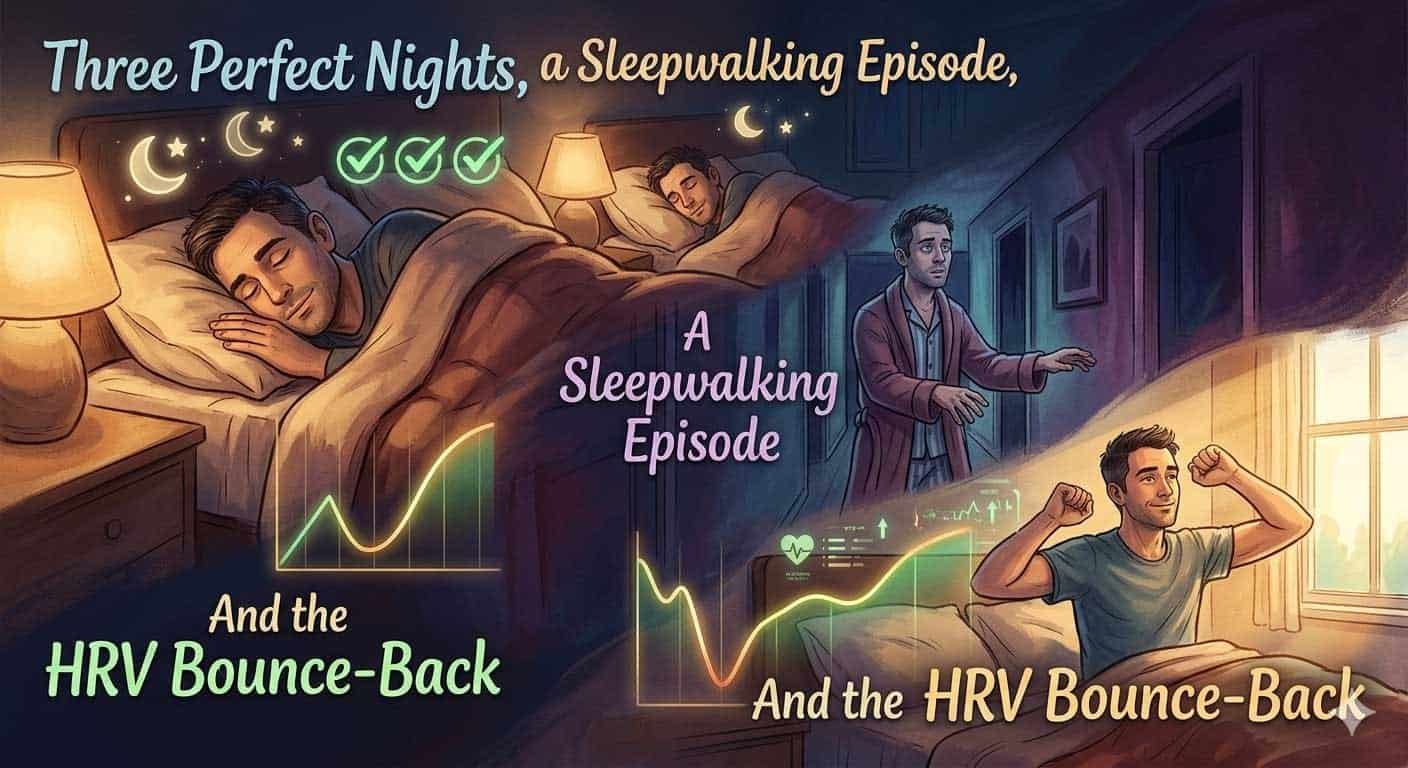
DAY 21 — Three Perfect Nights, a Sleepwalking Episode, and the HRV Bounce-Back
The relationship between heart rate variability and sleep apnea is one of the quieter stories in this experiment, running underneath the daily drama of fluctuating weight and blood pressure like a slow tide that only becomes visible when you step back far enough to see the direction. Today, on Day 21, that tide surged. The Hume Band recorded an HRV of 86.3 ms this morning — up from 69.0 ms yesterday, a jump of more than 17 points in a single day. Not quite the series high of 88.5 ms set last week, but close enough to confirm that when the protocols hold, the recovery follows fast.
It was also a night in which I sleepwalked around my house in the small hours after a nightmare tore me from sleep, ripped the CPAP mask from my face, and sent me stumbling through rooms I did not recognise until the sound of pressurised air hissing from the disconnected tube brought me back to reality. And yet: 100 out of 100. Again.
Day 21 Data Summary
| Metric | Value | Source |
|---|---|---|
| Weight | 100.20 kg (HIGH) | Eufy |
| Weight | 100 kg ↓ | Hume Pod |
| BMI | 28.0 (HIGH) | Eufy |
| Body fat % | 30.4% (EXTREMELY HIGH) | Eufy |
| Body fat mass | 30.40 kg (EXTREMELY HIGH) | Eufy |
| Lean body mass | 69.80 kg (LOW) | Eufy |
| Visceral fat | 15 (HIGH) | Eufy |
| Water % | 49.6% (LOW) | Eufy |
| BMR | 1,732 kcal (LOW) | Eufy |
| Protein | 12.5% (LOW) | Eufy |
| Subcutaneous fat | 26.8% (HIGH) | Eufy |
| CPAP score | 100/100 | CPAP App |
| CPAP usage | 09:17 | CPAP App |
| AHI | 3.8 events/hr | CPAP App |
| Mask seal | Good | CPAP App |
| Mask-off events | 2 | CPAP App |
| Hume Band sleep | 10h 32m | Hume Band |
| Heart rate | 69 bpm | Hume Band |
| HRV | 86.3 ms | Hume Band |
| Stress level | 15.5 | Hume Band |
| SpO₂ | 94–99% | Hume Band |
| Body temperature | 35.9–37.3°C | Hume Band |
| Metabolic Momentum | 10 ↓ | Hume Band |
| Pace of Aging | 0.3x | Hume Band |
| Life Added This Week | 5.0 days ↑ | Hume Band |
| Life Added Overall | 10.5 days ↑ | Hume Band |
| Blood pressure | Elevated | BP Monitor |
| Cycling | 7.89 km / 28:20 / 16.7 km/h avg | Strava |
| Steps (as at 10:07) | 644 | Hume Band |
CPAP: Three Consecutive Perfect Scores and One Nightmare
Three nights. Three scores of 100 out of 100. This is now the longest streak of perfect CPAP scores in the experiment — Day 19 with 7 hours 59 minutes, Day 20 with 9 hours 12 minutes, and Day 21 with 9 hours 17 minutes. The usage figure has climbed with each consecutive night, and tonight’s 9 hours 17 minutes sets yet another series record, surpassing yesterday’s by five minutes.
The AHI, however, tells a different story. At 3.8 events per hour, it is nearly triple yesterday’s 1.4 — still well within the clinically acceptable range for treated obstructive sleep apnea, but the highest of the three-night streak. The mask-off count of 2 is the fingerprint of what happened at approximately 3am.
I was dreaming. The details have faded as dream details do, but it was bad enough to jolt me upright in bed, and in that half-conscious state between sleep and waking, my hands went to my face and tore the CPAP mask off. The sound of pressurised air rushing from the disconnected hose is a particular kind of alarm clock — a mechanical hiss that has no business existing at 3am. I was on my feet before I was fully awake, sleepwalking through the house, navigating rooms by muscle memory while my conscious brain tried to work out where I was and why my face felt wrong. It took perhaps a minute — though it felt considerably longer — before the penny dropped, and I found myself standing in the hallway, mask dangling from one hand, genuinely confused about how I had got there.
I went back to bed. I put the mask back on. I slept until the morning. And the CPAP app, blissfully indifferent to the drama, scored the night 100 out of 100.
The AHI spike to 3.8 almost certainly reflects the unmasked period around the nightmare. The breathing events accumulate during the minutes when the therapy is not being delivered, and once the mask went back on, the remaining hours would have been closer to the sub-2 figures of the previous nights. The mask-off count of 2 — one for the nightmare removal, presumably one for the morning wake-up — captures the mechanical fact of what happened without any of the existential strangeness of sleepwalking through your own house at 3am wondering whose corridor you are standing in.
HRV: The Bounce That Tells the Story
Yesterday’s HRV was 69.0 ms — the reading left behind by a conference weekend that disrupted fasting, sleep routine, and dietary control. Today: 86.3 ms. That is a jump of more than 17 points in a single day, and it is among the highest readings of the entire experiment, just shy of the series best of 88.5 ms recorded last week.
The speed of the recovery is the story here, not the absolute number. One night of proper protocol — early bed, CPAP on for over nine hours, no alcohol, fasting window resumed — and the autonomic nervous system bounced back almost to its best. The connection between heart rate variability and sleep apnea treatment is well established in the clinical literature. Untreated obstructive sleep apnea produces repeated oxygen desaturation events during the night, each one triggering a sympathetic nervous system response — the body’s fight-or-flight mechanism activating dozens of times per hour. Over time, this chronic sympathetic activation suppresses HRV, which is a measure of how well the parasympathetic rest-and-recovery system is functioning. Effective CPAP therapy reduces those desaturation events, gives the parasympathetic system room to operate, and — over weeks and months of consistent use — should produce a measurable increase in HRV.
That is what this three-week data set appears to show. The baseline has shifted upward. The dips caused by late nights, alcohol, or conference disruption are shallower and shorter-lived. And the recovery speed — from 69.0 to 86.3 overnight — suggests that the body’s adaptive capacity is improving rather than merely returning to a static set point. If tomorrow’s reading holds in the 80s, that would confirm a new normal. If it dips, it was a single-day bounce after an exceptionally long sleep. Either way, the HRV trend line across twenty-one days is the most quietly encouraging metric in the experiment.
Weight: The Descent Confirmed
Yesterday I made the argument that the weight figures might already be on the way down from the conference peak — that the missing Day 19 weigh-in meant we could not know whether Day 20’s readings represented the summit or the descent. Today’s numbers confirm it was the descent.
Eufy: 100.20 kg, down from 100.60 kg yesterday. Hume Pod: 100 kg with a green down arrow, down from 101.9 kg yesterday.
The Hume Pod figure is the more dramatic movement — a drop of 1.9 kg in a single day, from 101.9 to 100. That is almost certainly water weight and digestive mass clearing from the conference food rather than any structural change in body composition, but it brings the Hume Pod back below the threshold and — more interestingly — narrows the gap between the two scales to just 0.2 kg. Yesterday the discrepancy was 1.3 kg, the widest of the series. Today it is the narrowest. The same body, the same morning, and two devices that have spent twenty-one days disagreeing with each other have briefly arrived at something approaching consensus.
The Eufy’s body composition figures are essentially unchanged from yesterday: body fat at 30.4%, body fat mass at 30.40 kg, lean body mass at 69.80 kg, visceral fat at 15. The weight is moving but the composition is holding steady — which suggests that what is being lost is water and food mass rather than fat. The structural work of fat loss happens over weeks, not days, and will only become visible in these figures with sustained compliance.
The Hume Pod Body Scan: “Users Like You” Returns
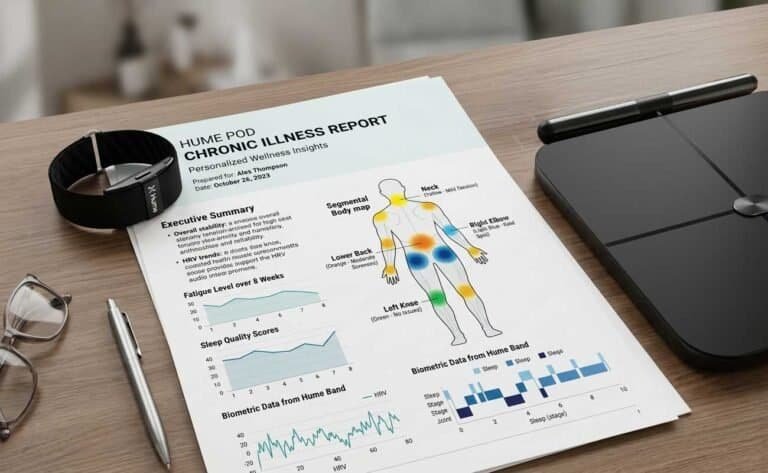
The Hume Pod’s segmental body scan today provides muscle mass and fat percentage breakdowns by body region, and at the bottom of the screen, in text small enough to miss, the phrase reappears: “Results are compared to Hume Health users like you.”
There it is again. The phrase that launched a hundred questions and an increasingly entertaining email thread with Hume Support. All muscle mass readings — right arm 4.0 kg, left arm 3.9 kg, trunk 33.6 kg, both legs at 12.0 kg — are rated “Standard.” On the fat percentage view, arms are “High” at 21.9% and 23.4%, trunk is “Standard” at 25.3%, and both legs are “Standard” at 18.3%.
So my trunk fat — the area directly relevant to visceral fat, cardiovascular risk, and sleep apnea severity — is rated “Standard” by the Hume Pod. Meanwhile, the Eufy scales rate my overall body fat at “EXTREMELY HIGH.” Both devices are measuring the same body. One says the trunk is fine. The other says the whole package is an emergency. And both are comparing me to a reference population whose composition I am still not allowed to understand.
Metabolic Momentum and the Pace of Aging
The Metabolic Momentum screen introduces a new metric to the series: Pace of Aging, reported at 0.3x. The normal pace is 1.0x. The Hume Band is claiming that my body is aging at less than a third of the normal rate.
Combined with yesterday’s biological age of 31 against a chronological age of 55, this builds an increasingly flattering picture that I am not entirely sure how to square with the weight, blood pressure, and body fat data. The “Life Added This Week” figure is 5.0 days — meaning that, according to the algorithm, this week’s habits have added five days to my expected lifespan. “Life Added Overall” since the experiment began stands at 10.5 days.
These are compelling dashboard numbers. They are also precisely the kind of numbers that are impossible to verify and difficult to challenge because the methodology sits behind a proprietary algorithm. If I am aging at 0.3x, that is extraordinary. If the calculation is based on a week of improved sleep and moderate exercise compared to a sedentary baseline, it might simply mean that the starting point was so poor that any improvement looks miraculous. Either way, the Hume Health app is working very hard to make me feel good about myself — which is exactly what you want from a product you have paid for, and exactly what a data-driven experiment should question.
Blood Pressure: Still Elevated
Blood pressure remains elevated this morning — consistent with the pattern established across this series, where disruption to the fasting window and dietary protocol produces a response in the diastolic that takes 48 to 72 hours to resolve. Yesterday’s conference-driven readings showed an average of 123/82. Today’s readings have not moved significantly. The expectation remains that two to three days of clean protocol — no alcohol, fasting maintained, early bedtimes — will bring the numbers back into the green range, as happened after the Day 13 spike.
The Bike: 7.89 km and a Four-Week Streak
The morning ride went out at 8:27am — the earliest cycling start of the experiment, and the beginning of the “exercise every day” commitment declared yesterday. The route looped through Cambourne and Upper Cambourne in South Cambridgeshire: 7.89 km in 28 minutes 20 seconds, average speed 16.7 km/h, maximum speed 32.0 km/h, elevation gain 34 metres.
The Strava notification that accompanied the ride deserves its own small celebration: a four-week streak. That means I have recorded at least one cycling activity every week for the past month, which predates this experiment slightly and confirms that the habit was already forming before the blog started tracking it. The note on the ride — “Too many dog walkers at this time!” — is the price of an early start in a Cambridgeshire new town on a Tuesday morning. The dogs are charming. The extendable leads across the cycle path are less so.
Where Day 21 Sits in the Experiment
Three weeks done. Nine days remaining — though the idea of extending the experiment beyond thirty days with less frequent reporting is increasingly appealing. The data patterns are becoming clearer with each passing week, and stopping at Day 30 would mean cutting the story just as the longer-term trends in HRV, body composition, and CPAP compliance are becoming structurally interesting.
The scorecard at the three-week mark: CPAP compliance has transformed from under an hour on Day 1 to three consecutive nights above nine hours with perfect scores. HRV has climbed from the mid-70s to the mid-80s, with the recovery speed after disruption accelerating noticeably. Weight is down from 102 kg to approximately 100 kg — less dramatic than hoped, but consistently in the right direction when measured across weeks rather than days. Blood pressure responds rapidly to protocol breaks but recovers equally fast when the routine resumes. The Hume Pod thinks I am biologically 31 and aging at 0.3x. The Eufy thinks my body fat is extremely high. The Fitbit thinks I slept excellently. The CPAP thinks the nightmare never happened. And the dog walkers of Cambourne think I cycle too fast on their footpaths.
The plan holds: no alcohol this week, bed before 10pm every night, exercise daily, fasting maintained. The data will follow the discipline — or it will not, and that will be a different but equally honest article.
Data captured Tuesday 21 April 2026. Eufy reading 21/04/2026 at 09:55. Hume Pod updated 09:58. Hume Band data as at 10:07–10:26, last recorded 21/Apr/26. CPAP covers the night of 20–21 April 2026. Cycling recorded 8:27am, South Cambridgeshire — 7.89 km. Blood pressure elevated, readings taken morning of 21 April.
— Day 21 of 30