DAY 14 — Hume Pod Chronic Illness Report: What a Grade D Really Means
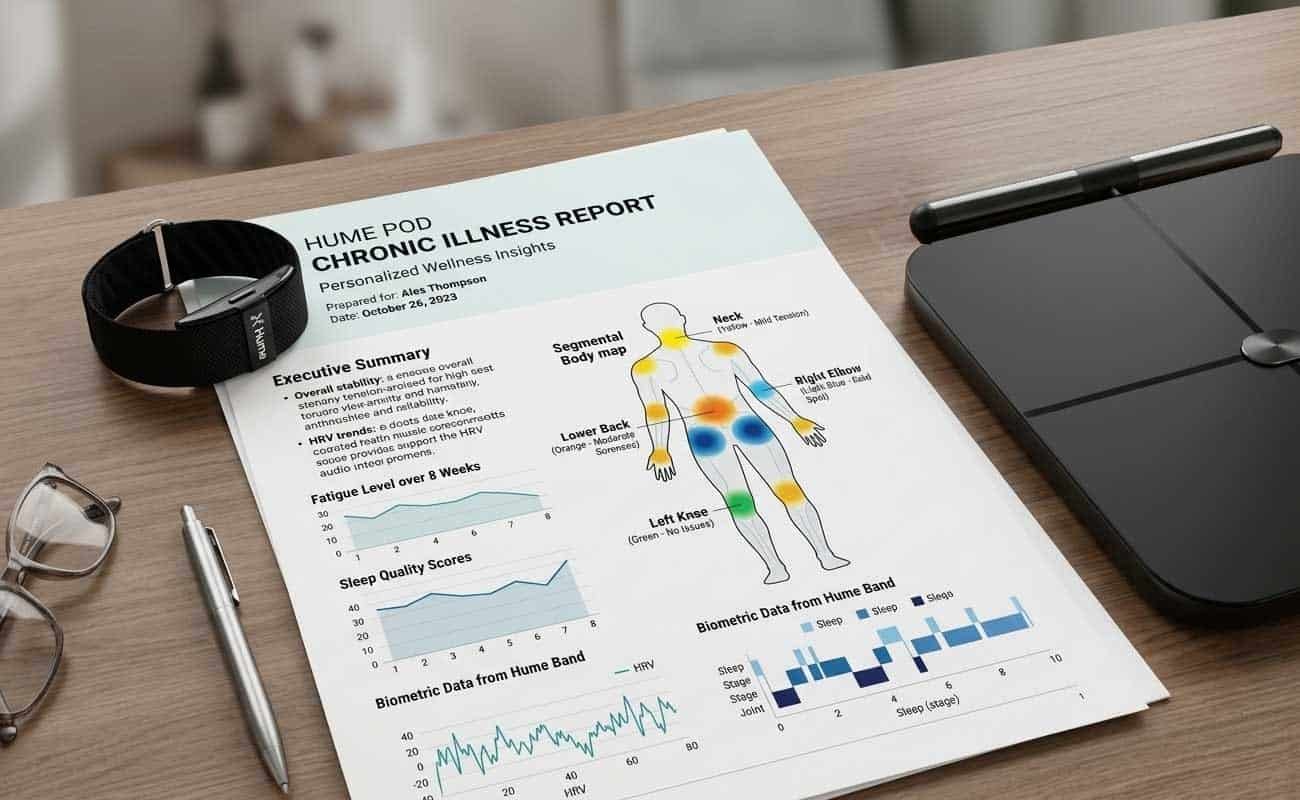
Fourteen days in, and today delivered more data than any single day of this experiment so far. The hume pod chronic illness report — a feature I had been waiting to unlock — arrived this afternoon, and it is comprehensive, detailed, and in places quite blunt. There was also a morning walk through Cambridge, a blood pressure reading considerably better than yesterday’s, and a near-perfect CPAP night on the full face mask that I am increasingly warming to. And then, just to complete the picture, a brief message from Hume Support that has been a long time coming. We will get to all of it.
Day 14 Data Summary
| Metric | Value | Source |
|---|---|---|
| Body fat mass | 30.40 kg | Eufy |
| Lean body mass | 70.10 kg | Eufy |
| Visceral fat | 15 | Eufy |
| Water % | 49.6% | Eufy |
| Subcutaneous fat | 26.8% | Eufy |
| Protein | 12.6% | Eufy |
| HRV | 76 ms | Hume Band |
| Stress | 16.6 | Hume Band |
| SpO₂ | 95–98% | Hume Band |
| Body temperature | 35.5–37.0°C | Hume Band |
| Metabolic Capacity (today) | 69 | Hume Band |
| Metabolic Momentum | +6 (↑) | Hume Band |
| Strain | 16 | Hume Band |
| Recovery | 52 | Hume Band |
| CPAP score | 96 | CPAP App |
| CPAP usage | 07:14 | CPAP App |
| AHI | 2.9 | CPAP App |
| Mask seal | Good | CPAP App |
| Mask-off events | 5 | CPAP App |
| Hume Band sleep | 7h 54m / 88% — Very Good | Hume Band |
| Fitbit sleep | 7h 6m / Score 88 — Good | Fitbit |
| Sleep timeline | 01:26–09:06 | Fitbit |
| Blood pressure (avg) | 118/86 / Pulse 72 | BP Monitor |
| Morning walk | 2.02 km / 29:46 / 2,542 steps | Strava |
| Chronic Illness Score | 54/100 — Grade D | Hume Pod |
CPAP: Full Face Mask Delivers Again
Last night’s CPAP data is straightforwardly excellent. Seven hours and fourteen minutes of usage, a score of 96, Good mask seal, and an AHI of 2.9. The full face mask — which caused such trouble on Day 11 with its one-hour-and-abandon performance — delivered a near-continuous night of therapy. Five mask-off events is slightly elevated compared to the best nights of this experiment, but in the context of over seven hours of usage, they were clearly brief interruptions rather than wholesale abandonments.
The significance of this should not be understated. The mask that hurt, that was rejected, that I nearly gave up on entirely, has now produced back-to-back strong nights. The fit is improving, or I am learning to sleep with it, or both. Either way, this is the CPAP story of the experiment right now — and it is a positive one.
The Hume Band corroborates this independently. Sleep quality of 88% and a time-in-bed of 7 hours 54 minutes, rated Very Good. That is the band doing exactly what it should do: confirming what the CPAP data shows from a completely different measurement angle. When two devices measuring different things tell the same story, you can have some confidence in the story.
The Fitbit records 7 hours and 6 minutes with a sleep score of 88, rated Good, on a timeline of 01:26 to 09:06. REM sleep came in at 1 hour 47 minutes, deep sleep at 1 hour 29 minutes, light sleep at 3 hours 50 minutes, and awake time at 33 minutes. That awake figure is higher than the best nights of this experiment — 33 minutes of wakefulness across seven hours is noticeable — but a sleep score of 88 suggests the architecture was solid enough that the disruptions were brief rather than prolonged. The five mask-off events in the CPAP data likely account for at least some of those awake periods.
The experiment’s sleep schedule target remains 22:30–07:30. Last night fell short on bedtime by nearly three hours. That is the work still to do.
Blood Pressure: A Welcome Improvement
Yesterday’s blood pressure readings — averaging 139/92 — were the most concerning data point of the experiment so far. Today’s repeat, taken under similar conditions in the early afternoon, tells a rather different story.
Four readings between 13:16 and 13:30:
- 13:16 — 121 / 91 / Pulse 73 (systolic OK, diastolic HIGH!)
- 13:23 — 114 / 91 / Pulse 71 (systolic OK, diastolic HIGH!)
- 13:28 — 117 / 87 / Pulse 75 (systolic OK, diastolic HIGH)
- 13:30 — 118 / 76 / Pulse 71 (systolic OK, diastolic OK)
Daily average: 118 / 86 / Pulse 72
The systolic figures are all within normal to optimal range throughout. The diastolic readings started high but came down meaningfully across the four readings, with the final measurement showing both values in the green. This pattern — diastolic elevated early and normalising across repeated readings — is consistent with white-coat-effect-style reactive elevation, where the act of taking a reading initially elevates it, and it settles as the measurement continues.
Compare that to yesterday’s average of 139/92 after a weekend of disrupted sleep, dietary excess, and a two-hour-later-than-normal bedtime: the difference reflects how acutely blood pressure responds to lifestyle factors. Last night’s better sleep, the return to intermittent fasting, and the morning walk have all left visible fingerprints on today’s numbers.
This is precisely why this experiment exists. Data, repeated daily, shows you the connections that subjective experience cannot.
The Morning Walk: Cambridge
Today’s exercise was a 2.02 km morning walk through Cambridge, recorded on Strava at 10:55am. Moving time was 29 minutes and 46 seconds, 2,542 steps, and 6 metres of elevation gain. Modest by any conventional fitness measure — but it is the first intentional outdoor activity since the left knee situation began shaping rest day decisions, and the knees managed it without complaint. That matters more than the distance right now.
The Hume Band logged 28 minutes in heart rate Zone 2 and 11 minutes in Zone 3 across the morning, which aligns with the walk providing light to moderate cardiovascular stimulus. Zone 2 is where the exercise physiology literature consistently places the most meaningful aerobic base-building at low intensity. This was not a workout. But it was not nothing either, and after several consecutive rest days it represents a return to movement — which is exactly what the chronic illness report below says is the single most powerful intervention available.
The Hume Pod Chronic Illness Report: Grade D, Honestly Explained
This is the headline data point of Day 14, and it deserves proper space.
The Hume Pod’s chronic illness assessment scores the overall risk profile at 54 out of 100, Grade D — Stable. That grade sits in Moderate Risk territory across the majority of conditions tracked. Here is the full breakdown:
| Condition | Score | Risk Level |
|---|---|---|
| Cardiovascular Disease | 54/100 | Moderate Risk |
| Non-Alcoholic Fatty Liver Disease | 62/100 | Moderate Risk |
| Type 2 Diabetes | 52/100 | Moderate Risk |
| Sleep Apnea (Obstructive) | 58/100 | Moderate Risk |
| Chronic Inflammation | 54/100 | Moderate Risk |
| Accelerated Aging | 57/100 | Moderate Risk |
| Obesity-Related Cancer Risk | 52/100 | Moderate Risk |
| Sarcopenia | 35/100 | Low Risk |
| Age-Related Muscle Loss | 46/100 | Low Risk |
| Functional Movement Disorders | 32/100 | Low Risk |
The consistent thread running through every Moderate Risk condition is identical: central fat distribution, elevated visceral fat mass, and — stated repeatedly and directly by the report — the near-complete absence of recorded daily activity minutes. The report is not subtle about this. Visceral fat releases fatty acids directly into the portal circulation feeding the liver, driving the NAFLD risk score. The android-gynoid ratio exceeding 1.0 places the fat distribution pattern in the zone most strongly associated with cardiovascular and metabolic risk. And the absence of regular movement amplifies every single one of these signals simultaneously.
The report’s overall summary puts it plainly: central fat distribution drives meaningful pressure across metabolic, cardiovascular, and hepatic systems simultaneously. HRV and oxygen saturation offer encouraging signals — suggesting the autonomic and cardiopulmonary systems retain real adaptive capacity. But the activity pattern has to change for that capacity to be unlocked.
What prevents the picture from being worse: the Low Risk ratings for sarcopenia, age-related muscle loss, and functional movement disorders. With 48.7 kg of skeletal muscle mass, good bilateral leg muscle symmetry, and intracellular water holding at 33.5 kg, the structural and functional foundation is genuinely intact. The engine is there. The fuel and the running schedule are the problem.
A Note on Bone Health and What the Report Does — and Doesn’t — Say
One condition notably absent from the Moderate Risk column is osteoporosis. Bone mineral content comes in at 4.1 kg, skeletal mass at 11.4 kg, both rated Standard by the Hume Pod. The report does not flag bone health as an elevated risk based on this data, which is worth noting.
That said, bone health deserves ongoing monitoring in any individual carrying a metabolic age of 51, a historically sedentary pattern, and the body composition profile this experiment has been documenting. The Hume Pod is not a DEXA scanner — bioimpedance-derived bone mineral content carries its own limitations — and if bone density is a genuine long-term concern, a proper DEXA scan and a conversation with an endocrinologist or GP about specific bone density markers would be far more clinically meaningful than any wearable device can provide. The Low Risk or Standard figures here are encouraging as a starting point, but they are a baseline to be watched, not a dismissal of the issue.
The Hume Support Saga: A Response, Of Sorts
After nearly a month of silence punctuated by standard acknowledgement messages, a new reply arrived from Hume Support this afternoon. Published here in full, as all correspondence in this series is:
“Hi Jean, thank you for your message, and I sincerely apologize for the inconvenience this has caused. We understand the situation and have already sent a follow-up to our engineering team to further investigate the issue with your device not collecting data. We’ll update you as soon as we receive more information from them. In the meantime, please don’t hesitate to reach out if you have any additional questions. Kind regards, Mac”
Let me be measured about this. It is a polite message, and the apology is noted. But the substance is this: the engineering team has been asked to investigate, and an update will follow when one is available. After approximately one month. With a device that has displayed “baseline not found” since Day 1 of the experiment. That is not an answer — it is a holding position dressed in courteous language.
What makes this particularly pointed today is the chronic illness report sitting directly above it in this article. The Hume Pod has produced a detailed, multi-condition health risk assessment drawing on body composition data it has been collecting throughout the experiment. Meanwhile, the Hume Band — the wearable layer that should be the continuous daily dimension of that picture — has been operating without a confirmed baseline for fourteen consecutive days. The question is not whether the Band is collecting data. Clearly some data is flowing: HRV, stress, strain, recovery, and SpO₂ are all logging, and they have been tracking logically against the experiment’s events throughout. The question is what “baseline not found” means for the accuracy of everything built on top of those readings — the Metabolic Capacity score, the Recovery figure, the Metabolic Momentum trend. And that is the question Mac’s team has not yet answered.
We wait.
Hume Band vs Fitbit: Are They Really That Different?
A question arose this week about whether the Hume Band offers meaningfully more than the Fitbit Charge 5 for the metrics this experiment tracks. It is a fair challenge and deserves a direct answer.
Both devices measure HRV, SpO₂, resting heart rate, stress, and sleep quality. Both offer a daily recovery or readiness score built from broadly the same inputs. The Fitbit’s readiness score now draws on HRV, resting heart rate, and recent sleep — essentially the same foundations as the Hume Band’s Recovery score. For the core biometric layer, the overlap is substantial.
Where the Hume Band differentiates itself is in the proprietary scoring system: Metabolic Capacity, Strain broken down into cardiovascular, muscular, and mental components, Metabolic Momentum as a longitudinal trend indicator, and the integration with the Hume Pod’s body composition data. Those are genuinely distinctive. Whether they are reliable given the persistent baseline issue remains the outstanding question. Today the Band shows Metabolic Momentum climbing to +6 from the flat 4s of recent days, Metabolic Capacity at 69, Strain at 16, and Recovery at 52. Yesterday’s resolution summary confirmed 27 accumulated strain fully recovered overnight — a clean slate going into today.
The honest answer is that both devices are earning their place in the stack for different reasons. The Fitbit handles step count and sleep duration cleanly. The Hume Band adds a metabolic performance layer. Neither is uniquely irreplaceable. But together, cross-referenced against the CPAP and Eufy data, they produce a picture that no single device could deliver alone.
Fourteen Days In: The Honest Ledger
Two weeks of daily data. Here is where things stand, plainly stated.
Moving in the right direction: CPAP compliance has transformed from near-zero on Day 1 to consistently over seven hours on most nights, with a near-perfect score last night on the full face mask. Visceral fat has returned to 15 after the weekend spike to 16. Blood pressure is substantially lower today than yesterday. The morning walk happened, the knees held, and Zone 2 minutes are beginning to accumulate again. Metabolic Momentum is climbing. The Hume Band’s Sleep grade sits at A- and is trending upward.
Still requiring sustained work: Bedtime is consistently too late — last night’s 01:26 start was nearly three hours behind target. Water percentage remains chronically low at 49.6%. Protein at 12.6% is flagged Low and needs addressing through diet. The chronic illness report is a Grade D, driven by central fat distribution and visceral fat that respond to months of sustained effort, not two weeks of data collection. And Hume Support has not yet explained what “baseline not found” means for the integrity of the Band’s proprietary scores.
The second half of the experiment begins tomorrow. The data is talking. The question, as always, is whether the lifestyle is listening.
Data captured Tuesday 14 April 2026. Eufy body composition reading taken 14/04/2026 at 12:56. Hume Pod chronic illness report generated 14/04/2026 at approximately 13:04–13:08. Blood pressure readings taken between 13:16 and 13:30. Fitbit sleep data covers the night of 13–14 April 2026, timeline 01:26–09:06. CPAP data reflects the night of Monday 13 April. Strava walk recorded 10:55am, Cambridge. Hume Support correspondence published in full as part of the ongoing series record.
— Day 14 of 30