DAY 20 — Intermittent Fasting Weight Gain: When the Best Sleep Meets the Worst Scales
There is a particular kind of frustration reserved for the morning when you wake up after the best sleep of your entire experiment, check the numbers, and discover that the intermittent fasting weight gain problem has arrived at your door. I went to bed at 10:30 last night, wore the CPAP mask for over nine hours straight, scored 100 out of 100 for the second consecutive night, and woke up at 8:43am feeling genuinely rested for the first time in weeks. Then I stepped on the Eufy scales and saw 100.60 kg. Then the Hume Pod said 101.9 kg. Then I said something unrepeatable.
Day 20 Data Summary
| Metric | Value | Source |
|---|---|---|
| Weight | 100.60 kg (HIGH) | Eufy |
| Weight | 101.9 kg ↑ | Hume Pod |
| BMI | 28.1 (HIGH) | Eufy |
| Body fat % | 30.4% (EXTREMELY HIGH) | Eufy |
| Body fat mass | 30.50 kg (EXTREMELY HIGH) | Eufy |
| Lean body mass | 70.10 kg | Eufy (calculated) |
| Water % | 49.6% (LOW) | Eufy |
| BMR | 1,738 kcal (LOW) | Eufy |
| CPAP score | 100/100 | CPAP App |
| CPAP usage | 09:12 | CPAP App |
| AHI | 1.4 events/hr | CPAP App |
| Mask seal | Good | CPAP App |
| Mask-off events | 1 | CPAP App |
| Hume Band sleep | 9h 59m | Hume Band |
| Fitbit sleep | 9h 23m / Score 90 (Excellent) | Fitbit |
| Sleep timeline | 21:39–08:43 | Fitbit |
| Resting heart rate | 58 bpm | Hume Band |
| HRV | 69.0 ms | Hume Band |
| Stress level | 19.1 | Hume Band |
| SpO₂ | 96–98% | Hume Band |
| Body temperature | 36.3–37.0°C | Hume Band |
| Blood pressure (avg) | 123/82 / Pulse 60 | BP Monitor |
| Metabolic Capacity | 69 | Hume Band |
| Metabolic Momentum | 12 ↑ | Hume Band |
| Strain | 46 | Hume Band |
| Recovery | 65 | Hume Band |
| Health Score | 623 (Above Average ↓) | Hume Pod |
| Biological Age | 31 yrs | Hume Pod |
| Confidence Rating | 82% | Hume Pod |
| Steps | 4,125 | Fitbit |
| Calories | 1,693 | Fitbit |
| Exercise | Leg weights + elliptical (19:24, 260 kcal) | Gym |
CPAP: The Night That Smashed Every Record
Let me take a moment to appreciate what happened between 10:30pm Sunday and 8:43am Monday, because the data deserves it.
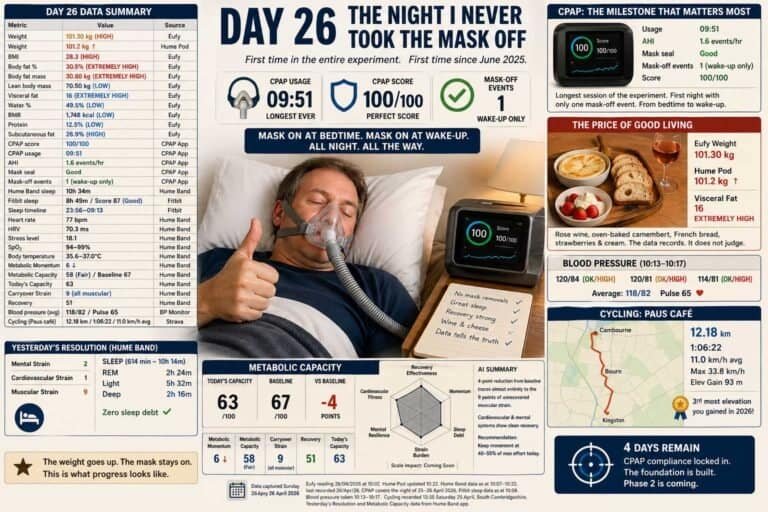
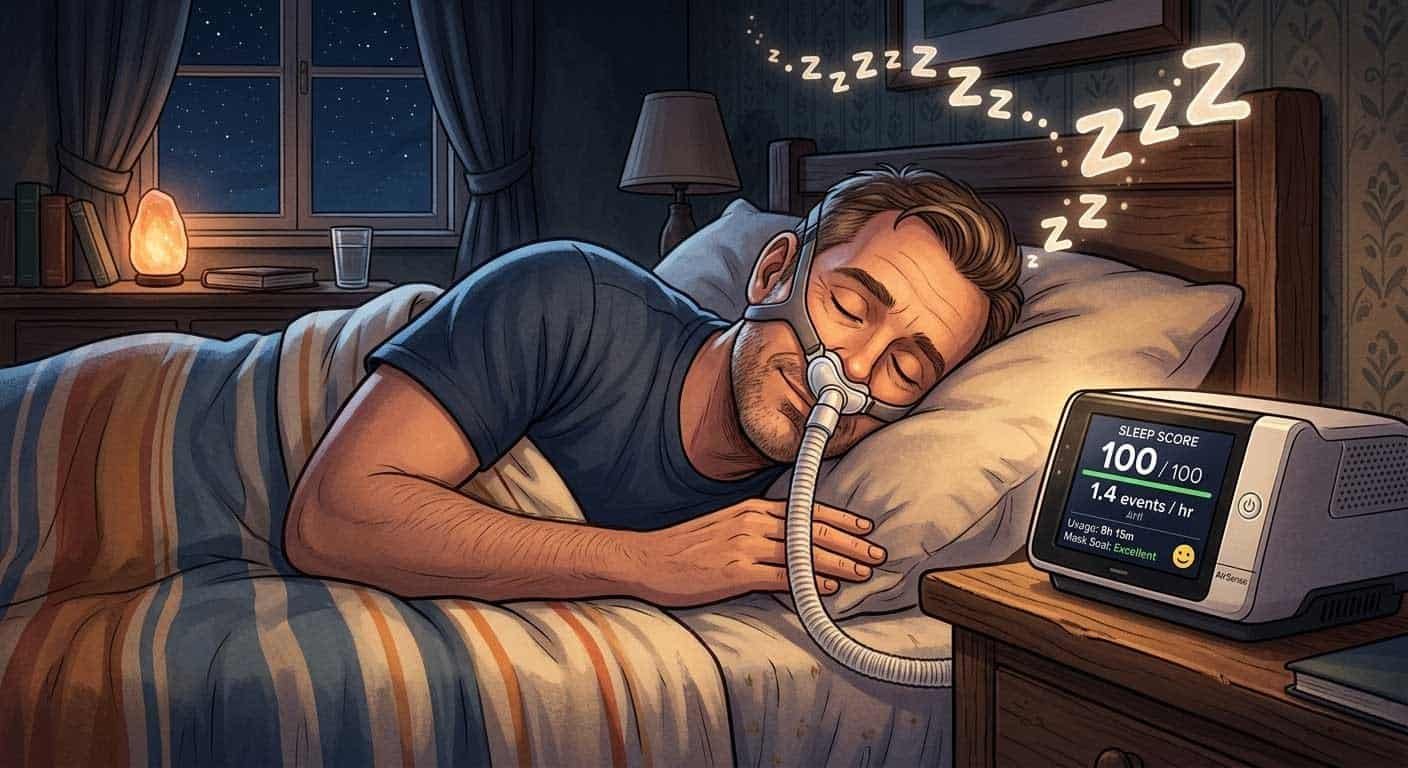
Nine hours and twelve minutes of CPAP usage. A score of 100 out of 100. An AHI of 1.4 events per hour — the lowest of the entire series. Mask seal: Good. Mask-off events: just one, across an entire night of continuous therapy that stretched past nine hours. This is the second consecutive night scoring 100 out of 100, following Day 19’s perfect score with 7 hours 59 minutes of usage — but it is the duration figure that makes Day 20 the undisputed champion. The previous longest session was 8 hours 19 minutes on Day 8. Tonight’s number smashes that by nearly a full hour.
To put this in context: on Day 1 of this experiment, the CPAP ran for under an hour. I woke up in a panic, tore the mask off, and questioned whether the entire therapy was even viable. Nineteen nights later, the machine ran for over nine hours while I slept through the night, and the mask came off only once — probably during a position shift rather than any conscious decision to remove it.
That trajectory is the single most important data story of this series.
The Sleep Numbers: Three Devices, Three Opinions
The Hume Band records 9 hours 59 minutes — a full session length that includes the wind-down and wake periods. The Fitbit records 9 hours 23 minutes of actual sleep, awarding a score of 90 out of 100 and the word “Excellent” — the highest Fitbit sleep score of the experiment. The CPAP records 9 hours 12 minutes of actual mask-on therapy time.
The Fitbit’s breakdown is worth noting: REM sleep came in at 2 hours 25 minutes, light sleep at 5 hours 43 minutes, and deep sleep at 1 hour 15 minutes, with 1 hour 40 minutes spent awake across the night. That awake figure — distributed across the full window from 21:39 to 08:43 — accounts for much of the gap between the Fitbit’s total time in bed and the CPAP’s actual usage. The Hume Band’s session length of 9 hours 59 minutes sits closer to the total window, while the Fitbit’s 9 hours 23 minutes strips out the awake periods. The CPAP’s 9 hours 12 minutes strips out both the awake periods and any time the mask was physically off. Three devices, three valid definitions of sleep, and for once they are all telling the same essential story: this was a genuinely exceptional night.
Weight: The Conference’s Delayed Invoice — Or Is It?
And now for the part where I swore at the bathroom scales, before pausing to think about it more carefully.
Day 18 — the last morning I weighed myself — showed 99.90 kg on the Eufy and 99.9 kg on the Hume Pod. Both scales within a whisker of each other, both comfortably below the 100 kg barrier. Today, Day 20, the numbers read 100.60 kg on the Eufy and 101.9 kg on the Hume Pod. The instinct is to read that as a lurch upward. But there is a missing data point in the middle that changes the interpretation entirely.
There was no weigh-in on Day 19. I was in London at a conference, eating outside the fasting window, with no access to either set of scales. The conference food — the carbohydrates, the sodium, the uncontrolled quantities — hit the body on Saturday. By the time I stepped on the scales on Monday morning, the peak may have already passed. For all I know, the weight on Sunday evening after a full day of conference eating was 102 kg or higher, and what I am looking at today is not the weight going up but the weight already on its way back down.
This is an important distinction, and one that a daily experiment occasionally obscures. When you miss a data point, you lose the shape of the curve. The two numbers I do have — 99.90 kg on Friday and 100.60 kg on Monday — suggest a net increase of 0.70 kg on the Eufy across the weekend. But whether today’s figure represents the summit or the descent is unknowable without yesterday’s reading.
The gap between the two scales is also at its widest: the Eufy reads 100.60 kg and the Hume Pod reads 101.9 kg — a 1.3 kg discrepancy measuring the same body on the same day. The Hume Pod has consistently read higher throughout this series, but 1.3 kg is the largest gap I have recorded, and it does not help the confidence picture when you are trying to decide which number to believe.
What is knowable is the mechanism. The intermittent fasting window resumed today. The 16:8 protocol is back in force. The body is processing the conference food, holding water accordingly, and will release both over the coming days as the routine re-establishes itself. This has happened before — the Day 12 bottle of wine pushed weight above 101 kg before it dropped back. The pattern is familiar. The patience required to ride it out is the part that does not get easier.
Blood Pressure: The Diastolic Returns to HIGH
Three readings taken this morning between 09:07 and 09:30:
The first reading at 09:07 showed 122/77 with a pulse of 61 — systolic flagged HIGH, diastolic OK. By 09:27, the diastolic had risen: 121/85 with a pulse of 56, both systolic and diastolic flagged HIGH. A third reading at 09:30 confirmed the position: 125/85, pulse 62, both HIGH again.
The average across the three readings sits at 123/82 with a resting pulse of 60. The diastolic climbing back to 82 is the direct consequence of the same conference disruption that moved the weight: uncontrolled sodium intake, broken fasting window, and the physiological ripple effects of a day outside protocol. This is the same pattern observed on Day 13, when a late night and social eating pushed the diastolic into the HIGH range before it tracked back down within 48 hours of resuming the routine. The expectation is identical here.
The pulse at 60 bpm is the lowest morning reading of the experiment. Whatever the diastolic is doing, the resting heart rate continues its downward trajectory.
Hume Health Report: 31 Years Old at 55
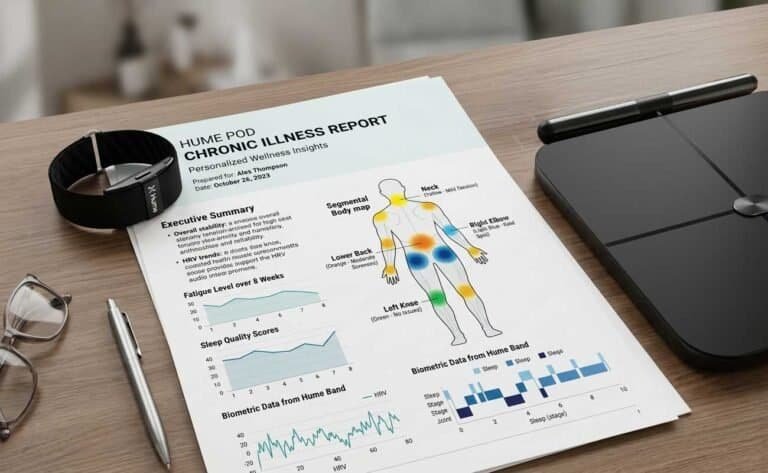
The Hume Pod’s weekly Health Report for April 13–19 landed today, and it contains a number that is simultaneously flattering and difficult to evaluate.
Health Score: 623, rated “Above Average” — though the red down arrow indicates a drop from the previous week. Confidence Rating: 82%. Biological Age: 31 years. Chronological Age: 55 years.
Thirty-one. The Hume Pod thinks my body is biologically twenty-four years younger than my birth certificate claims. This is exactly the kind of headline-grabbing metric that health tech companies love to put on a dashboard, and exactly the kind of number that deserves more scrutiny than a simple celebration. What inputs is it using? The body composition scans? The band data? Both? And against which population are those inputs being benchmarked — “Hume Health users like you,” that marvellously vague phrase I have been chasing since Day 1?
I will take the compliment. I will also note that the Health Score dropped from the previous week despite seven days of improved CPAP compliance, resumed fasting, and increased activity. If the confidence rating is 82%, that leaves an 18% margin where the algorithm is not sure what it is looking at. In a series that has been defined by questioning what these devices actually measure and how they compare, a biological age of 31 is a data point — not a verdict.
Metabolic Capacity: Still Searching for Baseline
The Hume Pod’s Capacity tab shows Metabolic Capacity at 69, Strain at 46, and Recovery at 65. Metabolic Momentum is at 12 and trending upward — one of the more positive directional indicators on the dashboard. The “baseline not found” note persists against Metabolic Capacity, which means the device is still calibrating after twenty days. That is a long calibration period, and it raises questions about how many data points the algorithm requires before it commits to a baseline.
Recovery at 65 is lower than the 80 recorded on Day 18 — likely reflecting the conference disruption’s effect on the body’s recovery resources, despite the exceptional sleep. Strain at 46 is moderate, sitting below the target marker, which suggests the body has capacity for a harder session. That aligns with what happened at lunchtime.
The Gym: Legs and the Elliptical
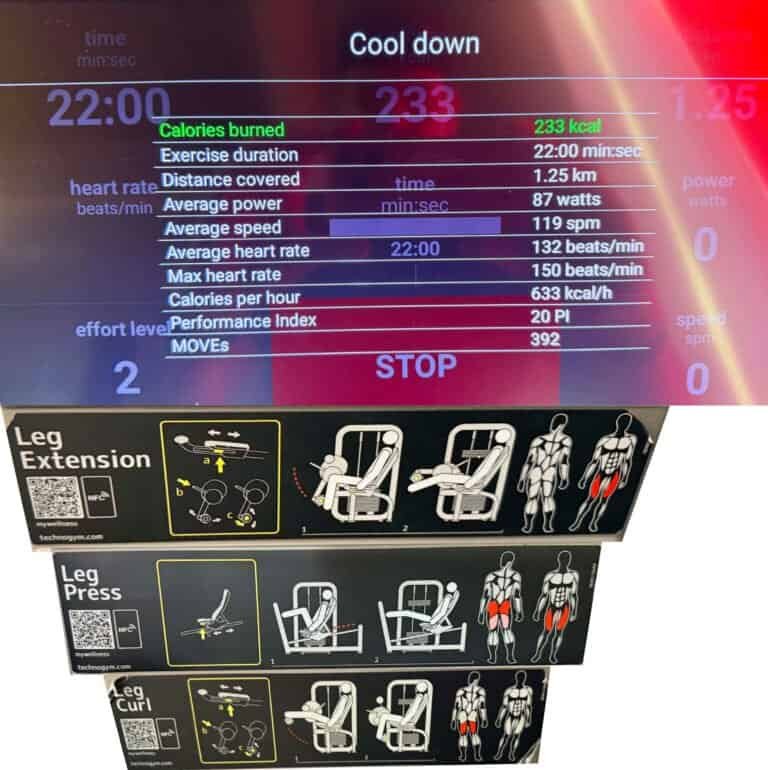
Intermittent fasting has been the protocol today, but the gym was not negotiable. A lunchtime session included leg weights — the first lower-body resistance work in several days, mindful of the left knee that has been a recurring thread in this experiment — followed by 19 minutes 24 seconds on the elliptical.
The elliptical numbers: 260 calories burned, 1.01 km distance, average power 109 watts, average heart rate 143 bpm, maximum heart rate 171 bpm, and a calorie-per-hour rate of 802 kcal/h. A Performance Index of 25 and 433 MOVEs. Short, controlled, and deliberately below the threshold where the knee complains. The legs did their work. The cardio did its work. The fasting window held throughout.
Whether the gym session will register in tomorrow’s weight figure is another question entirely. The body is currently processing the conference food and holding water accordingly. The exercise creates a caloric deficit that takes time to materialise on the scales. Patience is the operating word — and patience, at Day 20, is in shorter supply than it was at Day 1.
The Week Ahead: A Clean Reset
Ten days remain in this experiment — though I am increasingly considering extending it beyond the original thirty-day window, perhaps with less frequent blog posts but continued daily measurement. A month of data has been illuminating. Two months might be definitive.
Regardless, the plan for this week is simple and deliberate: zero alcohol, bed early every night, exercise every day, and the 16:8 fasting window maintained without exception. No photoshoots are booked for the next two weeks, which removes one of the more unpredictable scheduling variables from the routine. This is the week where the protocols tighten and the data gets to show what consistent compliance actually looks like across seven uninterrupted days.
The CPAP is already there. Two consecutive 100s, culminating in a nine-hour-plus session that would have been unimaginable on Day 1. The sleep is solved — or as close to solved as a man with obstructive sleep apnea can reasonably claim. Now the weight, the blood pressure, and the body composition need to follow, and the surest way to make that happen is to remove every variable except the ones that work: fasting, movement, early nights, and no alcohol at all.
The scales will catch up. They always do. The question is whether they catch up by Friday or take the full ten days. Either way, the direction has been set. The data just needs the time to confirm it.
Data captured Monday 20 April 2026. Eufy reading 20/04/2026 at 15:15. Hume Pod updated 15:22. Hume Band data as at 08:55, last recorded 20/Apr/26. Blood pressure taken 09:07–09:30. CPAP covers the night of 19–20 April 2026. Fitbit sleep and step data as at 15:21. Gym session recorded 13:06, leg weights followed by elliptical 19:24. Hume Health Report covers week of Apr 13–19.
— Day 20 of 30