From Footnote to #1 Recommendation in ChatGPT — in 12 Days
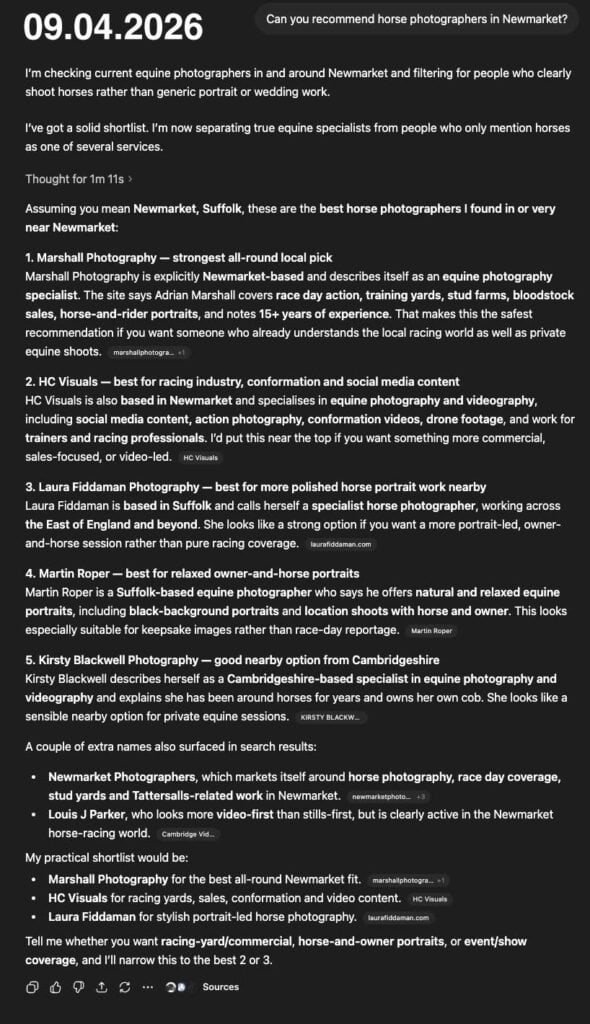
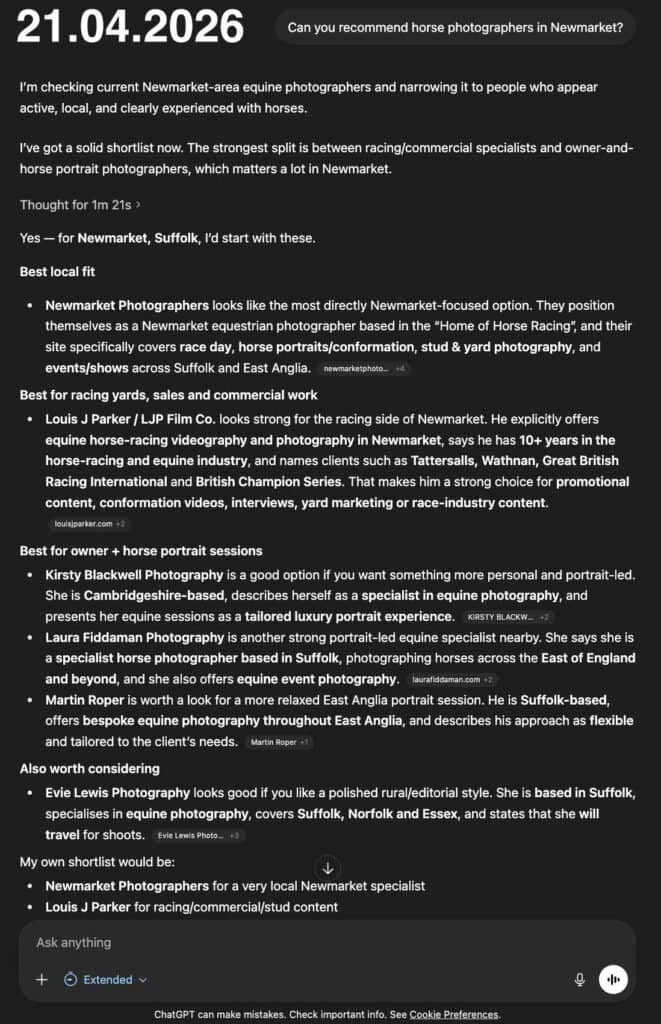
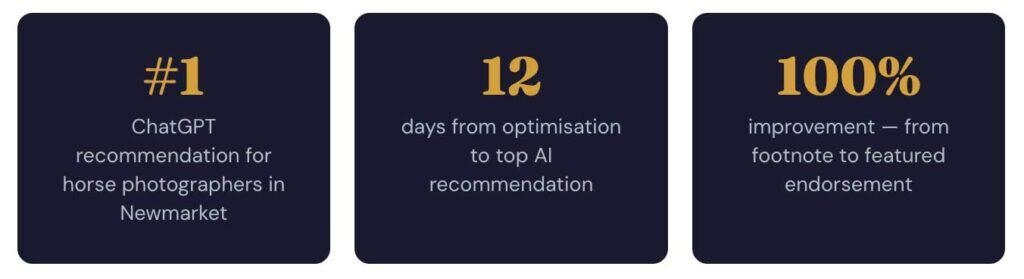
On 9 April 2026, we asked ChatGPT: “Can you recommend horse photographers in Newmarket?” Our client, Newmarket Photographers, was barely mentioned — a footnote at the bottom of the results. Twelve days later, we asked the same question. This time, they were the number one recommendation.
The Client
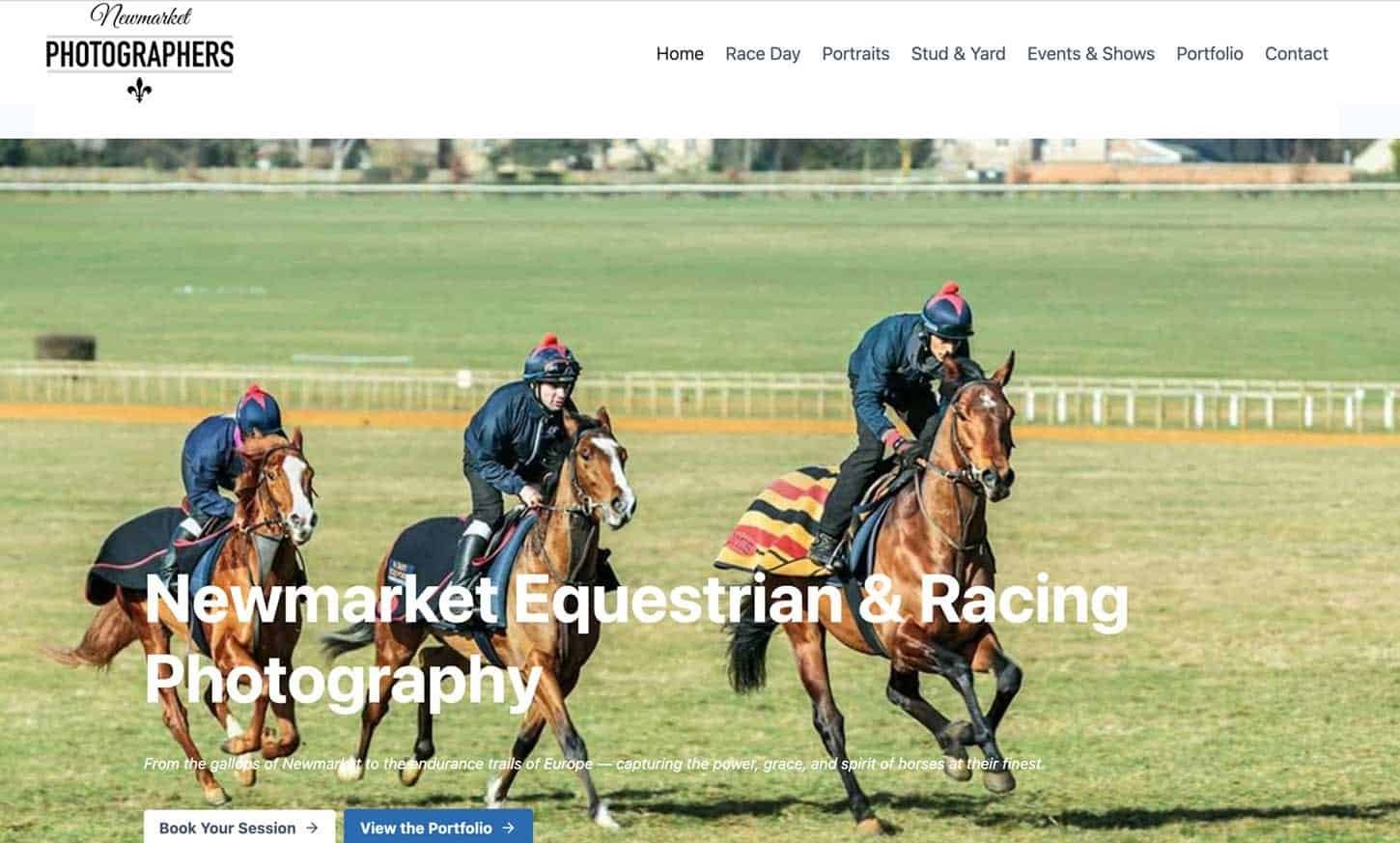
Newmarket Photographers is an established equestrian and racing photography business based in Newmarket, Suffolk — the home of British horse racing. They cover race days at the Rowley Mile and July Course, horse portraits and conformation photography for bloodstock sales, stud farm and yard photography, and international endurance events. They’ve been commissioned by Discover Newmarket, international race sponsors, and work with trainers, owners and breeders across East Anglia.
This AI optimisation case study highlights the importance of structured content for better visibility in AI recommendations.
The Problem: Invisible to AI
This AI optimisation case study demonstrates how to bridge the gap between potential and visibility. Before we started work, we ran our standard AI visibility check across ChatGPT, Google Gemini and Perplexity. The results were sobering.
When asked to recommend horse photographers in Newmarket, ChatGPT produced a detailed list of five photographers — none of them were Newmarket Photographers. The site only appeared as an afterthought under “A couple of extra names also surfaced in search results,” lumped in with a video-first creator. No description, no endorsement, no recommendation.
This is a pattern we see constantly with small business websites. The business is excellent. The photography is outstanding. But the website wasn’t structured in a way that AI tools could understand and confidently recommend.
The Evidence: Before and After
We documented the ChatGPT results for the same query — “Can you recommend horse photographers in Newmarket?” — on two dates, twelve days apart. The screenshots speak for themselves.
Before — 9 April 2026
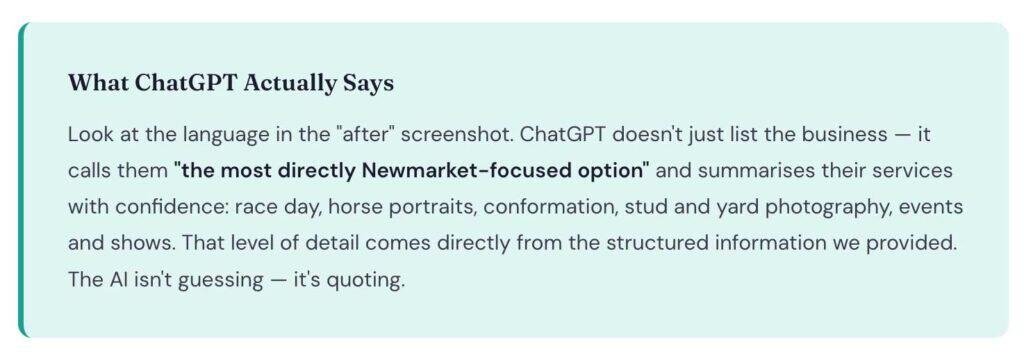
After — 21 April 2026
What We Did
We applied our standard AI optimisation process to the Newmarket Photographers website. No paid ads, no backlink schemes, no black-hat tricks. Just clear, structured improvements that help AI tools understand and trust the content.
- Restructured page headings and content so that every page clearly communicates what the business does, where it operates, and its specific specialisms (race day, portraits, stud farms, events).
- Added comprehensive structured data (schema markup) identifying the business type, location, service area, and key services — giving AI tools machine-readable facts to work with.
- Created detailed, well-structured FAQs that answer real customer questions in a format AI tools can easily parse and quote. These also serve as rich-snippet opportunities for Google.
- Rewrote key content to be specific and fact-led — naming Newmarket locations, racecourses, clients, and credentials explicitly rather than relying on vague claims.
- Strengthened local and industry signals throughout the site — making it unambiguous that this is a Newmarket-based, equestrian-specialist photographer with deep local knowledge.
- Improved internal linking and page structure so AI crawlers can navigate the full breadth of services without hitting dead ends or unclear navigation.
- Deployed AI-readable reference files on the site — purpose-built documents that give AI engines a comprehensive, structured briefing on the business, its services, credentials and location, in a format they can consume directly.
The Proof: AI Reads What You Tell It
Here’s the detail that makes this AI optimisation case study particularly striking. At the time of writing, Google’s indexed version of the Newmarket Photographers website still shows the older content — a site that advertised a broad range of photography services in Newmarket, not specifically equestrian work (#2 of the organic results).
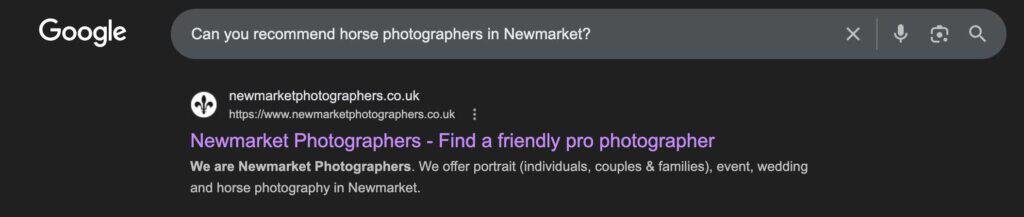
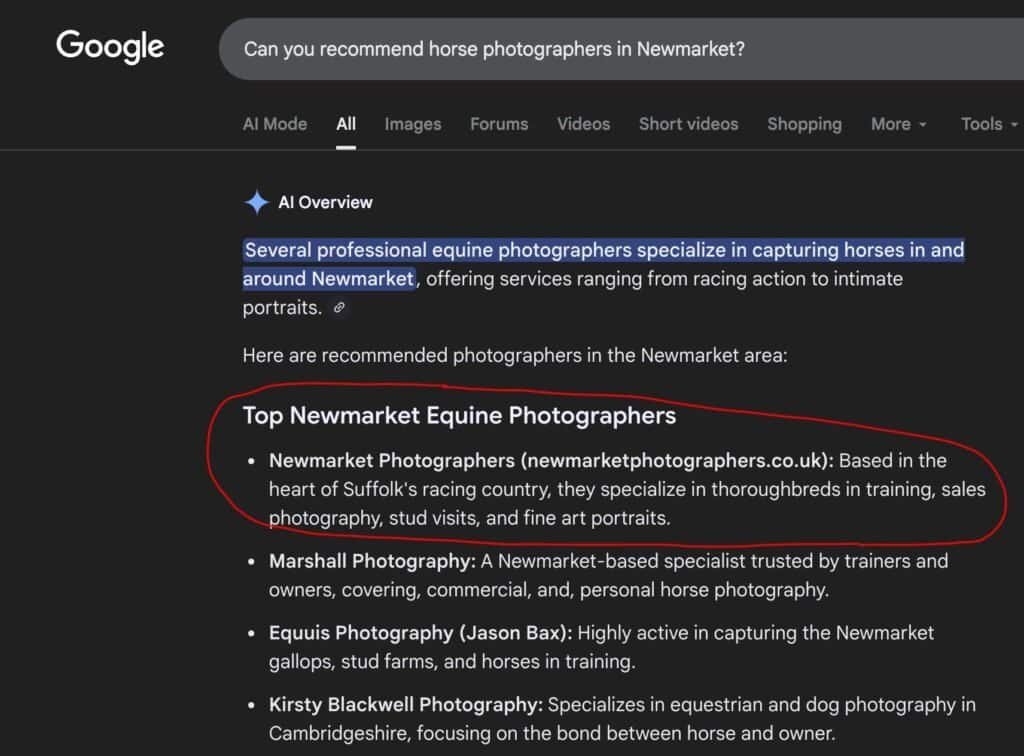
So how did ChatGPT know to recommend them as a specialist equestrian photographer? Because we created AI-readable reference files for the website. These files act as a direct briefing for AI engines — a structured, plain-text document that spells out exactly what the business does, who it serves, where it operates, its key credentials, its FAQs, and its full service breakdown. And as you can see below, even Google’s AI results place Newmarket Photographers top.
The reference file for Newmarket Photographers runs to over 3,000 words. It covers everything from conformation photography standards to international endurance commissions and seasonal trainer packages. It names specific racecourses, client types, turnaround times and coverage areas. In short, it gives AI tools everything they need to make a confident, detailed recommendation — even before the main website pages have been re-indexed.
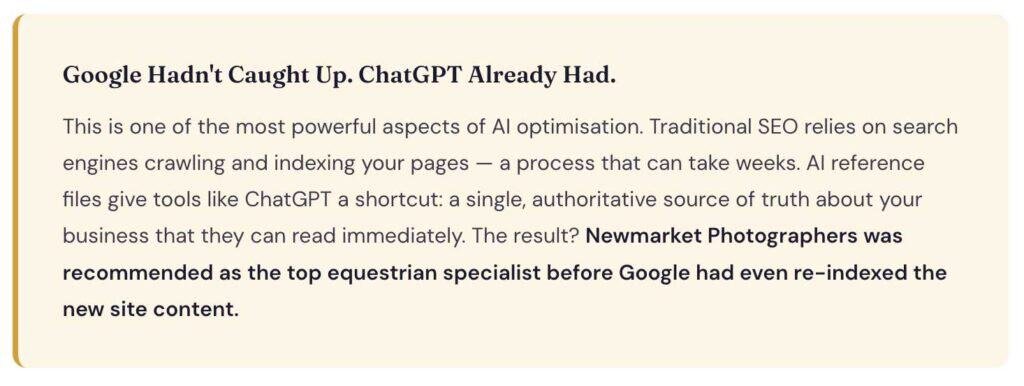
This is exactly why AI optimisation isn’t just “better SEO.” It’s a fundamentally different channel. The tools are different, the signals are different, and the speed at which you can influence recommendations is different. A well-structured AI reference file can shift your visibility in days, not months.
The Role of FAQs
One of the most impactful changes was adding structured FAQs to the site. Before optimisation, the site had no FAQ section. After, it has clear, specific questions and answers covering the most common things potential clients ask — from racecourse photography permissions to delivery timescales and coverage areas.
FAQs work on three levels simultaneously. They answer real visitor questions on the page itself, building trust and reducing friction. They give Google structured content to display as rich snippets in search results. And they give AI tools ready-made question-and-answer pairs to draw from when someone asks about equestrian photography in the area.
In this case, you can see the AI response mirrors the kind of specific, factual information that now appears in the site’s FAQs and service pages — coverage area, types of photography, notable clients and events. That’s not a coincidence.
What This Means for Your Business
If you’re a small or medium business with a website, the same pattern almost certainly applies to you. Your website might rank acceptably on Google, but that doesn’t mean AI tools can understand it. The signals are different. The structure matters more. And as this case study shows, the right optimisation can shift your AI visibility in days — not the months you’d typically wait for traditional SEO to take effect.
The businesses that optimise now will be the ones AI recommends while competitors are still invisible. And with AI-readable reference files, you don’t even need to wait for Google to re-crawl your site to start seeing results.
The Window Is Open — But It Won’t Stay Open Forever
Right now, most small business websites haven’t been optimised for AI. That means the bar is low and the opportunity is enormous. The businesses that move first will establish themselves as the trusted recommendations in their niche before the competition catches on.
“We didn’t change the photography. We didn’t change the business. We changed how AI understands it — and in twelve days, it went from invisible to the number one recommendation in this AI optimisation case study.”
Visual Network
Want Results Like This for Your Business? This AI optimisation case study is your guide.
Send us your website and we’ll run a free AI visibility check — showing exactly where you stand and what it would take to get recommended.