DAY 24 — 34 Kilometres, and Every Number Changed
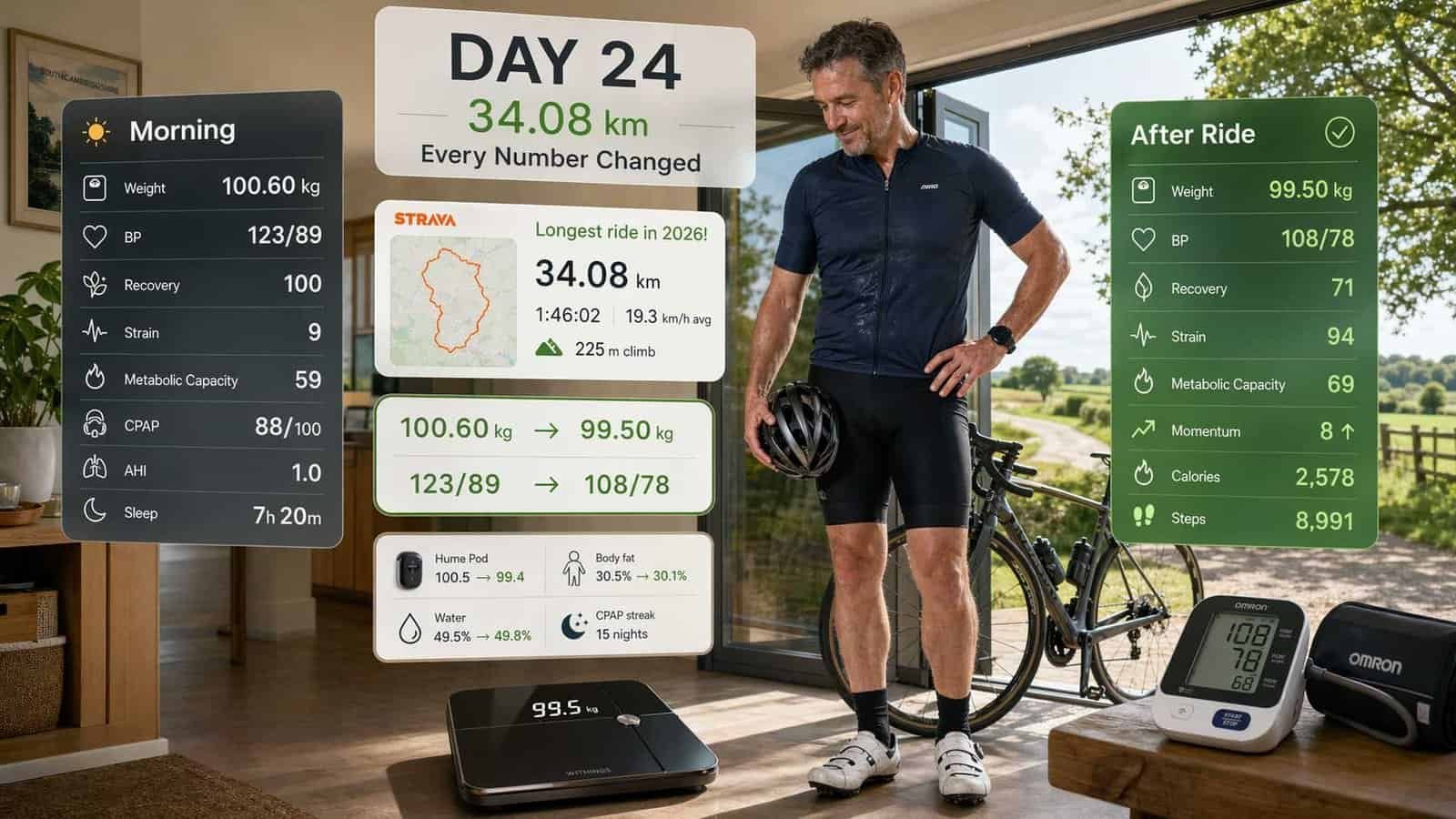
The case for cycling for weight loss and blood pressure has never been more plainly made than by today’s data. This morning I weighed 100.60 kg on the Eufy scales and my blood pressure read 123/89 — both systolic and diastolic flagged HIGH. Then I rode 34.08 kilometres through the South Cambridgeshire countryside in the sun, drank a litre of water with electrolytes, and came home to weigh myself again. The Eufy read 99.50 kg. The blood pressure read 108/78 — both systolic and diastolic flagged OK. Same body, same scales, same blood pressure monitor, four hours apart, and a bike ride in between that changed every number it touched.
Day 24 Data Summary
| Metric | AM Value | PM Value | Source |
|---|---|---|---|
| Weight | 100.60 kg (HIGH) | 99.50 kg (HIGH) | Eufy |
| Weight | 100.5 kg ↑ | 99.4 kg | Hume Pod |
| BMI | 28.1 (HIGH) | 27.8 (HIGH) | Eufy |
| Body fat % | 30.5% (EXTREMELY HIGH) | 30.1% (EXTREMELY HIGH) | Eufy |
| Body fat mass | 30.60 kg (EXTREMELY HIGH) | 29.90 kg (EXTREMELY HIGH) | Eufy |
| Water % | 49.5% (LOW) | 49.8% (LOW) | Eufy |
| BMR | 1,738 kcal (LOW) | 1,722 kcal (LOW) | Eufy |
| Blood pressure | 123/89 (HIGH/HIGH) / 66 | 108/78 (OK/OK) / 100 | BP Monitor |
| Blood pressure | 123/84 (HIGH/HIGH) / 66 | 108/74 (OK/OK) / 97 | BP Monitor |
| CPAP score | 88/100 | — | CPAP App |
| CPAP usage | 05:54 | — | CPAP App |
| AHI | 1.0 events/hr | — | CPAP App |
| Mask seal | Good | — | CPAP App |
| Mask-off events | 3 | — | CPAP App |
| Hume Band sleep | 7h 20m | — | Hume Band |
| Fitbit sleep | 6h 48m / Score 79 (Fair) | — | Fitbit |
| Sleep timeline | 02:19–09:54 | — | Fitbit |
| Heart rate | 92 bpm | — | Hume Band |
| HRV | 70.3 ms | — | Hume Band |
| Stress level | 19.5 | — | Hume Band |
| SpO₂ | 96–99% | — | Hume Band |
| Body temperature | 35.9–37.2°C | — | Hume Band |
| Metabolic Momentum | 7 ↓ (AM) / 8 ↑ (PM) | — | Hume Band |
| Metabolic Capacity | 59 (AM) / 69 (PM) | — | Hume Band |
| Strain | 9 (AM) / 94 (PM) | — | Hume Band |
| Recovery | 100 (AM) / 71 (PM) | — | Hume Band |
| Pace of Aging | 0.4x | — | Hume Band |
| Life Added This Week | 3.5 days ↑ | — | Hume Band |
| Life Added Overall | 11.8 days ↑ | — | Hume Band |
| Cycling | 34.08 km / 1:46:02 / 19.3 km/h avg | — | Strava |
| Steps | 8,991 | — | Fitbit |
| Calories | 2,578 | — | Fitbit |
The Ride: 34.08 km, the Longest of 2026
The bike left at 12:49pm under sunshine and came back nearly two hours later, having looped through Caxton, Longstowe, Bourn, and Abbotsley — a route through the kind of gently rolling South Cambridgeshire countryside that is flat enough to keep moving but hilly enough to know you have been somewhere.
34.08 kilometres. Moving time: 1 hour 46 minutes 2 seconds. Average speed: 19.3 km/h. Maximum speed: 44.6 km/h. Elevation gain: 225 metres. Maximum elevation: 80 metres. Strava awarded it the “Your longest ride in 2026!” personal record badge.
For context: every previous ride in this experiment has been in the 6–8 km range. Day 7’s 13.29 km was the previous longest ride of the series. Today’s ride is more than four times the length of the typical morning loop around Cambourne and more than double the previous experiment best. This is not a gentle cruise. At an average of 19.3 km/h sustained for nearly two hours with 225 metres of climbing, this is proper cardiovascular work — the kind that burns through glycogen stores, depletes water weight, and leaves a physiological signature that shows up across every device in the experiment.
The heart rate on the Hume Band at time of recording: 92 bpm. That is the highest resting reading of the recent experiment, but the Band was likely still capturing the elevated state from the ride. The Fitbit’s total calorie burn for the day hit 2,578 — the highest single-day figure in the experiment.
Weight: Before and After
This morning at 11:13: Eufy 100.60 kg, Hume Pod 100.5 kg. After the ride at 15:53: Eufy 99.50 kg, Hume Pod 99.4 kg.
A drop of 1.10 kg on the Eufy and 1.1 kg on the Hume Pod in a single afternoon. Both scales agree on the magnitude. Both scales are now back below 100 kg. And the Hume Pod has dropped to 99.4 kg — matching the reading from Day 16, the previous lowest Hume Pod figure in the experiment.
The Hume Pod also delivered an editorial moment. When the afternoon weigh-in registered, the app displayed a warning: “Too soon for a new measurement. Your next recommended weigh-in is tomorrow around 8:55AM. We do not recommend adding this weigh-in to your Body Composition records.” The device that has been cheerfully accepting two weigh-ins a day throughout this experiment has suddenly developed opinions about data collection frequency. For a man running a daily experiment that involves weighing himself at various times of day to track the effect of exercise and fasting, being told by the scale that it would prefer not to record the result is a particular kind of irony.
I kept the weigh-in.
The 1.1 kg drop is overwhelmingly water weight — sweat lost during nearly two hours of cycling in sunshine, despite drinking a litre of water with electrolytes during the ride. The body fat figures tell the real story: 30.5% before the ride, 30.1% after. Body fat mass: 30.60 kg before, 29.90 kg after. These movements are too large to represent actual fat loss in four hours and are driven by the changed hydration state affecting the bioelectrical impedance readings. Tomorrow morning’s weigh-in — after overnight rehydration and a full evening’s food and drink — will reveal how much of the drop persists. The structural question is whether the body settles back at 100.40 kg where it spent three days, or whether the ride has broken the flatline.
Blood Pressure: The Most Dramatic Single-Day Shift of the Series
Morning readings at 10:38 and 10:43: 123/89 and 123/84. Both systolic and diastolic flagged HIGH. The diastolic at 89 is the highest single reading since the Day 13 peak of 92.
Afternoon readings at 16:05 and 16:10 — after the ride: 108/78 and 108/74. Both systolic and diastolic flagged OK. Every indicator green.
The systolic dropped 15 points. The diastolic dropped 11–15 points. The same body, the same arm, the same monitor, and a bike ride in between. The pulse tells its own story: 66 bpm at rest in the morning, 100 and 97 bpm in the afternoon readings — still elevated from the cardiovascular work, with the heart rate gradually returning to baseline.
This is the most dramatic single-day blood pressure shift of the entire experiment. Previous patterns showed disruption producing elevated readings that took 48 to 72 hours to resolve through protocol compliance. Today, a single exercise session produced the same resolution in four hours. The implication is straightforward: the body responds to exercise faster and more completely than it responds to passive recovery. The protocols work — fasting, early nights, no alcohol — but cycling works faster.
The morning diastolic of 89 is worth noting separately. This is the first time the diastolic has climbed back to HIGH since it resolved on Day 23. Another late night — bed at 02:19 — appears to be the culprit. The pattern across the full experiment is now clear: late bedtimes push the diastolic up; exercise pulls it down; the question is which force wins on any given day.
Hume Support: The “Baseline Not Found” Bug — Fixed
An email from Hume Support arrived yesterday evening, and it resolves one of the longest-running subplots of this experiment. Here it is in full:
Hi Jean,
I hope you’re doing well, and thank you for reaching out. I’m really sorry for the frustration this has caused you, and I completely understand how concerning it is to see “baseline not found” in your metabolic capacity graph, especially while also waiting for a response to your previous inquiry.
I want to let you know that I have forwarded this issue to our backend team, and they have confirmed that the issue has now been fixed. This update has been included in the latest app release (v9.17.3), which was released on April 22nd.
To ensure everything is working correctly, please delete the app from your device and reinstall the latest version from the App Store. Once updated, the baseline issue should be resolved.
I’m also sorry for the delay in getting back to your earlier message, I understand how important timely support is, and I appreciate your patience.
Warm regards, Patrick
Credit where it is due: this is the first time in the support correspondence that Hume has confirmed an actual bug rather than offering a general explanation. The “baseline not found” message was not a calibration issue, not a data insufficiency problem, not a matter of needing more time. It was a software bug, now fixed in version 9.17.3. The backend team confirmed it. Patrick communicated it clearly.
I reinstalled the app last night. The result is immediate and visible: where the Metabolic Capacity bar previously displayed “baseline not found” beneath it, it now reads “Baseline” — a single word that has been missing from this experiment since Day 1. The Metabolic Capacity figure itself — 59 this morning, rising to 69 after the ride — can now be measured against an actual reference point for the first time in twenty-four days.
This is good support work. It took longer than it should have — the ticket has been open for over a month — but the resolution is clean, the communication is honest, and the fix works. The outstanding question about the Hume Pod’s benchmarking methodology — what “Hume Health users like you” actually means — remains unanswered, but on the Metabolic Capacity issue specifically, this chapter is closed.
Strain: From 9 to 94 in a Single Ride
The Metabolic Capacity tab tells the story of the ride in three numbers.
This morning: Metabolic Capacity 59, Strain 9, Recovery 100. The body at full capacity, barely taxed, completely recovered — the state that has been building across two rest days.
This afternoon: Metabolic Capacity 69, Strain 94, Recovery 71. The ride consumed almost the entire daily strain budget, pushing the bar deep into the red zone past the target marker. Recovery dropped 29 points from its perfect score as the body allocated resources to process the cardiovascular load. And Metabolic Capacity climbed 10 points — from 59 to 69 — which, now that the baseline is actually visible, shows the ride pushing capacity back toward the levels seen earlier in the experiment.
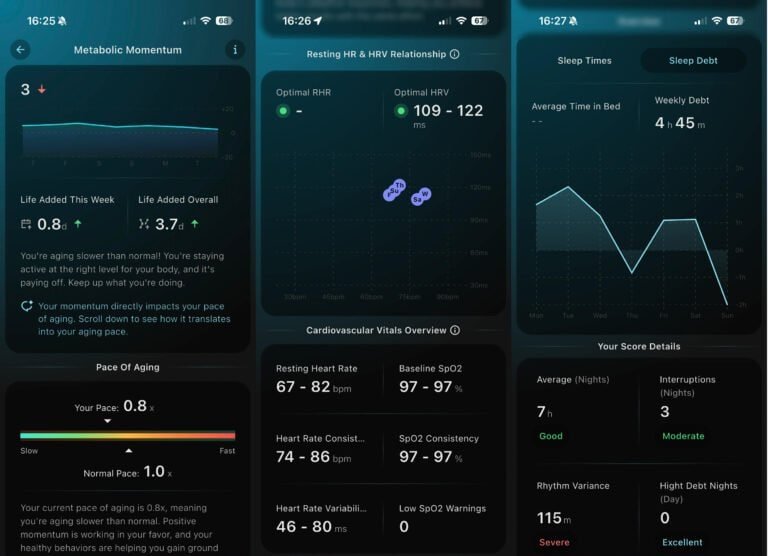
Metabolic Momentum reversed its four-day decline, climbing from 7 to 8 with a green up arrow. Life Added Overall ticked up to 11.8 days. Pace of Aging sits at 0.4x — slightly higher than Day 21’s 0.3x but still claiming the body is aging at less than half the normal rate.
Sleep: Another Late Night
Bed at 02:19, up at 09:54. The Hume Band records 7 hours 20 minutes. The Fitbit records 6 hours 48 minutes with a score of 79, rated Fair — the lowest Fitbit sleep score since the experiment began tracking it. The architecture: REM 1 hour 34 minutes, light sleep 4 hours 20 minutes, deep sleep 53 minutes, awake 46 minutes.
The CPAP scored 88 out of 100 — a recovery from yesterday’s 99 back into the upper 80s, driven by the shorter usage window of 5 hours 54 minutes and 3 mask-off events. The AHI at 1.0 is the second-lowest of the entire series, just above Day 22’s record of 0.9. The therapy quality continues to be exceptional even on shorter nights — the mask is doing its job in the hours it is on, and the AHI figures of the past week have been consistently below 2.0.
The “bed before 10pm” commitment is now five consecutive nights late. The CPAP still holds. The AHI still delivers. But the sleep scores, the deep sleep figures, and the morning blood pressure are all telling the same story: the late bedtimes are costing performance across multiple metrics. The ride overcame the blood pressure deficit today. It cannot overcome the sleep deficit if the pattern continues.
HRV: The Cost of Late Nights
HRV dropped to 70.3 ms — down from 80.4 ms yesterday and 86.3 ms on Day 21. The declining trend over the past three days mirrors the sequence of late nights: 01:56 on Day 22, 01:42 on Day 23, 02:19 on Day 24. Each subsequent late night has pulled the HRV lower, eroding the bounce-back that followed the conference recovery. The body’s parasympathetic capacity is being compressed by the reduced and late sleep windows, even as the CPAP therapy continues to deliver excellent AHI figures.
This is the experiment’s clearest illustration of a principle that has been building across twenty-four days: CPAP compliance is necessary but not sufficient. The therapy quality can be excellent — an AHI of 1.0 tonight — but if the sleep window is compressed by a late bedtime, the HRV, deep sleep, and morning blood pressure all suffer regardless. The machine can only treat the hours it is given.
Where Day 24 Sits
Six days remain. Today was the day the experiment needed — the first genuine exercise in three days, the longest ride of 2026, and a before-and-after data set that shows the immediate impact of cycling across weight, blood pressure, and metabolic strain more clearly than any previous day in the series. The Hume baseline bug is resolved. The weight is back below 100 kg. The blood pressure is back to green. The Metabolic Momentum has reversed its decline.
The one thing the ride cannot fix is the bedtime. Five consecutive nights past 1am is a pattern, not an accident, and it is visible in the declining HRV, the rising morning diastolic, and the falling Fitbit sleep scores. The CPAP compliance streak — now at fifteen consecutive nights — is holding despite the late starts, and the AHI figures are the best of the experiment. But the sleep timing is the last protocol that has not been honoured this week, and it is increasingly the metric that is holding everything else back.
Tomorrow: bed before 11pm. The ride has earned it.
Data captured Friday 24 April 2026. Eufy morning reading 24/04/2026 at 11:13; afternoon reading at 15:53. Hume Pod morning reading 11:21; afternoon reading 15:55 (99.4 kg — app warning noted). Hume Band data as at 11:21 (morning) and 16:11–16:12 (afternoon). CPAP covers the night of 23–24 April 2026. Fitbit sleep and activity data as at 16:11. Blood pressure taken 10:38–10:43 (morning) and 16:05–16:10 (afternoon). Cycling recorded 12:49pm, South Cambridgeshire — 34.08 km. Hume Support email from Patrick received 23 April 2026.
— Day 24 of 30