WEEK 3 REVIEW — Health Tracking Experiment Week 3: Perfect Scores, Derailment, and Recovery | Days 16–21
If Week 1 was the foundation and Week 2 was the stress test, this health tracking experiment week 3 was the proof of resilience. Six days that included the highest CPAP usage of the series, the lowest body fat mass, a seven-night compliance streak, the first sub-99 kg reading on either scale, a conference in London that dismantled every protocol simultaneously, a weight rebound that peaked at 101.9 kg, a sleepwalking episode triggered by a nightmare at 3am, and — by Tuesday morning — an HRV of 86.3 ms that said, quite clearly, the body had already recovered. Week 3 broke things. Week 3 also fixed them faster than any previous week had managed.
Weight: The Week 3 Arc
| Day | Date | Eufy Weight | Hume Pod | Notes |
|---|---|---|---|---|
| Day 15 (Week 2 close) | 15 Apr | 99.35 kg (am) | — | New series low entering Week 3 |
| Day 16 | 16 Apr | 99.05 kg | 98.9 kg ↓ | Below 99 kg on both scales — series first |
| Day 17 | 17 Apr | 99.65 kg | 99.5 kg ↑ | Wine and late night — up 0.6 kg |
| Day 18 | 18 Apr | 99.90 kg | 99.9 kg ↑ | Late night, yo-yo continues |
| Day 19 | 19 Apr | No weigh-in | No weigh-in | Conference in London |
| Day 20 | 20 Apr | 100.60 kg | 101.9 kg ↑ | Conference aftermath — widest scale gap (1.3 kg) |
| Day 21 | 21 Apr | 100.20 kg | 100 kg ↓ | Descent confirmed — narrowest scale gap (0.2 kg) |
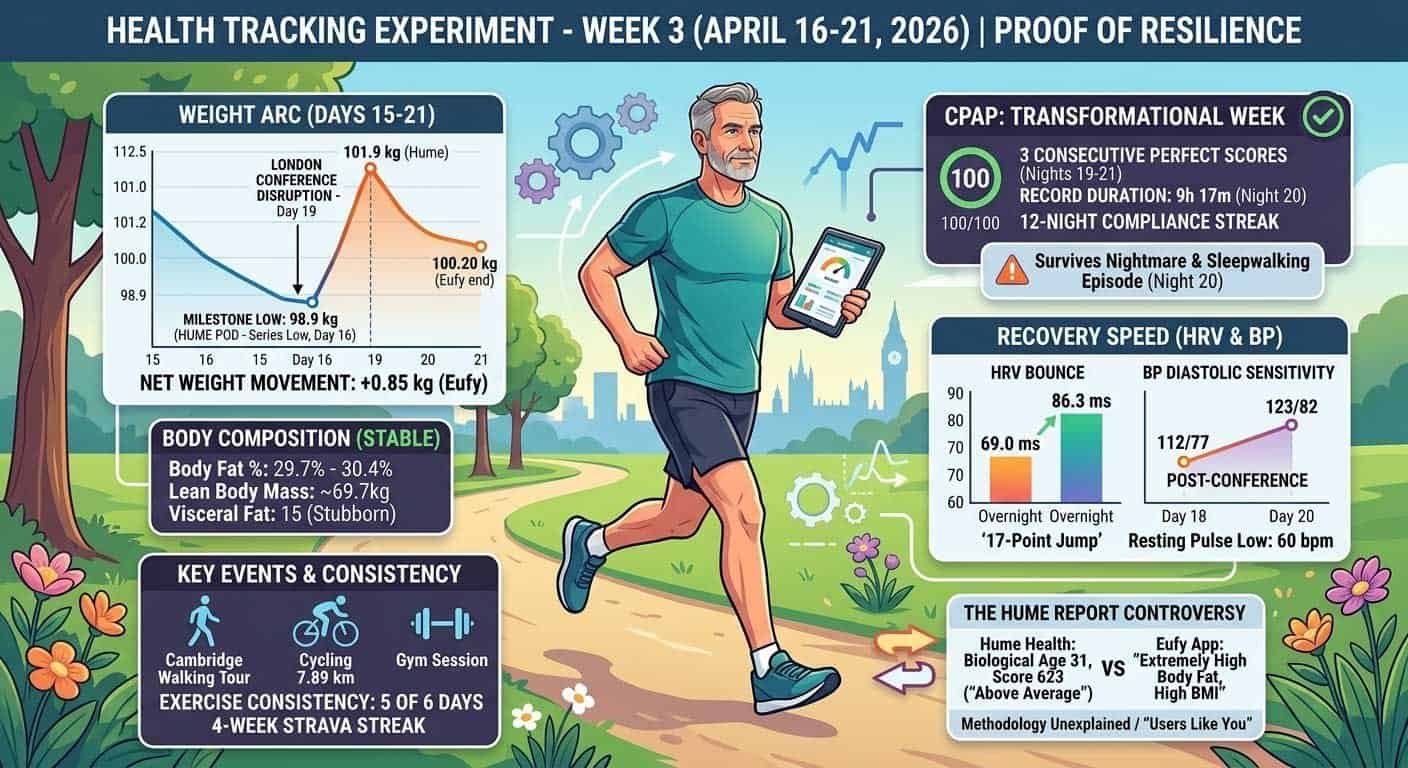
The Week 3 weight story divides cleanly into two halves. The first three days continued the downward trajectory of Week 2’s close, culminating on Day 16 with the Hume Pod reading 98.9 kg — the first time either scale had broken through the 99 kg barrier at any point in the experiment. Body fat mass on that same day fell to 29.40 kg, a new series low. Water percentage crossed 50% for the first time. The direction felt irreversible.
Then the conference happened.
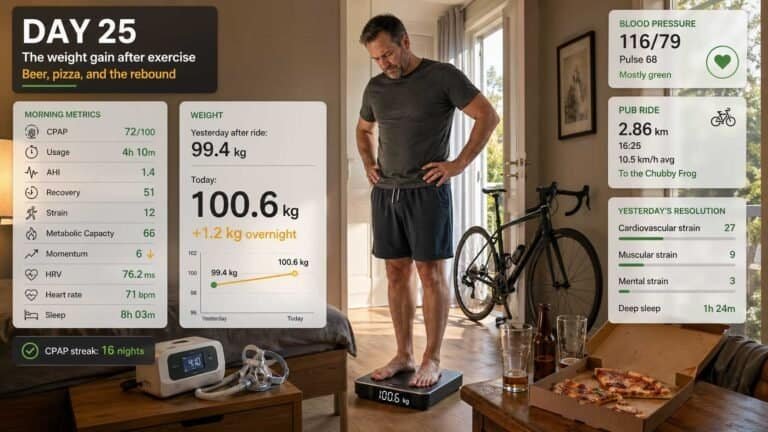
Day 19 in London meant no weigh-in, no fasting, uncontrolled eating, and the complete suspension of every protocol except sleep. By Day 20, the Eufy read 100.60 kg and the Hume Pod 101.9 kg — a gap of 1.3 kg between the two devices, the widest discrepancy of the entire series. The instinct was to read it as disaster. The data over the following 24 hours suggested otherwise: by Day 21, the Eufy had dropped to 100.20 kg and the Hume Pod to 100 kg, narrowing the scale gap to just 0.2 kg — the closest agreement the two devices have produced in twenty-one days.
The net movement across Week 3: from 99.35 kg to 100.20 kg on the Eufy, a net gain of 0.85 kg. That is the honest number. It reflects a conference weekend eating through the middle of the week and a recovery that was still in progress at the week’s close. The Hume Pod tells a different version: from approximately 99 kg at the start to 100 kg at the end — a net gain of roughly 1 kg. Either way, Week 3 is the first week of the experiment to close higher than it opened.
The structural body composition, however, has barely moved. Body fat percentage has hovered between 29.7% and 30.4% across the six days. Lean body mass has held between 69.70 kg and 69.80 kg. Visceral fat remains stubbornly at 15. The weight fluctuation is almost entirely water, food mass, and sodium retention — not fat gain. The underlying composition continues its glacial improvement.
CPAP: The Week That Changed Everything
| Night | Date | Usage | Score | AHI | Mask-off | Notes |
|---|---|---|---|---|---|---|
| Night 15 | 15 Apr | 05:35 | 86/100 | 1.4 | 2 | 7-night streak earned |
| Night 16 | 16 Apr | 07:05 | 99/100 | 1.8 | 3 | Late night with wine — still near-perfect |
| Night 17 | 17 Apr | 05:03 | 81/100 | 1.7 | 1 | Late bed, shorter session |
| Night 18 | 18 Apr | 07:59 | 100/100 | 1.7 | 2 | 2nd perfect score — pre-conference |
| Night 19 | 19 Apr | 09:12 | 100/100 | 1.4 | 1 | Record duration — 9h 12m |
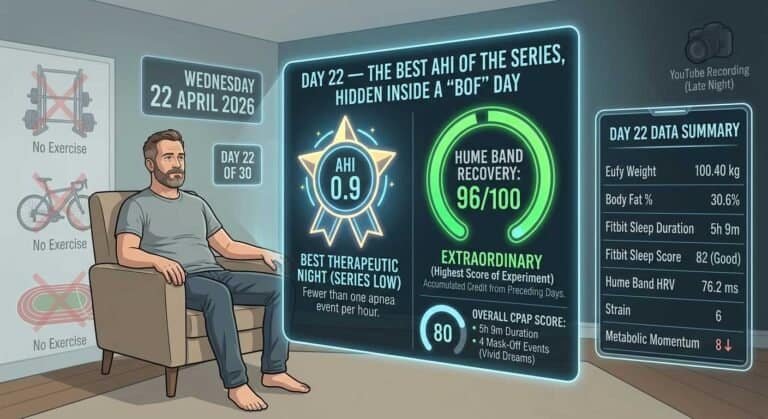
| Night 20 | 20 Apr | 09:17 | 100/100 | 3.8 | 2 | New record — 9h 17m — nightmare + sleepwalk |
Week 3 is the week the CPAP story moved from encouraging to transformational.
Three consecutive perfect scores of 100 out of 100 closed the week — Days 19, 20, and 21 — with usage climbing from 7 hours 59 minutes to 9 hours 12 minutes to 9 hours 17 minutes on successive nights. To put that final figure in context: on Day 1, the CPAP ran for under an hour before being torn off in a panic. Twenty nights later, the machine ran for over nine hours through a nightmare and a sleepwalking episode, and the app still scored it 100.
The AHI figures across the week tell their own story. Five of the six nights produced an AHI below 2.0 — clinically exceptional for treated obstructive sleep apnea. The outlier, Night 20’s 3.8, is directly traceable to the mid-night mask removal during the sleepwalking episode; the hours either side of that interruption would have been consistent with the sub-2 figures of the preceding nights.
The seven-night compliance streak earned on Day 16 extended through the entire week and beyond. At the close of Day 21, the CPAP has not missed a single night since Day 9 — a run of twelve consecutive compliant nights, with no sign of interruption. The machine that sat unused for nine months before this experiment has become as routine as brushing teeth.
Blood Pressure: Week 3’s Cleanest Arc
| Day | Date | Average BP | Pulse | Context |
|---|---|---|---|---|
| Day 16 | 16 Apr | 117/80 | 76 bpm | Post-fast recovery |
| Day 17 | 17 Apr | 113/79 | 66 bpm | Active day — cycling, walking |
| Day 18 | 18 Apr | 112/77 | 69 bpm | Best BP of the week — all green |
| Day 19 | 19 Apr | 120/82 | 62 bpm | Conference morning — diastolic HIGH |
| Day 20 | 20 Apr | 123/82 | 60 bpm | Conference aftermath — both elevated |
| Day 21 | 21 Apr | Elevated | — | Recovery in progress |
The blood pressure data from Week 3 repeats the pattern established in Week 2 with even greater clarity. Three days of clean protocol — Days 16 to 18 — produced readings that improved sequentially, bottoming out at 112/77 on Day 18 with every indicator green. Then the conference intervened, and the diastolic climbed back to 82 within 24 hours. By Day 21, the recovery was underway but not yet complete.
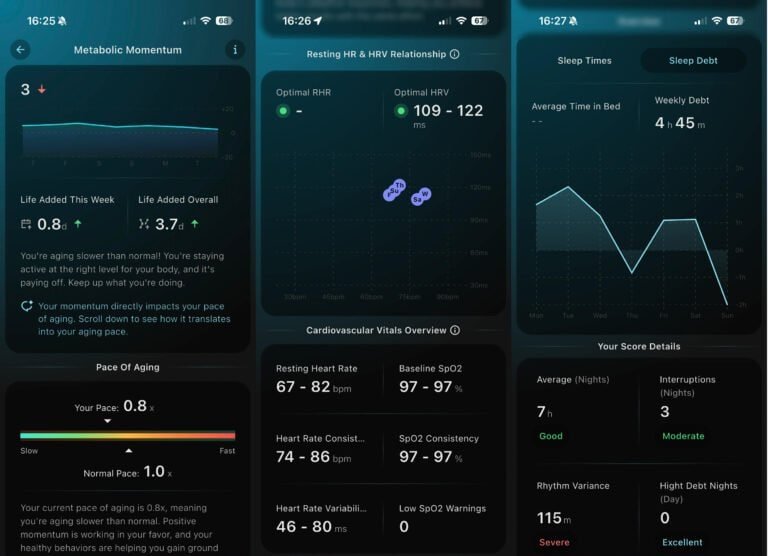
The pattern is now established beyond reasonable doubt across three weeks of daily data: the diastolic is the most sensitive metric to lifestyle disruption. It moves first, moves fastest, and recovers within 48 to 72 hours of protocol resumption. The systolic is more stable and less responsive. The resting pulse has continued its long-term downward trend regardless of daily disruption, reaching 60 bpm on Day 20 — the lowest morning reading of the entire experiment.
HRV: The Recovery Speed Story
| Day | HRV (Hume Band) | Context |
|---|---|---|
| Day 15 (series high) | 88.5 ms | Post-fast, earliest bedtime |
| Day 18 | 62.7 ms | Late night, yo-yo week |
| Day 20 | 69.0 ms | Conference aftermath |
| Day 21 | 86.3 ms | Bounce-back — 17-point overnight jump |
The HRV story in Week 3 is not about reaching a new peak — the series high of 88.5 ms set on Day 15 still stands. It is about the speed of recovery after disruption. The conference weekend dragged HRV down to 62.7 ms on Day 18 and 69.0 ms on Day 20. One night of proper protocol — early bed, nine hours of CPAP, no alcohol, fasting resumed — produced a 17-point overnight jump to 86.3 ms, within 2.2 ms of the all-time best.
That recovery speed is the most significant HRV finding of the entire experiment. In Week 2, the post-weekend HRV dip took several days to resolve. In Week 3, it resolved overnight. Whether this reflects accumulated fitness from three weeks of improved sleep and exercise, or simply the magnitude of the sleep session that preceded it — 9 hours 17 minutes of CPAP therapy — is an open question. Either interpretation is encouraging.
The Hume Health Report: Flattering Numbers, Hard Questions
Week 3 produced the Hume Pod’s most headline-friendly metrics of the experiment. Health Score: 623, rated “Above Average” with 82% confidence. Biological Age: 31 years against a chronological age of 55. Pace of Aging: 0.3x — less than a third of the normal rate. Life Added Overall: 10.5 days.
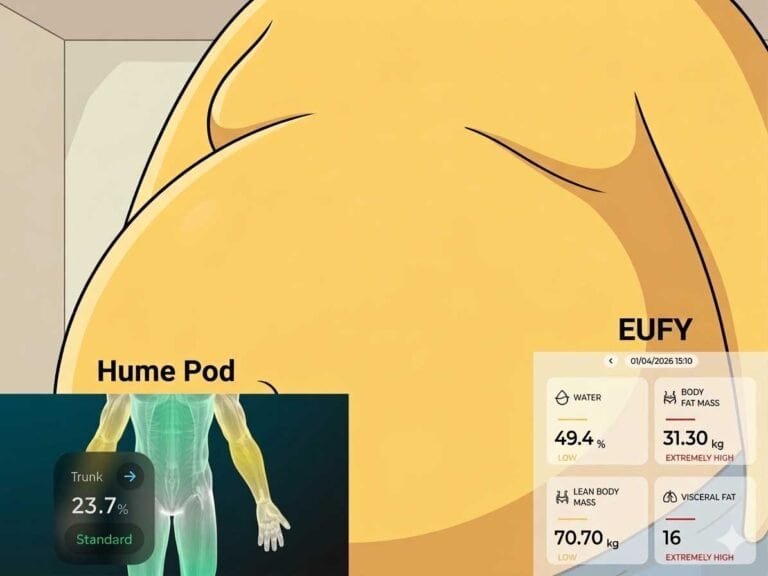
These numbers sit in uncomfortable tension with the Eufy’s assessment of the same body: body fat “EXTREMELY HIGH,” BMI “HIGH,” water “LOW,” BMR “LOW.” The Hume Pod’s segmental body scan rated trunk fat as “Standard” while the Eufy’s overall body fat reading screamed emergency. Both devices measured the same person on the same mornings.
The phrase “Hume Health users like you” reappeared at the bottom of the body scan on Day 21, confirming that the benchmarking methodology remains unchanged and unexplained despite the ongoing correspondence with Hume Support. The email thread — now several exchanges deep — has produced escalating responses but no technical clarity on what “users like you” actually means in statistical terms.
Key Events: What Week 3 Actually Taught
The sub-99 kg breakthrough on Day 16 was the week’s emotional high point. The Hume Pod reading 98.9 kg after the 48-hour fast had ended and normal eating had resumed confirmed that the fast had produced structural weight loss, not just a temporary dip. Body fat mass at 29.40 kg and water percentage crossing 50% for the first time reinforced the picture. That the weight subsequently climbed back above 100 kg does not erase the fact that the body reached that number under post-fast, fed conditions.
The conference on Day 19 was Week 3’s definitive stress test. Zero fasting. Uncontrolled eating. No exercise. No weigh-in. The immediate aftermath — weight rebounding to 100.60/101.9 kg, blood pressure diastolic returning to HIGH, HRV dropping to 69.0 ms — was predictable and predicted. What was less predictable was the speed of recovery: within 48 hours, weight was dropping, HRV had bounced back to 86.3 ms, and the scale gap had narrowed from 1.3 kg to 0.2 kg.
The sleepwalking episode on Night 20 is the kind of event that does not appear in clinical data sets but matters enormously in the lived experience of CPAP therapy. A nightmare at 3am, a mask torn off in a semi-conscious state, sleepwalking through the house — and yet the night still scored 100 out of 100. The CPAP had already delivered sufficient therapy hours before the interruption, and the mask went back on afterward. Compliance is now deep enough to survive unconscious disruption.
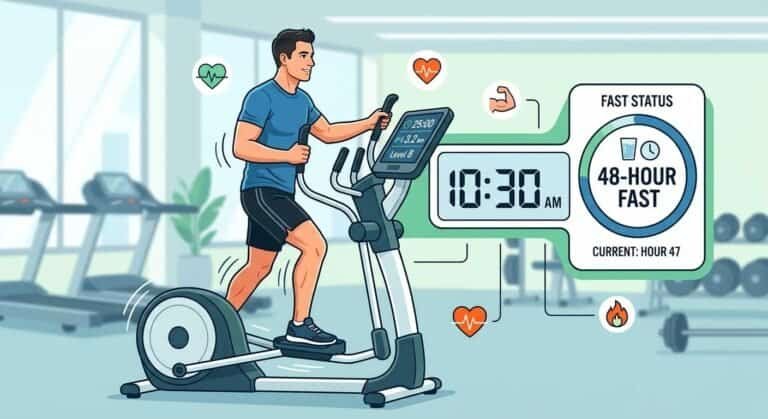
The cycling and walking consistency has been Week 3’s quietest success. A Cambridge walking tour on Day 16 (6.77 km), cycling on Day 17 (6.81 km plus a 2 km walk back with a punctured bike), a woodland photoshoot and cycling on Day 18 (6.96 km), a gym session on Day 20 (leg weights plus elliptical), and an early morning bike ride on Day 21 (7.89 km). Five out of six days included meaningful exercise. The four-week Strava streak earned on Day 21 predates the experiment itself.
Week 2 vs Week 3: The Honest Comparison
| Metric | Week 2 (Days 8–15) | Week 3 (Days 16–21) |
|---|---|---|
| Weight change | 99.4 → 99.35 kg (−0.05 kg) | 99.35 → 100.20 kg (+0.85 kg) |
| Weight low | 99.05 kg (Day 15 pm) | 98.9 kg (Day 16 — Hume Pod) |
| Weight high | 101.10 kg (Day 13) | 101.9 kg (Day 20 — Hume Pod) |
| CPAP best night | 8h 19m / 100/100 | 9h 17m / 100/100 |
| CPAP worst night | ~3.5h / mask abandoned | 5h 03m / 81/100 |
| Perfect CPAP scores | 1 | 3 (consecutive) |
| HRV high | 88.5 ms (Day 15) | 86.3 ms (Day 21) |
| HRV low | 76.0 ms (Day 14) | 62.7 ms (Day 18) |
| BP best | 105/78 (Day 15) | 112/77 (Day 18) |
| BP worst | 139/92 (Day 13) | 123/82 (Day 20) |
| Exercise days | 4 of 8 | 5 of 6 |
| Key disruption | Social weekend + wine | London conference |
Week 3 is the first week to close with a net weight gain. That is the uncomfortable headline. Everything else — CPAP compliance, HRV recovery speed, blood pressure range, exercise consistency, resting heart rate — improved or held steady. The weight gain is attributable to a single-day conference disruption whose effects were already clearing by Day 21. The underlying trajectory remains downward when measured across the full twenty-one days: 102.0 kg on Day 1 to 100.20 kg on Day 21, a net loss of 1.8 kg across three weeks of real life, with every social event, late night, and bottle of wine included.
Entering the Final Nine Days
The plan declared on Day 20 holds: zero alcohol, bed before 10pm every night, exercise daily, fasting maintained without exception. No photoshoots are booked. The schedule is clear. The protocols are set. The question for the final nine days is not whether the data will respond — three weeks of evidence confirm that it will — but how far it can move when every variable is controlled simultaneously for the first time in the experiment.
The CPAP is already there. The HRV has proven it can recover overnight. The blood pressure responds within 48 hours. The weight is the slowest-moving metric and the most psychologically challenging, but the structural composition — lean body mass holding, body fat percentage gradually declining, protein slowly improving — suggests the foundation is sound even when the daily number frustrates.
There is also the growing possibility that this experiment extends beyond thirty days. The patterns are becoming structurally interesting. The longer-term trends in HRV, body composition, and CPAP compliance deserve more runway than nine days can provide. Week 3 was the proof of resilience. The final stretch — and whatever follows it — will be the test of consistency.
Week 3 covers Days 16–21, April 16–21, 2026. All data verified against published daily articles at visualnetwork.co.uk. Weight figures cite Eufy as primary and Hume Pod as secondary unless otherwise stated. CPAP data from the CPAP app. Blood pressure from a home BP monitor. HRV, stress, SpO₂, and recovery from the Hume Band. Cycling from Strava.
— Week 3 of 4 (or more)