DAY 5 — “Under 101. The Mask Works. Hume Says I’m 50.”
April 5th, 2026 — Eufy: 100.9kg. Hume Pod: 101.0kg. CPAP: 6h 52m. Sleep quality: 100%.
There are mornings when the data surprises you. This is one of them.
The Eufy scales this morning read 100.9 kilograms. For the first time in this experiment — for the first time in longer than I care to admit — I am below 101 kg. The Hume Pod, which has consistently read higher than the Eufy throughout this series, shows 101.0 kg. The two scales have never agreed so closely. Both are pointing in the same direction. Down.
I will not pretend this is purely the result of clean living. Yesterday was Easter Saturday, the gym was closed, my hip needed rest, and I slept until nearly 11am to catch up on a week of disrupted nights. But the direction of travel is correct, and on Day 5 that is what matters.
The CPAP Story: 98 Out of 100, Then a Smoking Gun
Last night produced the best CPAP score of the series so far.
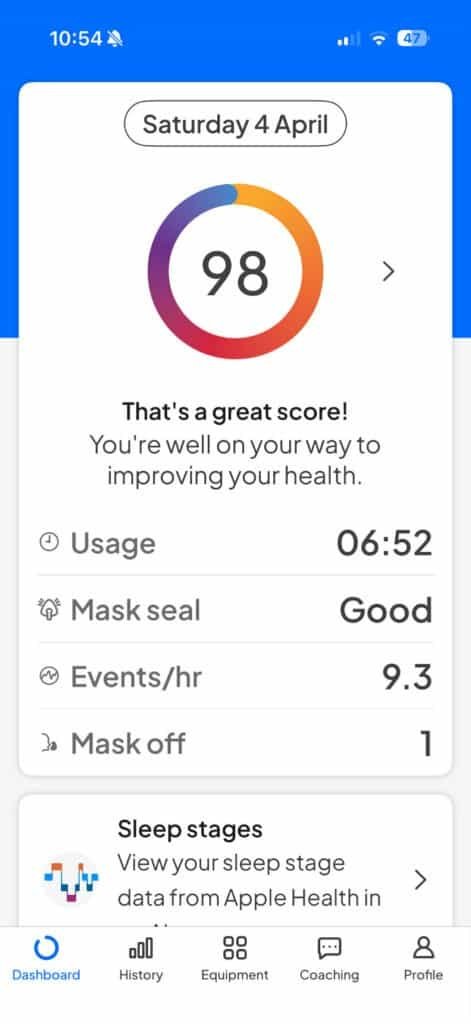
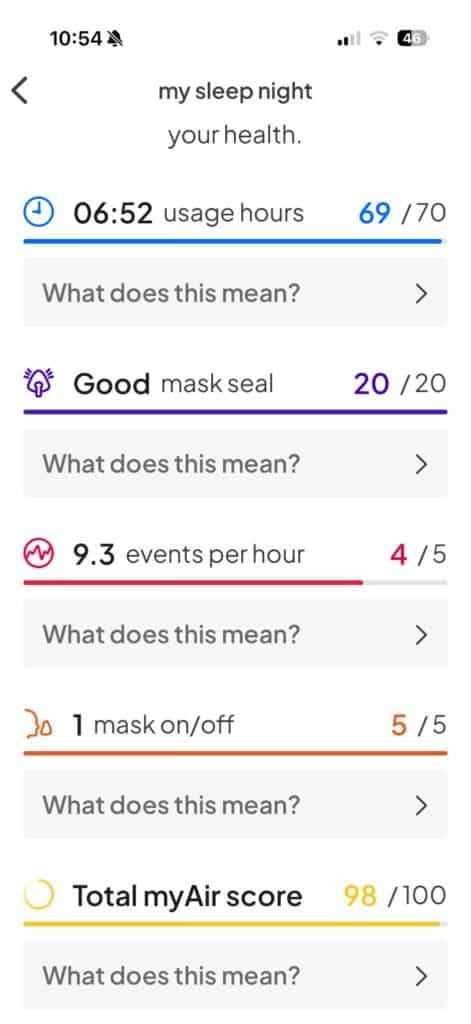
Saturday 4th April — myAir data:
- Usage: 6 hours 52 minutes
- Score: 98/100
- Mask seal: Good — 20/20
- Events per hour: 9.3 — 4/5
- Mask off: 1 — 5/5
Three nights of solid data now show a consistent pattern: when I wear the mask properly, for long enough, with a good seal, the score sits between 96 and 98 out of 100. The machine is not the problem. The compliance is the story.
But this morning provided the clearest possible demonstration of what happens when compliance ends.
I wore the CPAP without the positional vest last night — partly because my hip needed to rest in a more natural position, partly as an experiment in whether the vest is contributing meaningfully to the results. I kept the mask on until 7:30am, at which point my nose was itchy enough that I removed it and went back to sleep.
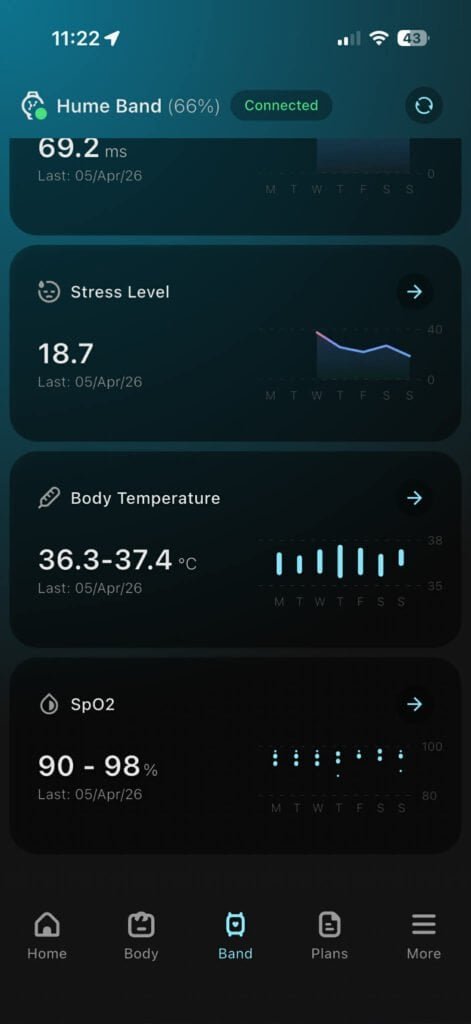
The Hume Band recorded what happened next. My SpO2, which had been stable throughout the night with the mask on, dropped to 90% after removal. Not as catastrophic as Night 1’s 88%, but a clear, immediate, measurable decline the moment the machine stopped doing its job.
This is now the clearest cause-and-effect relationship the data has produced:
| Night | CPAP On | SpO2 With Mask | SpO2 Without |
|---|---|---|---|
| Night 1 | 1h 04m | — | 88% |
| Night 3 | 6h 42m | 95–98% | — |
| Night 4 | 4h 29m | 95–99% (with vest) | — |
| Night 5 | 6h 52m | 95–98% | 90% after removal |
The CPAP is not a lifestyle accessory. It is the difference between 90% and 98% blood oxygen, demonstrable every single night.
Sleep: The Recovery Night My Body Needed
Without the gym, without the alarm, and with Easter Saturday giving me permission to simply rest, last night was the longest sleep of the series.
Hume Band: 10h 42m sleep session
Fitbit breakdown (00:50–10:51):
- Awake: 42 min
- REM: 2h 7m
- Light: 6h 7m
- Deep: 1h 3m
- Estimated oxygen variation: Low ✅
The Fitbit’s “estimated oxygen variation: Low” is its way of saying blood oxygen was stable throughout the night — which aligns precisely with the CPAP data showing good coverage until 7:30am.
The Hume Pod’s sleep overview gave last night a Sleep Quality score of 100% — Excellent, with a note that the score reflects “excellent sleep architecture, continuity, and biomarker alignment” that supports recovery and consolidation. After four days of exercise, a wedding, disrupted sleep, and a 4am bedtime, the body took what it needed when it was finally allowed to.
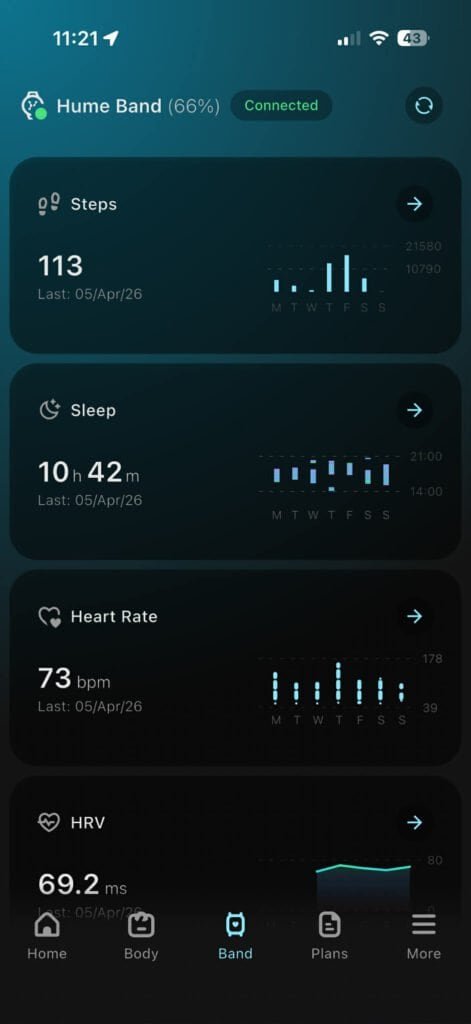
The Hume Band metrics confirm the recovery:
- Heart Rate: 73 bpm — lowest of the series
- HRV: 69.2 ms — highest of the series
- Stress Level: 18.7 — lowest of the series
- Body Temperature: 36.3–37.4°C — tighter, more stable range
The Weight: Two Scales, One Direction
Eufy smart scales: 100.9 kg ⬇️ First time below 101kg in this experiment Hume Pod: 101.0 kg ⬇️ Closest the two scales have been
A note worth making: the Hume Pod app actually queried this morning’s reading, flagging the drop in weight as outside its expected range. A device questioning its own user’s progress is a curious response — it may reflect the fact that bioelectrical impedance measurements can be sensitive to rapid shifts in hydration. I stepped on it twice to confirm. 101.0 kg both times.
In five days, the Eufy reading has moved from 102.0 kg to 100.9 kg. That is 1.1 kg lost. Some of it is water. Some is the early metabolic response to fasting, reduced alcohol, and daily movement. None of it is magic. All of it is real.
The Full Body Comparison: Eufy vs Hume Pod — Day 5
Today I have comprehensive data from both devices. Put them side by side and the divergence remains remarkable.
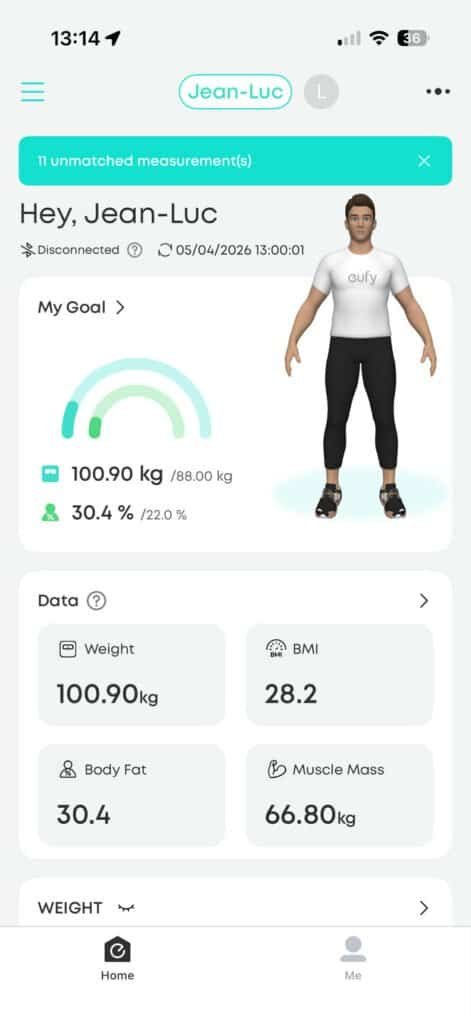
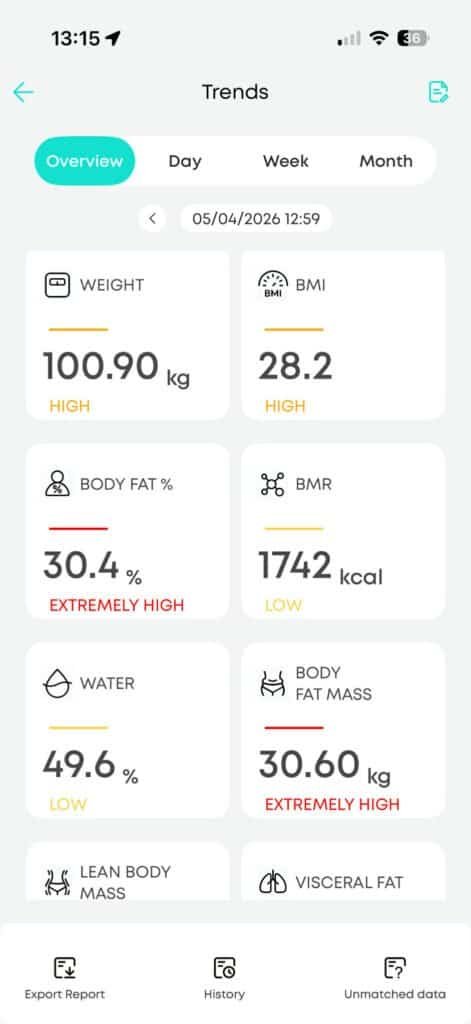
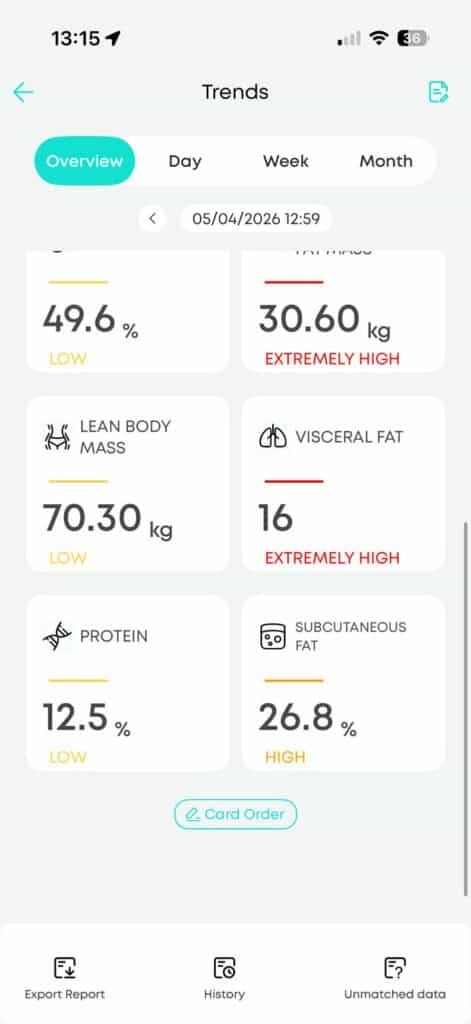
Eufy Trends — 05/04/2026:
| Metric | Eufy Reading | Eufy Rating |
|---|---|---|
| Weight | 100.90 kg | High |
| BMI | 28.2 | High |
| Body Fat % | 30.4% | Extremely High |
| Body Fat Mass | 30.60 kg | Extremely High |
| Visceral Fat | 16 | Extremely High |
| Lean Body Mass | 70.30 kg | Low |
| Water | 49.6% | Low |
| BMR | 1,742 kcal | Low |
| Protein | 12.5% | Low |
| Subcutaneous Fat | 26.8% | High |
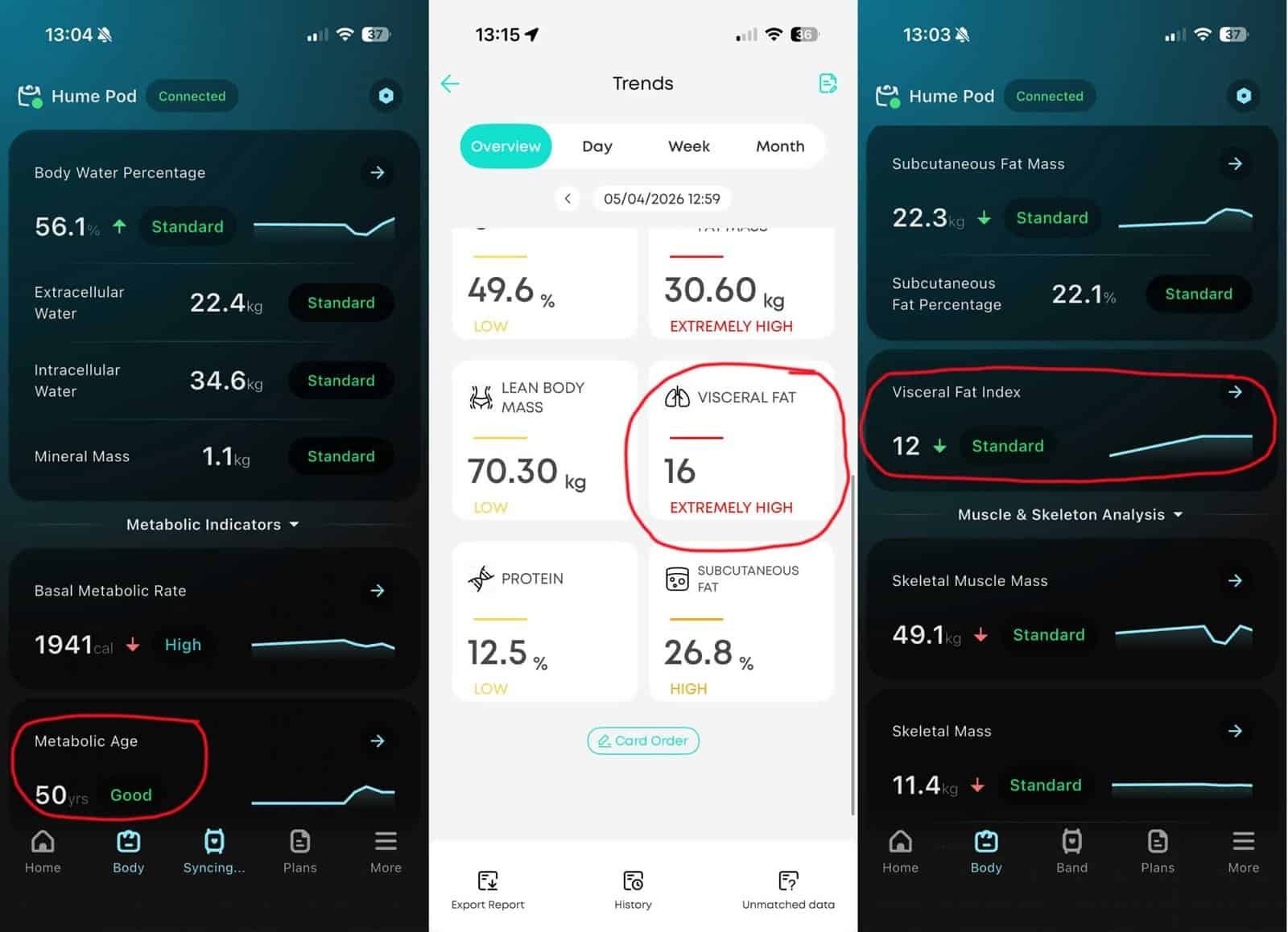
Hume Pod — 05/04/2026:
| Metric | Hume Reading | Hume Rating |
|---|---|---|
| Weight | 101.0 kg | High |
| BMI | 28.2 | High |
| Body Fat % | 25.4% | Standard |
| Body Fat Mass | 25.7 kg | High |
| Visceral Fat Index | 12 | Standard |
| Lean Mass | 71.4 kg | Standard |
| Body Water % | 56.1% | Standard |
| BMR | 1,941 kcal | High |
| Subcutaneous Fat | 22.1% | Standard |
| Metabolic Age | 50 years | Good |
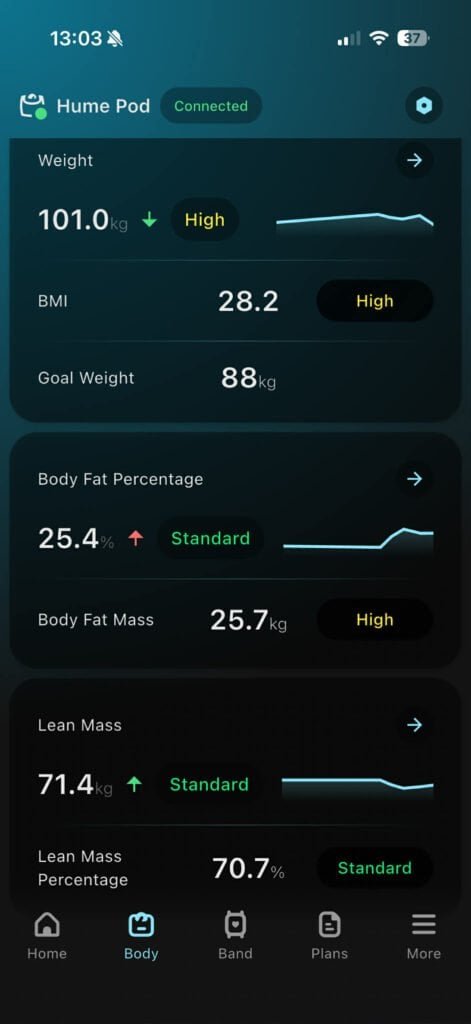
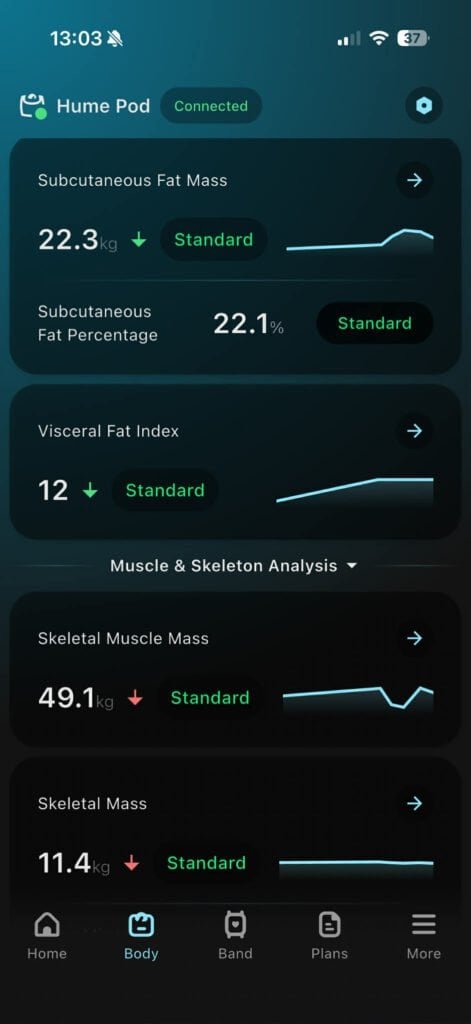
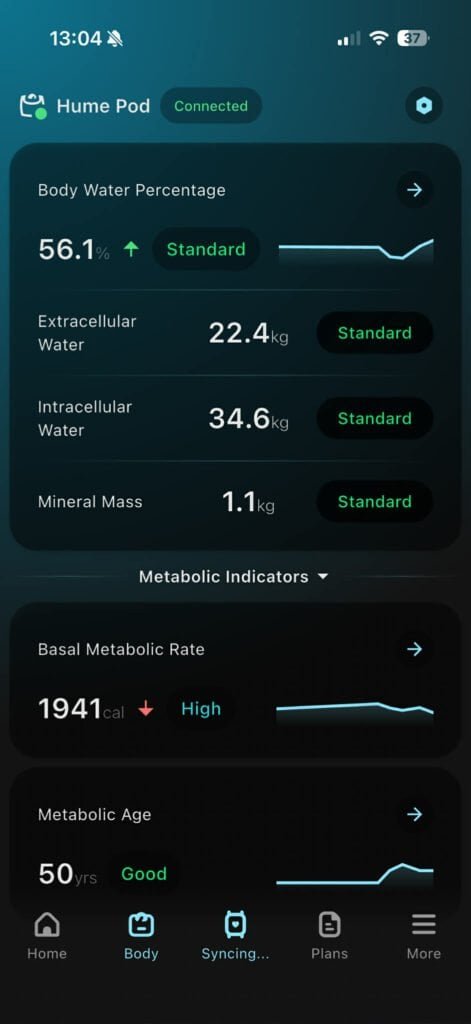
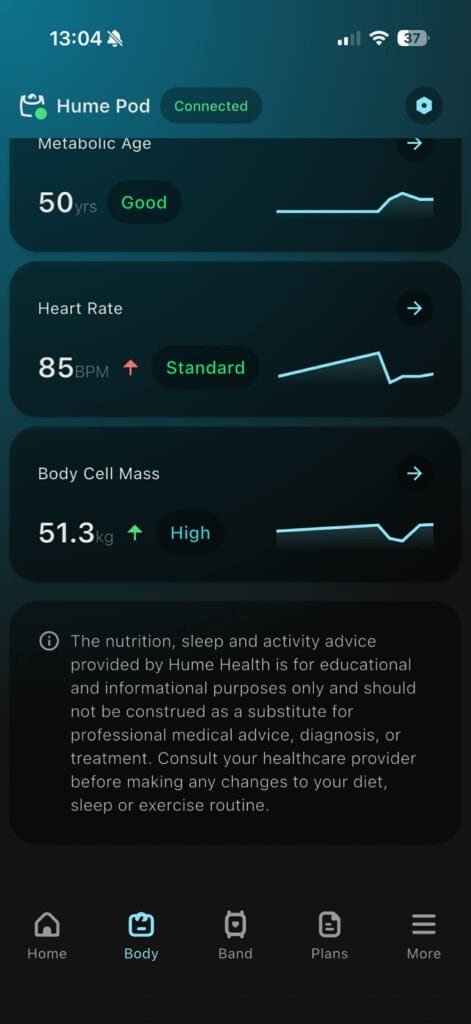
The contradictions are now impossible to ignore and worth stating plainly:
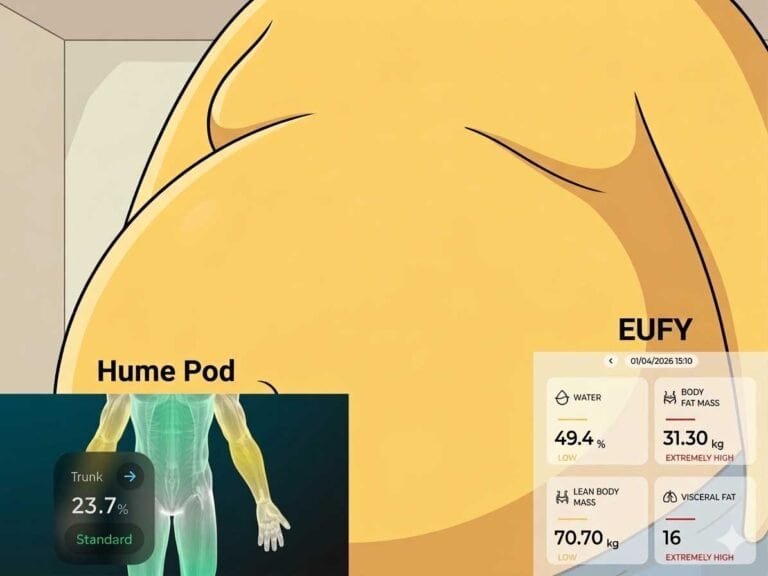
Body fat percentage: Eufy says 30.4% — Extremely High. Hume says 25.4% — Standard. A gap of five full percentage points on the same body on the same day.
Visceral fat: Eufy says 16 — Extremely High. Hume says 12 — Standard. A different number, a different scale, and a completely different clinical conclusion.
BMR: Eufy says 1,742 kcal — Low. Hume says 1,941 kcal — High. A difference of nearly 200 calories per day in opposite categories. If the Hume Pod is correct, I burn significantly more at rest than the Eufy suggests, which changes how I should think about my caloric deficit. If the Eufy is correct, I need to be considerably more careful. These cannot both be right.
Water percentage: Eufy says 49.6% — Low. Hume says 56.1% — Standard. Five days of drinking more water appears to be registering on the Hume Pod in a way the Eufy is not reflecting. Or one device is simply better calibrated for hydration measurement.
Hume’s technical team response — when it eventually arrives after the Easter weekend — will need to address not just the benchmark methodology but also why these absolute measurements diverge so significantly from a clinically validated scale.
The One Hume Pod Reading I Am Choosing to Believe Unconditionally
Metabolic Age: 50 years — Good.
I am 55. The Hume Pod believes my metabolism is performing like a 50-year-old’s. I have applied rigorous scepticism to virtually every other number this device has produced. This one I am accepting without question, in a way I am accepting almost nothing else.
Selective scepticism. At 55, it is a survival skill.
Hume Support: The Easter Weekend Holding Pattern
A third message from Nuwai confirms that the technical team will not be available until after the Easter weekend. The questions — which clinical database underpins the benchmarks? Is weight factored into the comparison cohort? Why does Hume’s visceral fat index read 12 when Eufy reads 16 for the same body? — remain unanswered on Day 5.
Five daily articles have now been published. Each one read by an audience waiting for the same answers I am. The phrase “we will circle back as soon as we hear back” carries a particular weight when addressed to someone with a live readership and a deadline every morning.
The technical response will be published in full, unedited, with commentary, the moment it arrives.
The Hip: Improving
Yesterday’s left hip pain — attributed to cumulative exercise load and possibly the positional vest — is significantly better this morning after a full rest day. Not gone entirely, but manageable. The gym reopens tomorrow and I intend to be there. The vest returns tonight alongside the CPAP. Both, together, as established. Last night’s experiment without the vest confirmed that the CPAP alone improves the SpO2 significantly — but the 90% drop after mask removal also confirms that the CPAP alone is not sufficient for the full night.
Day 5 Summary
| Metric | Eufy | Hume Pod | Direction |
|---|---|---|---|
| Weight | 100.9 kg | 101.0 kg | ⬇️ Below 101 |
| Body Fat % | 30.4% Extr. High | 25.4% Standard | Contradicting |
| Visceral Fat | 16 Extr. High | 12 Standard | Contradicting |
| BMR | 1,742 Low | 1,941 High | Contradicting |
| Water | 49.6% Low | 56.1% Standard | Contradicting |
| Metric | Value | Direction |
|---|---|---|
| CPAP usage | 6h 52m | ✅ |
| CPAP score | 98/100 | ✅ Best yet |
| SpO2 with mask | 95–98% | ✅ |
| SpO2 after removal | 90% | ⚠️ |
| Sleep session (Hume Band) | 10h 42m | ✅ Recovery night |
| Sleep quality (Hume Pod) | 100% Excellent | ✅ |
| HRV | 69.2 ms | ⬆️ Best of series |
| Stress | 18.7 | ⬇️ Lowest of series |
| Heart Rate | 73 bpm | ⬇️ Lowest of series |
| Metabolic Age (Hume Pod) | 50 years | 👍 |
| Alcohol | 0 | ✅ |
| Hip | Significantly better | ✅ |
Five days in. Below 101kg. The body is responding, the oxygen is stable, and two devices measuring the same body are living in parallel universes.
The technical team returns from Easter on Monday. So do I — to the gym, at 6am, with the CPAP score history now making a very clear argument for keeping the mask on.
— Day 5 of 30