DAY 30 — 30-Day Health Tracking Experiment: The Honest Reckoning
Day 30 of 30. The last daily post.
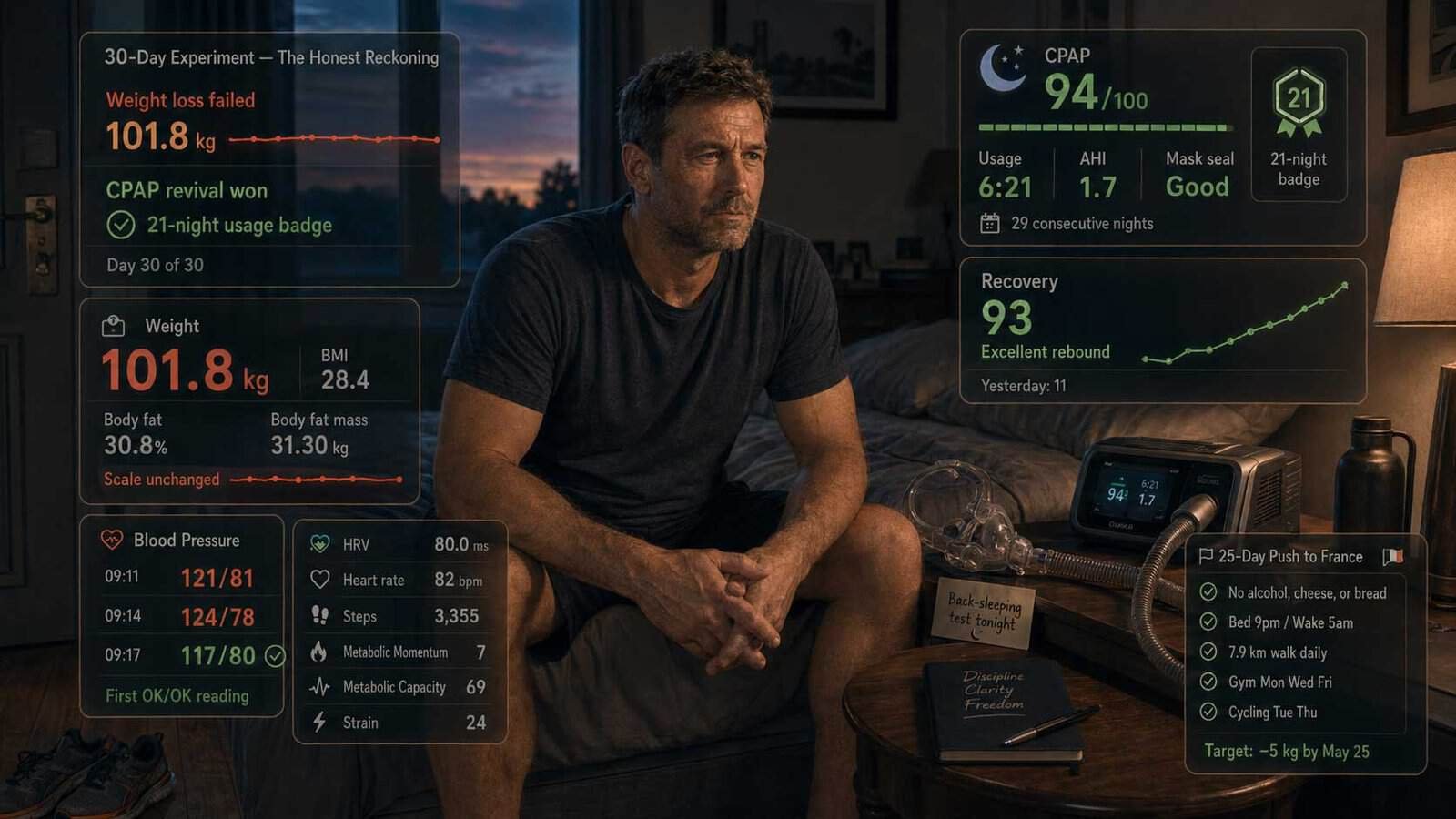
Let me say what’s true before anything else: weight loss has failed, and CPAP revival has won. Those are the two headlines of this 30-day health experiment, and pretending otherwise would betray the entire premise of the series. This 30 day health experiment has taught me valuable lessons about health and well-being.
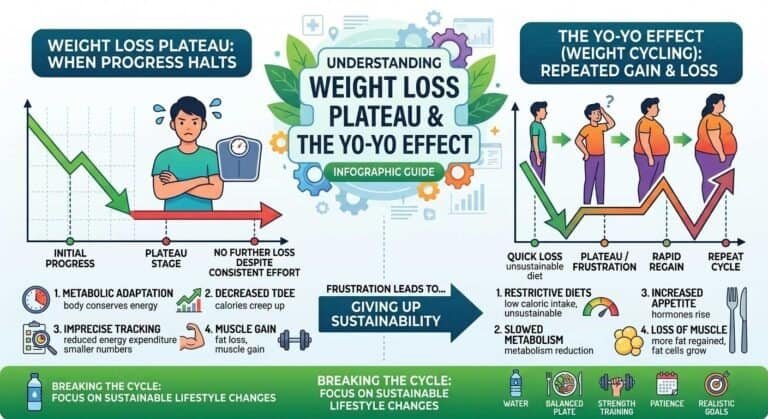
I started this on April 1st weighing roughly 102 kg. I’m finishing on April 30th weighing 101.80 kg. The scale has not moved. I can dress that up with body composition nuance and water percentage commentary, but I won’t. Across 30 days of measurement, the headline number has flatlined.
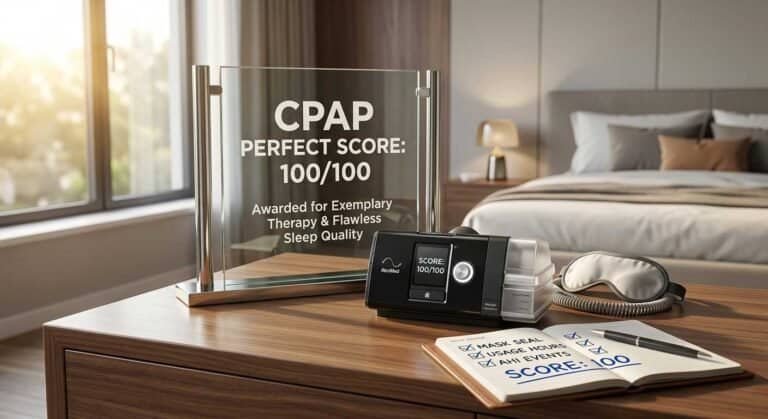
And yet. This morning, the myAir app awarded me the 21-night usage badge. The streak calendar shows every night of April lit up — 29 consecutive nights of CPAP use, with a personal best already locked in and tonight’s session about to make it 30. Last night’s myAir score: 94. Wednesday’s score, after the mask-off incident: 75. So even the bad night was, by the app’s standard, “a great score.” Nine months ago I couldn’t tolerate this machine for a full hour. Today I have a 21-night streak.
Both things are true. The scales didn’t move. The breathing did.
Today’s numbers — the finale data drop
Weight & body composition (Eufy, 13:52)
- Weight: 101.80 kg — HIGH (identical to yesterday)
- BMI: 28.4 — HIGH
- Body fat: 30.8% — EXTREMELY HIGH (up 0.2 from yesterday)
- Body fat mass: 31.30 kg — EXTREMELY HIGH (up 0.2 kg)
- Water: 49.3% — LOW
- BMR: 1,756 kcal — LOW
Hume Pod
- Metabolic Momentum: 7 (up arrow, green — yesterday 5, down)
- Metabolic Capacity: 69 (now reading from baseline rather than estimated)
- Strain: 24
- Recovery: 93
For context, yesterday’s Recovery score was 11. Today it’s 93. That single number is the cleanest before-and-after of the entire experiment — what the body looks like after a fragmented night with three mask-off events, versus what it looks like after a near-perfect CPAP night.
Sleep
- Hume Band (total session): 8h 38m
- CPAP usage (myAir, Wednesday 29 April): 6h 21m, score 94, 1.7 events/hr, 2 mask-off events, mask seal Good
Vitals (Hume Band)
- HRV: 80.0 ms (yesterday 69.0 — meaningful jump)
- Heart rate: 82 bpm
Steps: 3,355 (Hume Band)
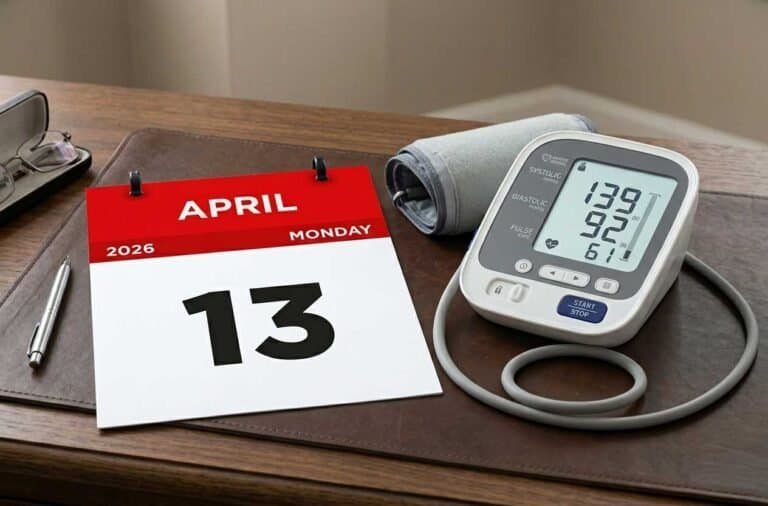
Blood pressure (best of three this morning)
- 09:11 — 121/81, HR 70 — both HIGH
- 09:14 — 124/78, HR 73 — systolic HIGH, diastolic OK
- 09:17 — 117/80, HR 71 — both OK
That third reading is the first OK/OK blood pressure reading I have logged in this entire 30-day series. After 29 days of HIGH systolic numbers in every panel, the third reading on Day 30 came in clean. One reading is one reading — but it’s not nothing.
The back-sleeping discovery
Last night, after Wednesday’s mask-falling-off incident, something clicked. I noticed that when I sleep on my back, I wake up in exactly the same position I went to sleep in — and the mask stays put. The displacement happens when I roll. So the answer to the mask problem may not be tighter straps or a different size. It may be position.
There’s a small irony here. The positional sleep therapy vest I’ve been wearing was designed to prevent back-sleeping, because for an untreated apnea sufferer, back-sleeping is the worst position. But for a CPAP user with reliable therapy, back-sleeping is arguably the best position for mask stability. The vest may have been solving the right problem nine months ago and the wrong problem now. Something to think about.
I’m testing the back-sleeping hypothesis tonight, mask on, vest off.
On the Hume reply
Hume Support replied yesterday with the substantive answer I’d been chasing for 30 days — what “users like you” actually means, what’s underneath the benchmarks, why the Eufy and Hume readings disagree on the same body. I’m holding the full breakdown for the 30-day review publishing next week. That’s where this evidence belongs, alongside the device-by-device verdict and the resolved contradictions. It’s verdict-shaping, and the review is the right room for it.
Why this isn’t a failure
Across 30 days the body did not lose weight. But:
- Nine months of CPAP non-compliance ended.
- Overnight blood oxygen stabilised in the 97–98% range.
- HRV climbed substantially.
- Recovery scores show what proper sleep does to a body in real numbers.
- I now know my four devices well enough to write 30 articles about their disagreements.
- I have a 21-night badge and tonight will make it 22.
What this experiment was actually for — public accountability, device comparison, building the editorial spine of a blog series — has worked. The weight piece didn’t. So the weight piece moves to the next chapter.
What happens next: the 25-day push to France
I’m flying to France to see family on May 25th. That gives me 25 days from tonight. The new commitment, written down so the internet can hold me to it:
- No alcohol, cheese, or bread until May 25.
- In bed by 9pm, awake by 5am, every day.
- A 7.9 km walk from 5am around the village, every day.
- Gym on Monday, Wednesday, Friday. Cycling on Tuesday and Thursday. Rest on weekends.
Target: at least 5 kg lost by May 25. Possibly more.
This is an aggressive plan. 5 kg in 25 days is roughly 1.4 kg per week — at the upper end of safe and sustainable, but achievable with the structure above and the recovery foundation that 21 nights of CPAP has laid down. Three things make me think it’s the right plan now and not three weeks ago: the sleep is working, the morning energy is back, and the CPAP routine means I can actually train without wrecking myself.
It starts tonight. 9pm bed. Mask on. Back-sleeping. 5am alarm. Walking shoes by the door.
And the series
Thirty days. Thirty articles. One Week 1 Review. A full inbox of correspondence with Hume Support. Four devices that now have me as one of their loudest critics and one of their more careful documenters. Thank you for reading this far.
Reflections on the 30 Day Health Experiment
The 30-day review is next.