DAY 28 — The Blood Test That Proved the CPAP Works
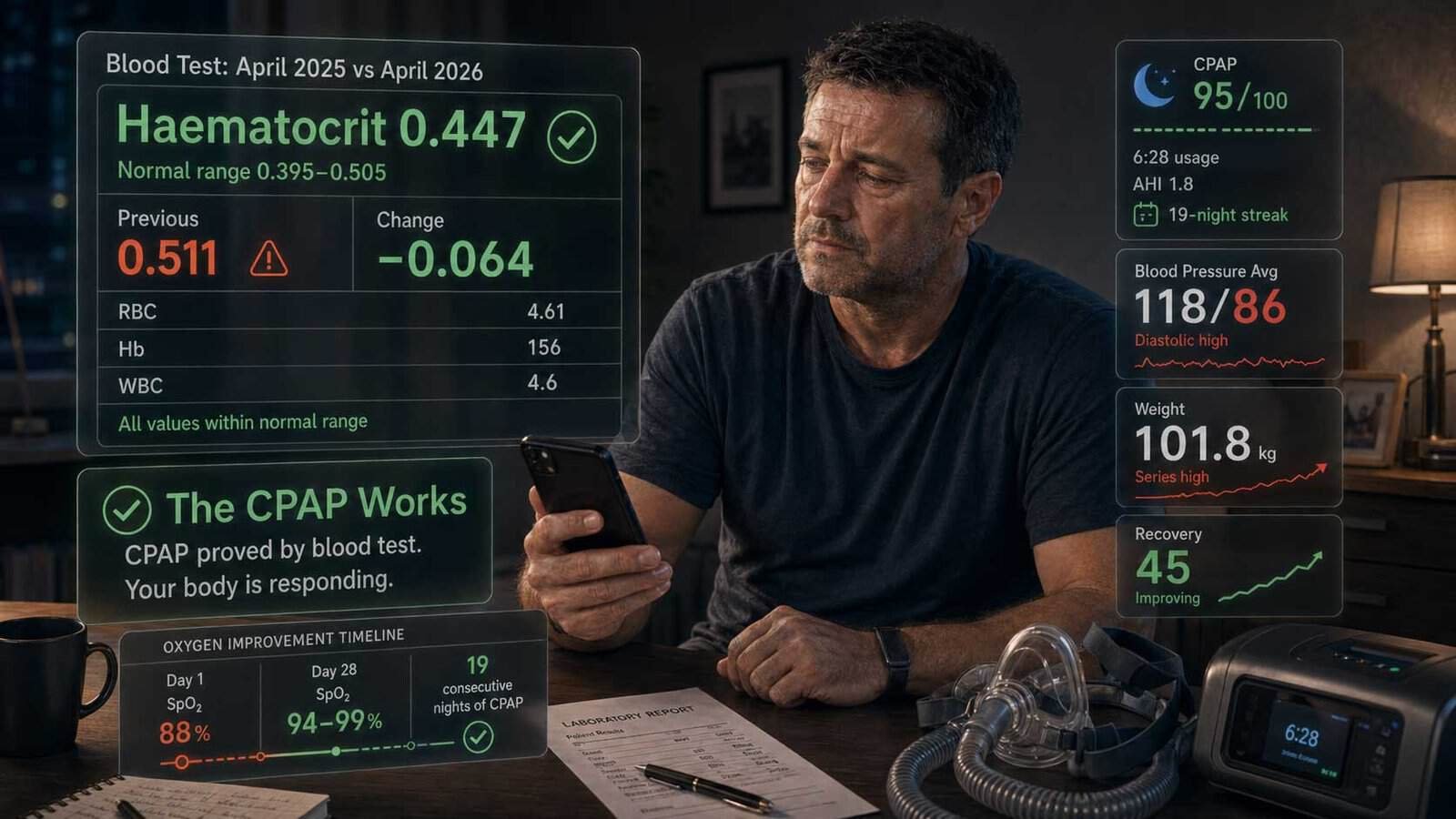
The cpap blood test hematocrit results came back this evening, and they contain the most clinically significant number of the entire twenty-eight-day experiment. Hematocrit: 0.447. Normal range: 0.395–0.505. Comfortably mid-range, unremarkable, a green indicator on the lab dashboard.
Twelve months ago, the same test returned 0.511 — above the upper limit of normal, flagged as elevated, a blood value consistent with a body that had been chronically starved of oxygen during sleep and was manufacturing extra red blood cells to compensate. Today, after nineteen consecutive nights of CPAP therapy and a month of documented compliance, the hematocrit has dropped by 0.064 — from above normal to the middle of the range. The body has stopped overproducing red blood cells because it no longer needs to. The CPAP is delivering the oxygen. The blood knows.
This is not a number that a wearable can measure. This is not a score on a dashboard or a percentage on a smart scale. This is a laboratory result from a tube of blood drawn at a GP surgery, processed by a clinical pathology lab, and returned with the quiet authority of chemistry that does not care about consumer technology reviews or device comparisons. The hematocrit dropped. The therapy works. Everything else in today’s data — the highest weight of the series, the elevated blood pressure, the body fat at its peak — exists in the shadow of that single finding.
The Blood Test: April 2025 vs April 2026
| Metric | April 2025 | April 2026 | Change | Normal Range |
|---|---|---|---|---|
| Haematocrit (Hct) | 0.511 ⚠️ | 0.447 ✅ | −0.064 | 0.395–0.505 |
| Red blood cell (RBC) | 5.25 | 4.61 | −0.64 | 4.30–5.75 |
| Haemoglobin (Hb) | 165 | 156 | −9 | 135–172 |
| White blood cell (WBC) | 4.9 | 4.6 | −0.3 | 3.9–10.2 |
| Mean cell volume (MCV) | 97.3 | 96.9 | −0.4 | 80.0–99.0 |
| Mean cell haemoglobin (MCH) | 31.4 | 33.9 | +2.5 | 27.0–33.5 |
| Red cell distribution (RDW) | 14.2 | 12.8 | −1.4 | 11.0–16.0 |
| Platelet count (PLT) | 225 | 226 | +1 | 150–370 |
| Mean platelet volume (MPV) | 7.6 | 8.2 | +0.6 | — |
| Neutrophil count | 2.95 | 2.18 | −0.77 | 1.50–7.70 |
| Lymphocyte count | 1.5 | 1.79 | +0.29 | 1.10–4.50 |
| Monocyte count | 0.24 | 0.26 | +0.02 | 0.10–0.90 |
| Eosinophil count | 0.11 | 0.22 | +0.11 | 0.00–0.50 |
| Basophil count | 0.02 | 0.04 | +0.02 | 0.00–0.20 |
Every value sits within normal range. Every single one. No flags, no warnings, no amber indicators. A clean bill of blood chemistry.
What Hematocrit Actually Means
Hematocrit measures the proportion of blood that consists of red blood cells. When the body experiences chronic low oxygen — as happens nightly with untreated obstructive sleep apnea — it responds by producing more red blood cells to increase the blood’s oxygen-carrying capacity. This is the same mechanism that operates at high altitude: the body adapts to lower oxygen by making thicker blood.
The problem is that thicker blood increases cardiovascular risk. Elevated hematocrit is associated with higher blood viscosity, increased risk of clotting, and greater strain on the heart. An untreated sleep apnea patient with a hematocrit of 0.511 — just above the upper normal limit — is carrying blood that is measurably thicker than it should be, with corresponding implications for blood pressure and cardiovascular health.
The drop to 0.447 after nineteen nights of CPAP therapy means the body has received enough consistent overnight oxygenation to reverse the compensatory mechanism. The red blood cell count has dropped from 5.25 to 4.61 — fewer cells being produced because fewer are needed. The haemoglobin has dropped from 165 to 156 — less oxygen-carrying protein because the existing supply is being adequately oxygenated. The RDW — red cell distribution width, a measure of how varied the red blood cell sizes are — has narrowed from 14.2 to 12.8, suggesting more uniform cell production now that the body is not in chronic compensation mode.
The MCH (mean cell haemoglobin) has actually increased from 31.4 to 33.9, sitting just at the upper edge of the normal range. This makes physiological sense: fewer red blood cells, but each one carrying slightly more haemoglobin — a more efficient oxygen transport system rather than the brute-force approach of simply making more cells.
The CPAP Story, Told by Blood
This experiment has documented the CPAP journey through consumer wearable data: SpO₂ readings, AHI figures, usage hours, compliance streaks, and sleep scores. All of those metrics have told a consistent story of improvement. But they are device readings — consumer technology outputs filtered through proprietary algorithms and displayed on dashboards designed to be encouraging.
The blood test is different. It is a laboratory measurement of physical reality. The hematocrit does not have a scoring algorithm. The red blood cell count does not benchmark against “users like you.” The haemoglobin level is not rated on a scale of 1 to 100 with a congratulations message. These are objective clinical values measured from a sample of blood, and they confirm what the wearable data suggested: the CPAP therapy is producing real, measurable, physiological change.
The arc from Day 1 to Day 28, told through the blood:
Day 1: SpO₂ dropped to 88%. CPAP usage: 1 hour 4 minutes. The body had been operating like this — or worse — for nine months of non-compliance, manufacturing extra red blood cells to cope with nightly oxygen deprivation.
Day 28: Nineteen consecutive nights of CPAP therapy. SpO₂ consistently 94–99%. AHI consistently below 2. The hematocrit has dropped from above normal to mid-range. The red blood cell count has dropped by 12%. The body has stopped compensating because the problem has been treated.
That is not a dashboard score. That is medicine.
Day 28 Data Summary
| Metric | Value | Source |
|---|---|---|
| Weight | 101.80 kg (HIGH) — series high | Eufy |
| Weight | 101.7 kg ↑ | Hume Pod |
| BMI | 28.4 (HIGH) | Eufy |
| Body fat % | 30.9% (EXTREMELY HIGH) | Eufy |
| Body fat mass | 31.40 kg (EXTREMELY HIGH) — series high | Eufy |
| Lean body mass | 70.40 kg (LOW) | Eufy |
| Visceral fat | 16 (EXTREMELY HIGH) | Eufy |
| Water % | 49.2% (LOW) | Eufy |
| BMR | 1,756 kcal (LOW) | Eufy |
| Protein | 12.5% (LOW) | Eufy |
| Subcutaneous fat | 27.3% (HIGH) | Eufy |
| CPAP score | 95/100 | CPAP App |
| CPAP usage | 06:28 | CPAP App |
| AHI | 1.8 events/hr | CPAP App |
| Mask seal | Good | CPAP App |
| Mask-off events | 2 | CPAP App |
| Fitbit sleep | 5h 59m / Score 84 (Good) | Fitbit |
| Sleep timeline | 01:22–07:48 | Fitbit |
| Metabolic Momentum | 8 (stable) | Hume Band |
| Metabolic Capacity | 68 / Baseline 67 | Hume Band |
| Strain | 43 | Hume Band |
| Recovery | 45 | Hume Band |
| Blood pressure (avg) | 118/86 / Pulse 64 | BP Monitor |
| Steps (as at 17:06) | 2,509 | Fitbit |
| Calories | 1,798 | Fitbit |
Weight: 101.80 kg — The Highest of the Experiment
On any other day, this would be the headline. The Eufy reads 101.80 kg — the highest reading since Day 1’s 102.0 kg. The Hume Pod reads 101.7 kg. Body fat mass at 31.40 kg is also a series high. Visceral fat holds at 16 for the third consecutive day.
The four-day trajectory from the post-ride low:
| Day | Eufy | Hume Pod |
|---|---|---|
| Day 24 (post-ride) | 99.50 kg | 99.4 kg |
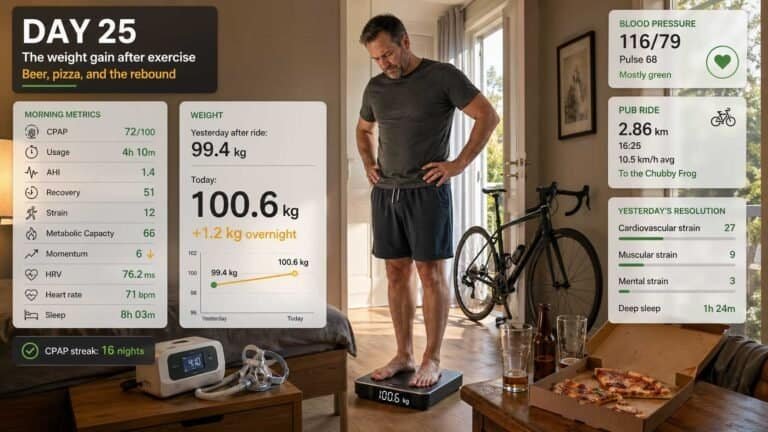
| Day 25 | — | 100.6 kg |
| Day 26 | 101.30 kg | 101.2 kg |
| Day 27 | 101.40 kg | — |
| Day 28 | 101.80 kg | 101.7 kg |
A gain of 2.30 kg in four days. The weekend’s rose wine, camembert, beer, pizza, and accumulated sodium are still fully in the system. Water percentage at 49.2% — the lowest of the experiment — confirms the body is retaining water in the tissues rather than the cellular compartments.
On a day when the blood test shows the body is healthier than it was a year ago at a cellular level, the bathroom scales show it is heavier than it has been in twenty-eight days. The tension between what the blood says and what the weight says is the most concise summary of this entire experiment: the things that matter most are invisible to the devices that shout loudest.
Blood Pressure: Diastolic Still Elevated
Three readings between 09:31 and 09:35: 124/88 (HIGH/HIGH), 117/84 (OK/HIGH), 114/86 (OK/HIGH). Average: 118/86, pulse 64.
Fourth consecutive day with the diastolic above 80 on every reading. The double-day weekend disruption is taking longer to resolve than any previous single-day event. The blood test results add context: the hematocrit at 0.447 is healthy, meaning the elevated blood pressure is dietary and behavioural rather than structural. The blood viscosity is not the issue. The sodium and recovery timeline is.
CPAP: 95/100 and Night Nineteen
The CPAP scored 95 out of 100 with 6 hours 28 minutes of usage and an AHI of 1.8. Mask seal: Good. Two mask-off events. Nineteen consecutive compliant nights.
In the context of today’s blood results, the CPAP data takes on a different weight. Each of those nineteen nights contributed to the hematocrit reduction. Each sub-2 AHI figure meant fewer oxygen desaturation events. Each hour of mask-on therapy was an hour of normal breathing that the body had been denied for nine months of non-compliance. The 95/100 score is a dashboard number. The 0.447 hematocrit is what the 95/100 actually produced.
Recovery: 45 — Rebuilding
Recovery has climbed from Day 27’s series-low 36 to 45. Still low, still reflecting the accumulated cost of the weekend and the Monday gym session, but moving in the right direction. Strain at 43. Metabolic Capacity at 68, essentially at Baseline. Metabolic Momentum steady at 8.
Where Day 28 Sits
Two days remain. The weight is at its highest. The body fat is at its highest. The diastolic is stubbornly elevated. And the blood test says the body is healthier than it was twelve months ago by every measurable haematological standard.
This experiment set out to compare consumer health tracking devices and build CPAP compliance over thirty days. It achieved both. But the blood test results add a dimension that no wearable could have provided: clinical confirmation that the CPAP therapy has produced real physiological change at the cellular level. The hematocrit dropped. The red blood cell count dropped. The haemoglobin dropped. The body has stopped manufacturing emergency oxygen transport because the emergency is over.
The scales will do what they do. The blood pressure will resolve when the sodium clears. But the blood results are permanent evidence that twenty-eight days of documented CPAP compliance changed something that matters more than a number on a bathroom floor.
Data captured Tuesday 28 April 2026. Eufy reading 28/04/2026 at 09:25. Hume Pod updated 09:57. Hume Band data as at 09:57. CPAP covers the night of 27–28 April 2026. Fitbit sleep and activity data as at 17:06. Blood pressure taken 09:31–09:35. Full blood count collected 08:46 at GP surgery; results returned same day. Previous blood test: April 2025. CPAP streak: 19 consecutive nights.
@— Day 28 of 30