DAY 26 — The Night I Never Took the Mask Off
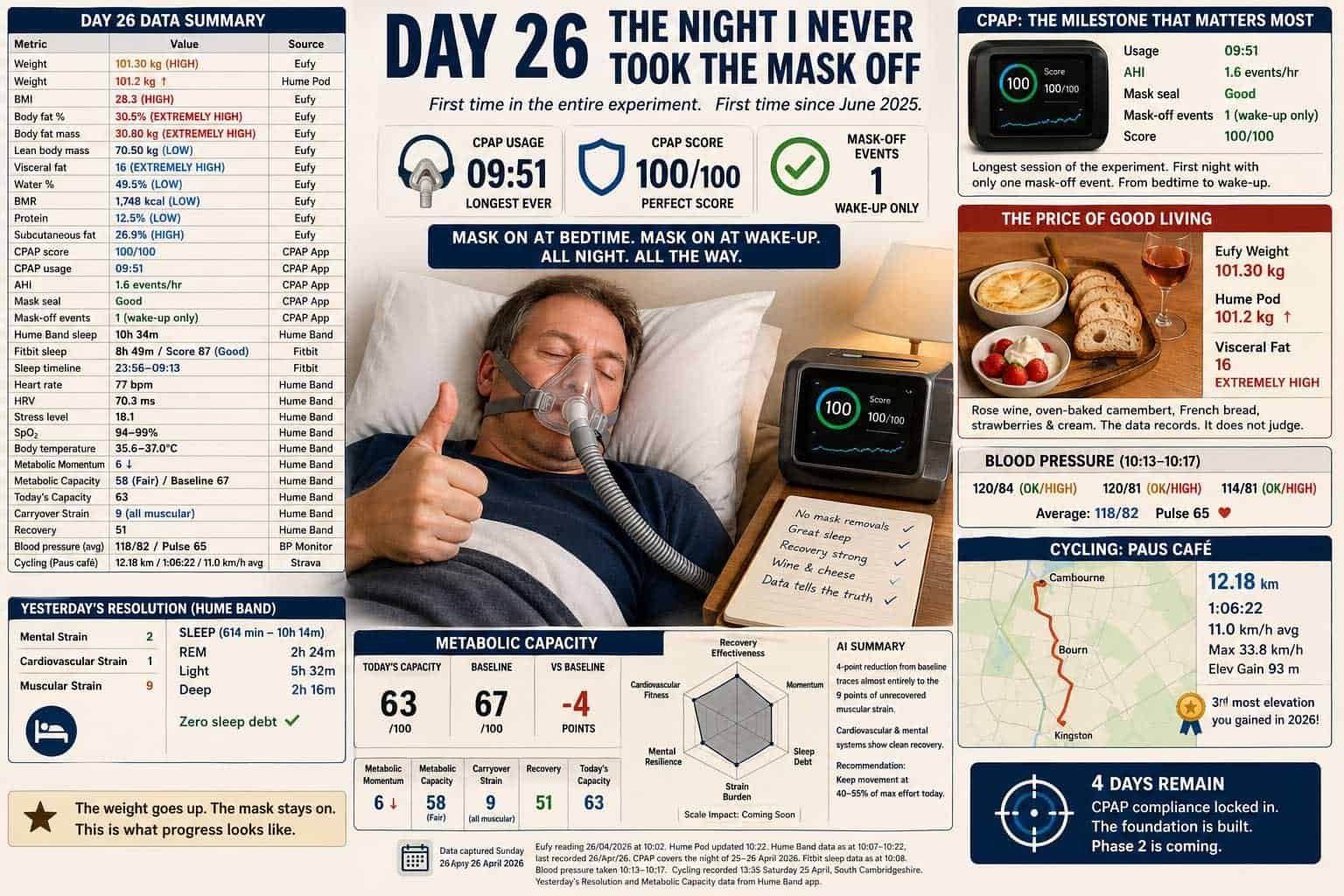
There is a number on today’s CPAP dashboard that is worth more than anything the scales have to say. Nine hours and fifty-one minutes. Score: 100 out of 100. Mask-off events: one. That single removal was the morning wake-up. For the first time in the entire experiment — and for the first time since the CPAP machine was purchased in June 2025 — I wore the cpap mask all night, from the moment I fell asleep until the moment I woke up, without removing it once.
Last night, by contrast, was the lowest CPAP score in two weeks: 72 out of 100, with four hours and ten minutes of usage and multiple mask removals. The night before the breakthrough was the setback. The worst followed by the best. This experiment has always been about contrasts, and this is the sharpest one yet.
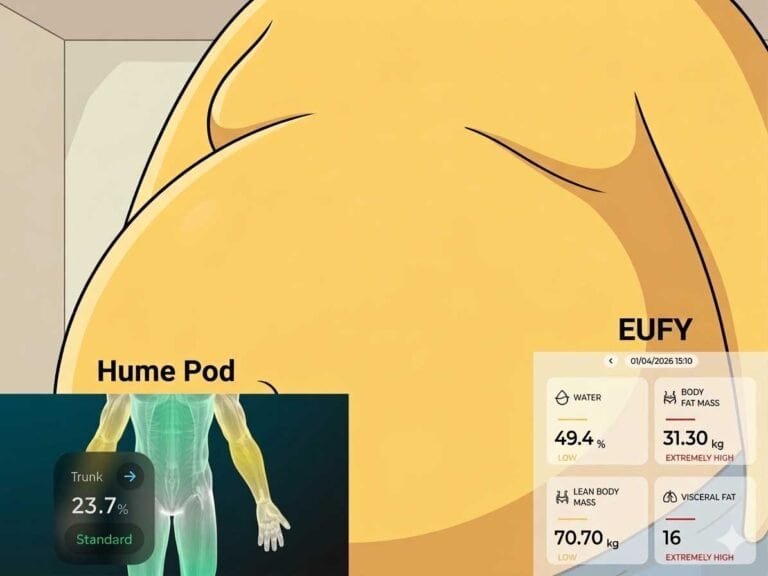
The weight, meanwhile, has its own contrasts. Eufy: 101.30 kg. Hume Pod: 101.2 kg. Visceral fat: 16 — back to “Extremely High” for the first time since the end of Week 1. An evening of rose wine, oven-baked camembert, French bread, and strawberries and cream will do that. The data does not judge. It records.
Day 26 Data Summary
| Metric | Value | Source |
|---|---|---|
| Weight | 101.30 kg (HIGH) | Eufy |
| Weight | 101.2 kg ↑ | Hume Pod |
| BMI | 28.3 (HIGH) | Eufy |
| Body fat % | 30.5% (EXTREMELY HIGH) | Eufy |
| Body fat mass | 30.80 kg (EXTREMELY HIGH) | Eufy |
| Lean body mass | 70.50 kg (LOW) | Eufy |
| Visceral fat | 16 (EXTREMELY HIGH) | Eufy |
| Water % | 49.5% (LOW) | Eufy |
| BMR | 1,748 kcal (LOW) | Eufy |
| Protein | 12.5% (LOW) | Eufy |
| Subcutaneous fat | 26.9% (HIGH) | Eufy |
| CPAP score | 100/100 | CPAP App |
| CPAP usage | 09:51 | CPAP App |
| AHI | 1.6 events/hr | CPAP App |
| Mask seal | Good | CPAP App |
| Mask-off events | 1 (wake-up only) | CPAP App |
| Hume Band sleep | 10h 34m | Hume Band |
| Fitbit sleep | 8h 49m / Score 87 (Good) | Fitbit |
| Sleep timeline | 23:56–09:13 | Fitbit |
| Heart rate | 77 bpm | Hume Band |
| HRV | 70.3 ms | Hume Band |
| Stress level | 18.1 | Hume Band |
| SpO₂ | 94–99% | Hume Band |
| Body temperature | 35.6–37.0°C | Hume Band |
| Metabolic Momentum | 6 ↓ | Hume Band |
| Metabolic Capacity | 58 (Fair) / Baseline 67 | Hume Band |
| Today’s Capacity | 63 | Hume Band |
| Carryover Strain | 9 (all muscular) | Hume Band |
| Recovery | 51 | Hume Band |
| Blood pressure (avg) | 118/82 / Pulse 65 | BP Monitor |
| Cycling (Paus café) | 12.18 km / 1:06:22 / 11.0 km/h avg | Strava |
Yesterday’s Resolution (Hume Band)
| Metric | Value |
|---|---|
| Mental Strain | 2 |
| Cardiovascular Strain | 1 |
| Muscular Strain | 9 |
| Sleep duration | 614 min (10h 14m) — zero sleep debt |
| REM | 2h 24m |
| Light | 5h 32m |
| Deep | 2h 16m |
CPAP: The Milestone That Matters Most
Nine hours and fifty-one minutes. One mask-off event — the morning removal. AHI: 1.6. Mask seal: Good. Score: 100 out of 100.
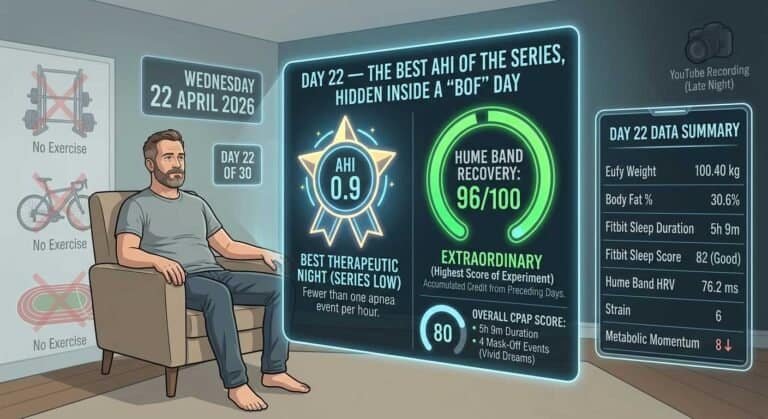
This is the longest continuous CPAP session of the experiment, surpassing the 9 hours 17 minutes of Day 21 by 34 minutes. But the duration is not the headline. The headline is the mask-off count: one. A single removal. In twenty-five previous nights, the minimum mask-off count has been two — one mid-night removal and one morning removal at a minimum, with nights involving three, four, or more mask-off events being common. Last night, for the first time, the mask went on at bedtime and stayed on until morning.
The sleep data confirms the picture. The Fitbit records a sleep window from 23:56 to 09:13 — just four minutes before midnight to just after nine — with a score of 87 and 8 hours 49 minutes of actual sleep. The Hume Band records 10 hours 34 minutes of total session time. The CPAP’s 9 hours 51 minutes of mask-on therapy sits between the two, as always, representing the actual treatment time with mask contact.
The sleep architecture from the Fitbit is strong: REM at 2 hours 32 minutes, light sleep at 5 hours 6 minutes, deep sleep at 1 hour 10 minutes, and only 27 minutes of awake time across nearly nine hours. The low awake time — the lowest of the past week — is consistent with a night where the mask was never consciously removed. No waking to fumble for the mask. No re-seating the headgear. No interruption to the sleep cycle beyond the body’s natural brief arousals.
And the Yesterday’s Resolution data from the Hume Band shows what the preceding night’s recovery produced: 2 hours 16 minutes of deep sleep across 10 hours 14 minutes of total sleep, with zero sleep debt accumulated. The Hume Band’s assessment: the body actively sought deeper recovery, and it found it.
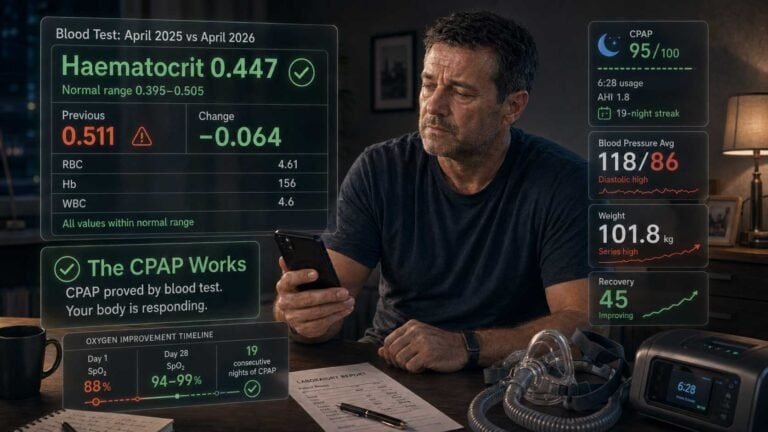
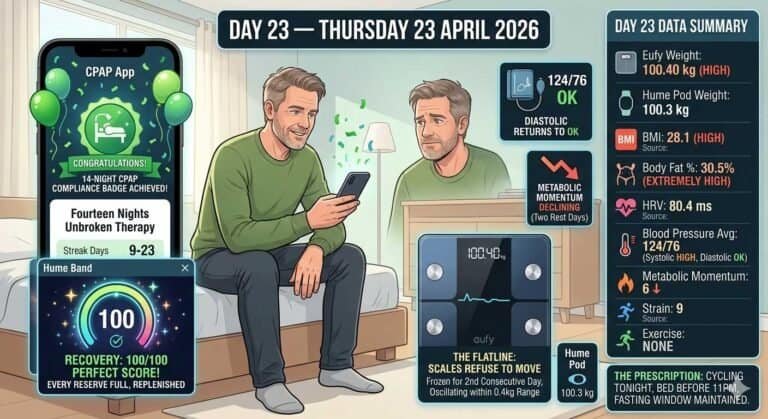
The CPAP arc across twenty-six days is now the most compelling single dataset of the experiment. From 1 hour 4 minutes and a score of 41 on Day 1 to 9 hours 51 minutes and a score of 100 on Day 26, with a mask-off count that has dropped from double digits to one. This is not incremental improvement. This is a person who could not tolerate a CPAP mask for more than an hour becoming a person who sleeps through the night without ever reaching for their face. The machine is no longer an intrusion. It has become invisible.
Weight: The Price of Good Living
101.30 kg on the Eufy. 101.2 kg on the Hume Pod. Both scales agreeing, both pointing upward, both reflecting an evening that began with a 12 km bike ride to a café called Paus and ended with oven-baked camembert, French bread, strawberries and cream, and rose wine.
The visceral fat score has climbed back to 16 — rated “Extremely High” — for the first time since the end of Week 1, when it dropped from 16 to 15 and stayed there for most of the experiment. Body fat mass at 30.80 kg and body fat percentage at 30.5% are both in the range they have occupied since the conference recovery. Lean body mass has ticked up to 70.50 kg, which is the highest reading of the past two weeks and may reflect the 34 km ride’s muscular impact beginning to register.
The weight at 101.30 kg is the highest reading since the Day 20 conference aftermath, when the Eufy showed 100.60 and the Hume Pod showed 101.9. On the Eufy, today is the highest reading since Day 13’s 101.10 kg — the post-social-weekend peak of Week 2. The pattern is now well-established and beyond debate: a single evening of wine, cheese, and bread produces a weight spike of approximately 1–2 kg that resolves within 48 to 72 hours of protocol resumption.
The question is whether that matters.
Reframing: What This Experiment Was Actually About
Twenty-six days in, with four remaining, it is worth being honest about what this month has achieved and what it has not.
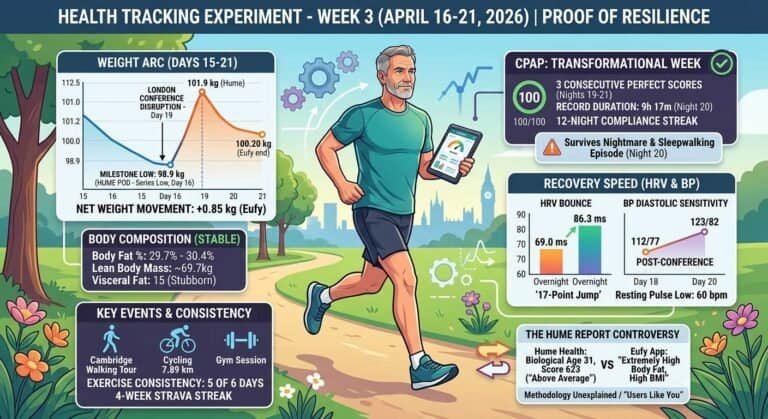
The weight has moved from 102.0 kg on Day 1 to 101.30 kg on Day 26. A net loss of 0.7 kg across nearly four weeks. By any weight-loss metric, that is modest to the point of insignificance. The lowest point — 98.9 kg on Day 16 — proved to be a post-fast outlier rather than a new baseline. The daily weight has oscillated between 99 and 102 kg with a periodicity driven almost entirely by social eating and alcohol, and the trendline across the full twenty-six days is shallow enough to disappear into the noise.
But this experiment was never primarily about fat loss. Looking back across twenty-six articles, two stories have emerged that are genuinely worth the month of data.
The first is the CPAP transformation. From a machine that sat unused for nine months to a device worn for nearly ten uninterrupted hours last night, scoring 100 out of 100, with an AHI that has been consistently below 2 for the past two weeks. The compliance streak stands at seventeen consecutive nights. The blood oxygen, which dipped to 88% on Night 1, has not dropped below 94% since CPAP compliance began. A man who could not keep a sleep apnea mask on for an hour is now sleeping through the night without noticing it is there. That is a clinical outcome that matters far more than a kilogram on the scales.
The second is the device investigation. Four tracking devices, four different stories about the same body, and a growing body of evidence that the numbers they produce are as much a function of their algorithms and benchmarking methodology as they are of the person standing on or wearing them. The Eufy rates visceral fat “Extremely High.” The Hume Pod rates the equivalent trunk composition “Standard.” The Hume Band’s weekly report grades body composition F while the Hume Pod’s Health Score calls the biological age 31. These contradictions are not bugs — they are the story. And the ongoing correspondence with Hume Support, now including a confirmed software bug fix, has produced consumer journalism that did not exist before this series began.
The small pleasures of good food and good wine are part of the life this data is recording. A baked camembert with French bread is not a failure of protocol — it is a Friday evening. The data captures the cost without pretending the cost was not worth paying. That honesty is what separates this experiment from a diet blog.
If there is a Phase 2 — and increasingly it looks like there will be — the CPAP compliance is already locked in, the device comparison framework is established, and the focus can shift entirely to fat loss and structured exercise with a foundation that Day 1 of this experiment did not have. This month built the infrastructure. The next month can build on it.
Blood Pressure: Diastolic Elevated Again
Three readings between 10:13 and 10:17: 120/84 (OK/HIGH), 120/81 (OK/HIGH), and 114/81 (OK/HIGH). Average: 118/82, pulse 65.
The systolic has settled at 118 average — fully in the OK range and the lowest systolic average of the past week. The diastolic, however, sits stubbornly at 82 — one point above the HIGH threshold — on all three readings. Rose wine and camembert: the diastolic knows.
The pulse at 65 is consistent with the recent downward trend that has taken the morning resting rate from the high 60s into the mid-60s. The cardiovascular system’s long-term adaptation to improved sleep continues to show in the resting heart rate, even on mornings when the blood pressure tells a different story about last night’s dinner.
The Cycling: 12.18 km to Paus and Back
Yesterday afternoon’s ride to the Paus café at 1:35pm covered 12.18 km in 1 hour 6 minutes 22 seconds at an average of 11.0 km/h — a gentler pace than Friday’s 34 km sprint, reflecting the social nature of the ride and the fact that the destination involved sitting down with food. Maximum speed: 33.8 km/h. Elevation gain: 93 metres. Strava awarded the “3rd most elevation you gained in 2026!” badge.
The route ran south from Cambourne through Bourn toward Kingston — the reverse of Friday’s wider loop — and the elevation profile with its 93 metres of climbing over 12 km suggests a proper undulating route rather than the flat Cambourne circuits. Two substantial rides in consecutive days — 34 km on Friday, 12 km on Saturday — is the most consistent multi-day cycling of the experiment, and the Hume Band’s carryover muscular strain of 9 confirms the body is registering the accumulated load.
Metabolic Capacity: The Baseline Speaks
The newly fixed Metabolic Capacity screen is now providing its most detailed output yet. Today’s Capacity sits at 63 out of 100, with a Baseline of 67 — meaning the body is operating 4 points below its established capacity. The radar chart shows the shape of the deficit: Recovery Effectiveness is strong, Momentum is moderate, but Strain Burden is pulling the overall score down. Sleep Debt sits at zero. Scale Impact is listed as “Coming Soon” — another locked feature behind what appears to be a paywall or future update.
The Hume Band’s AI summary is characteristically detailed: the 4-point reduction from baseline traces almost entirely to the 9 points of unrecovered muscular strain from the two consecutive days of cycling. Cardiovascular and mental systems show clean recovery profiles. The recommendation: keep movement at 40–55% of maximum effort today. The body needs time to convert the training load into adaptation.
This is genuinely useful coaching output — now that the baseline bug is fixed, the Metabolic Capacity feature is delivering personalised recommendations grounded in actual data. Whether the “Scale Impact” feature, when it arrives, will add to this picture or introduce another layer of proprietary opacity remains to be seen.
Yesterday’s Resolution: The Recovery Night
The Hume Band’s Yesterday’s Resolution confirms that the body processed the 34 km ride overnight with remarkable efficiency. Cardiovascular strain cleared completely — 1 unit recovered, 0 remaining. Muscular strain persists at 9 units, consistent with the carryover figure on today’s Capacity screen. Mental strain minimal at 2.
The sleep data within the resolution is the standout: 614 minutes (10 hours 14 minutes) with zero sleep debt. REM at 2 hours 24 minutes. Light at 5 hours 32 minutes. Deep at 2 hours 16 minutes. That deep sleep figure — 2 hours 16 minutes — is the highest of the entire experiment by a significant margin. The body used the extended sleep window and the uninterrupted CPAP therapy to drive more deep sleep than any previous night had delivered. The cardiovascular system was fully restored by morning. Only the muscular strain remains, and that is the expected timeline for adaptation after the most demanding ride of the series.
Where Day 26 Sits
Four days remain. The CPAP story reached its climax last night — or at least, its climax so far. Nearly ten uninterrupted hours, one mask removal, and a 100/100 score that represents not just a number but a fundamental change in the relationship between a man and the machine he needs to breathe properly while he sleeps.
The weight is where the weight is. Good food and good wine are part of a life worth tracking, and the data records the consequences without pretending they were not chosen deliberately. The experiment is entering its final stretch with its two strongest narratives — CPAP compliance and device comparison — firmly established, and the possibility of a Phase 2 focused on fat loss taking shape for May.
The next four days will close this chapter. What comes after may prove to be the more interesting one.
Data captured Sunday 26 April 2026. Eufy reading 26/04/2026 at 10:02. Hume Pod updated 10:22. Hume Band data as at 10:07–10:22, last recorded 26/Apr/26. CPAP covers the night of 25–26 April 2026. Fitbit sleep data as at 10:08. Blood pressure taken 10:13–10:17. Cycling recorded 13:35 Saturday 25 April, South Cambridgeshire — 12.18 km to Paus. Yesterday’s Resolution and Metabolic Capacity data from Hume Band app.
— Day 26 of 30