DAY 16 — Walking for Weight Loss Results: Cambridge, 6.77km and Below 99kg
The walking for weight loss results this experiment has been generating are rarely more direct than today’s. Six point seven seven kilometres through Cambridge this morning — a guided photo tour with two groups of French school pupils, which is exactly as energetic as it sounds.
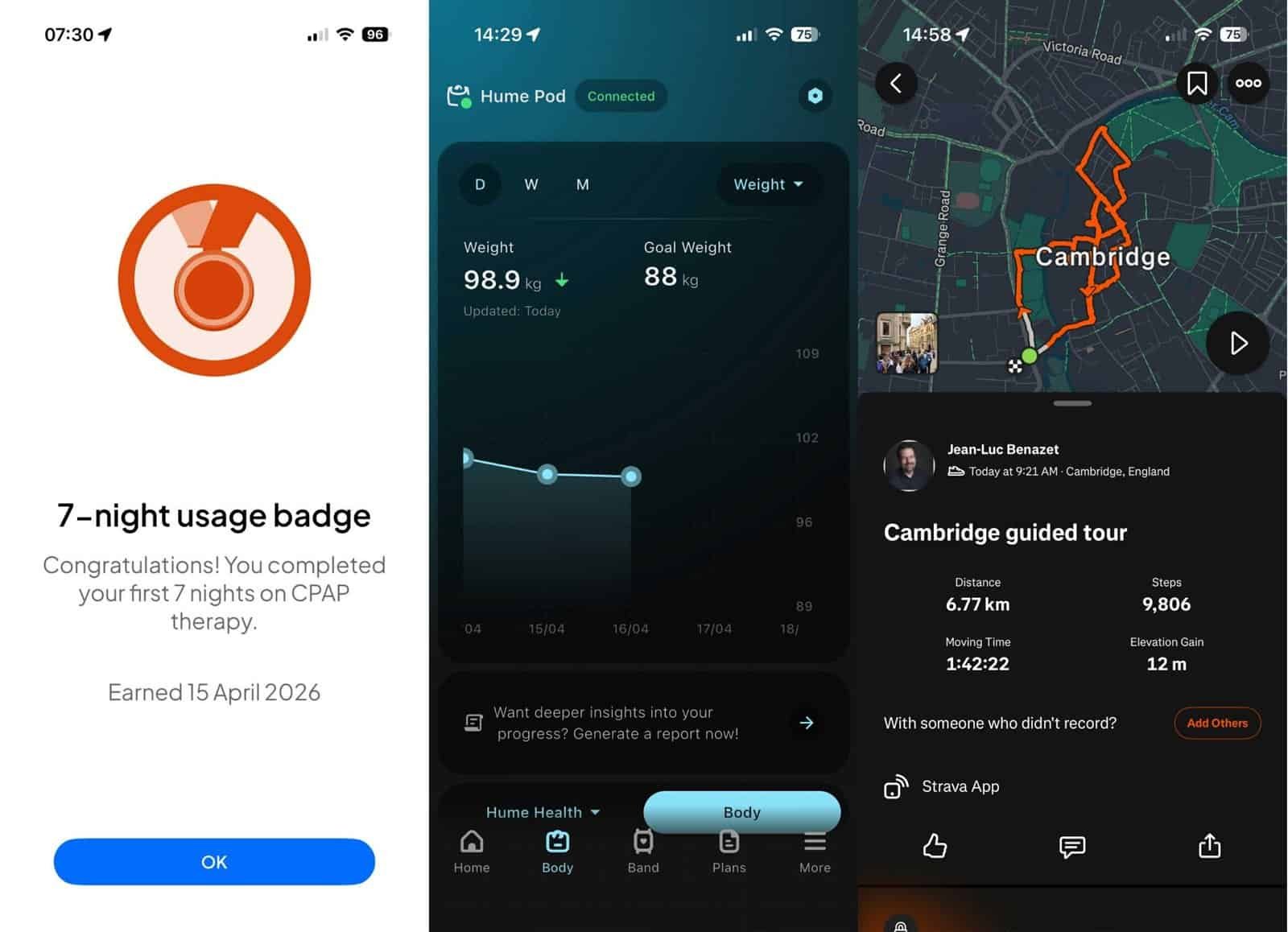
The Hume Pod is showing 98.9 kg this afternoon. Below 99 kg on either scale for the first time in this experiment. The 48-hour fast closed last night, the body has rehydrated, eaten, and returned to the 16:8 pattern, and the weight is still falling.
There was also a seven-night CPAP streak, a blood pressure reading that is nearly all green, and an Arsenal match last night that pushed my resting heart rate somewhere it had no business being. The data captures all of it.
Day 16 Data Summary
| Metric | Value | Source |
|---|---|---|
| Weight (Eufy, 14:27) | 99.05 kg | Eufy |
| Weight (Hume Pod, 14:29) | 98.9 kg ↓ | Hume Pod |
| BMI | 27.7 | Eufy |
| Body fat % | 29.7% | Eufy |
| Body fat mass | 29.40 kg | Eufy |
| Lean body mass | 69.70 kg | Eufy |
| Visceral fat | 15 | Eufy |
| Water % | 50.1% | Eufy |
| Protein | 12.6% | Eufy |
| Subcutaneous fat | 26.3% | Eufy |
| BMR | 1,714 kcal | Eufy |
| CPAP score | 86/100 | CPAP App |
| CPAP usage | 05:35 | CPAP App |
| AHI | 1.4 | CPAP App |
| Mask seal | Good | CPAP App |
| Mask-off events | 2 | CPAP App |
| CPAP streak | 7 consecutive nights | CPAP App |
| Blood pressure (avg) | 117/80 / Pulse 76 | BP Monitor |
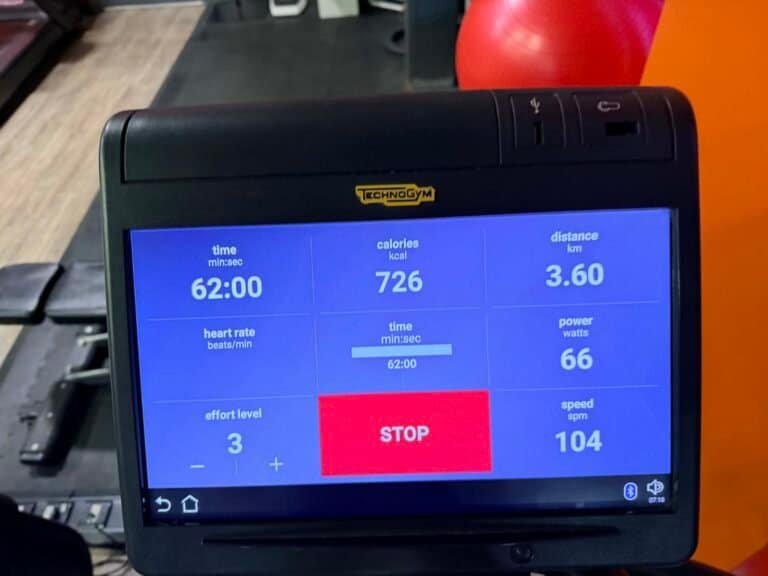
| Cambridge walk | 6.77 km / 9,806 steps / 1h 42m | Strava |
The Weight: Below 99kg for the First Time on Either Scale
The Hume Pod reads 98.9 kg this afternoon, updated today. The Eufy taken two minutes earlier shows 99.05 kg.
Between the two, this is the first time either device has returned a reading below 99 kg at any point in the experiment — including all the fasting-state readings of yesterday.
That last point deserves emphasis. Yesterday’s series lows of 99.35 kg in the morning and 99.05 kg in the afternoon were taken mid-fast, after approximately 40 and 45 hours without food respectively.
Today’s readings come after the fast has ended, after last night’s dinner, after a morning’s worth of coffee and movement. The body has refuelled and the weight is still lower. That is the structural progress the 48-hour fast was designed to create, and the data confirms it delivered.
Body fat mass at 29.40 kg is a new series low — the previous best was 29.70 kg on Day 15’s afternoon reading, and 29.80 kg on Day 6.
The direction is clear and the numbers are now verified across multiple consecutive readings rather than a single fasting-state snapshot.
Water percentage at 50.1% is the first time this figure has crossed 50% in the series.
Throughout the first fifteen days it has sat stubbornly in the 49-point-something range despite repeated hydration efforts. Crossing 50% today — after the fast ended and proper rehydration resumed — is a small but genuinely encouraging signal that the cellular hydration picture is improving.
Protein has ticked up to 12.6%, still low but moving in the right direction as the dietary focus on protein intake takes effect.
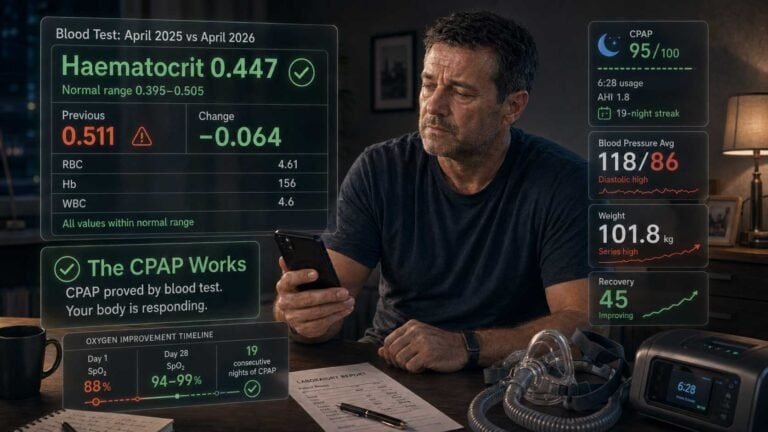
Seven consecutive compliant nights. The badge arrived this morning, and it represents something that was genuinely unimaginable at the start of this experiment: a full week of consistent, clinical-grade CPAP therapy for the first time since the machine was purchased in June 2025.
Seven consecutive compliant nights. The badge arrived this morning, and it represents something that was genuinely unimaginable at the start of this experiment: a full week of consistent, clinical-grade CPAP therapy for the first time since the machine was purchased in June 2025.
Last night’s session — the night of April 15th into the 16th — shows a score of 86, usage of 5 hours 35 minutes, Good mask seal, AHI of 1.4, and just two mask-off events.
The AHI of 1.4 is among the lowest of the series, confirming that the therapy itself is working effectively whenever the mask is on.
The shorter usage time reflects the later bedtime: Arsenal played last night, qualified for the next round, and the emotional investment involved in watching that unfold pushed the bedtime back further than the 9:30pm target of the night before.
There is something worth noting about the heart rate data here. The Hume Band’s heart rate recording for last night reached 130 bpm at points during the match — a figure associated in this series with moderate exercise, not with sitting on a sofa watching football.
The autonomic nervous system does not distinguish particularly carefully between physical exertion and intense emotional investment in whether a football team can hold a one-goal lead.
The cardiovascular cost of being an Arsenal supporter is, apparently, real and measurable.
The CPAP compliance streak survives nonetheless.
The Cambridge Walk: 6.77km, 9,806 Steps
A Cambridge guided photo tour at 9:21am with two groups of French school pupils. Moving time: 1 hour 42 minutes and 22 seconds. Distance: 6.77 km.
Steps: 9,806. Elevation gain: 12 metres, which is approximately what you would expect from the flattest city in England.
A Cambridge guided photo tour at 9:21am with two groups of French school pupils. Moving time: 1 hour 42 minutes and 22 seconds. Distance: 6.77 km. Steps: 9,806. Elevation gain: 12 metres, which is approximately what you would expect from the flattest city in England.
Nearly ten thousand steps accumulated before early afternoon.
For context, the step count target throughout this experiment has been 10,000 daily — a figure that has been elusive on most days given the knee management approach of the past week.
Today’s walk did not just approach that target, it arrived within two hundred steps of it before 1pm, which leaves meaningful room for the afternoon’s activity to push it comfortably past.
The walk itself covered the historic centre of Cambridge — colleges, the river Cam, the market area.
The kind of route that looks very different when you are responsible for keeping thirty French teenagers moving in the same direction as when you are walking it alone.
The professional dimension is worth noting: this is not leisure walking. It is work that happens to involve sustained movement, and the body registers both equally in the step count and the caloric expenditure.
Blood Pressure: Settling Back to Normal
Four readings between 14:35 and 14:42 this afternoon:
- 14:35 — 121 / 80 / Pulse 79 — systolic HIGH, diastolic OK
- 14:38 — 111 / 80 / Pulse 74 — both OK
- 14:40 — 117 / 81 / Pulse 76 — systolic OK, diastolic HIGH
- 14:42 — 118 / 78 / Pulse 75 — both OK
- 14:35 — 121 / 80 / Pulse 79 — systolic HIGH, diastolic OK
- 14:38 — 111 / 80 / Pulse 74 — both OK
- 14:40 — 117 / 81 / Pulse 76 — systolic OK, diastolic HIGH
- 14:42 — 118 / 78 / Pulse 75 — both OK
Daily average: 117 / 80 / Pulse 76.
The overall picture here is a return to the normal range that characterised the earlier part of this series — comparable to the 115/73 of Day 9 and the 117/74 of Day 8.
The first systolic reading of 121 flagged as HIGH is consistent with the pattern seen across this series of measurement, where the initial reading tends to be slightly elevated and subsequent readings settle.
The final reading of 118/78 is comfortably in the green on both figures.
The trend chart in the BP app continues to tell the most compelling story: the systolic line that peaked at 143 on Day 13 has now been declining for three consecutive days. The diastolic, which was the more concerning figure on Day 13 at 92, is back below 80.
Seven Days In: What the Streak Means
Seven consecutive compliant CPAP nights is a milestone that deserves its own paragraph, separate from the nightly detail.
In nine months of CPAP ownership before this experiment began, the longest compliance streak was somewhere in the low single digits.
The combination of public accountability, the positional sleep vest, earlier bedtimes, and — most recently — the willingness to swap between two masks mid-night rather than abandon the therapy entirely has produced something that clinical guidelines define as the threshold for meaningful sleep apnea treatment.
Seven consecutive compliant CPAP nights is a milestone that deserves its own paragraph, separate from the nightly detail. In nine months of CPAP ownership before this experiment began, the longest compliance streak was somewhere in the low single digits. The combination of public accountability, the positional sleep vest, earlier bedtimes, and — most recently — the willingness to swap between two masks mid-night rather than abandon the therapy entirely has produced something that clinical guidelines define as the threshold for meaningful sleep apnea treatment.
The AHI arc across those seven nights has been consistently within or close to the target range.
The CPAP compliance history chart, which opened this series with a single bar barely reaching one hour on Night 1, now shows a week of solid usage.
Only last night’s shorter session broke the otherwise impressive pattern.
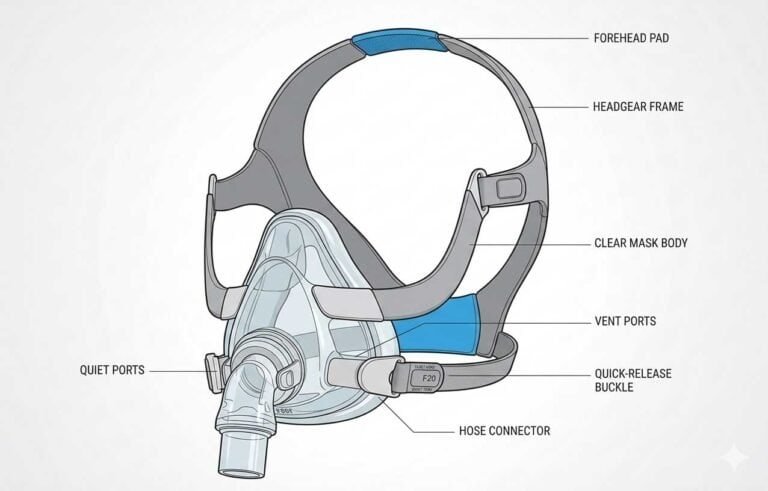
The full face mask pressure settings remain the outstanding issue.
A conversation with the CPAP supplier about ramp time and pressure ceiling is booked for this week.
The seven-night streak will continue in the meantime, whichever mask ends up carrying the night.
The Fast’s Aftermath: What the Data Shows One Day Later
Twenty-four hours after ending the 48-hour fast, the body composition data is more informative than any single fasting-state reading.
Weight at 99.05 kg on the Eufy and 98.9 kg on the Hume Pod confirms that the post-fast rebound is minimal. Body fat mass at 29.40 kg is lower than any reading taken during the fast itself.
Water percentage has climbed to 50.1% — the rehydration that the fast had compressed is now visible in the data.
This is what a well-executed extended fast followed by a controlled return to normal eating looks like in the numbers.
The glycogen that depleted during the fast has not rushed back in its full water-retaining form because the return to food has been measured.
The protein that was chronically low throughout the series is beginning to register an improvement. The direction across every metric today is positive.
Data captured Thursday 16 April 2026. Eufy reading taken 16/04/2026 at 14:27. Hume Pod weight updated 14:29. Blood pressure taken 14:35–14:42. CPAP covers the night of 15–16 April 2026. Cambridge guided tour recorded 9:21am on Strava, 6.77 km.
Fast ended Wednesday 15 April at approximately 19:00. 48-hour fast referenced in this article ran from Monday 13 April dinner to Wednesday 15 April dinner.
— Day 16 of 30