DAY 8 — “The Night Eating Cost Me. Here Is Exactly How Much.”
April 8th, 2026 — Eufy: 100.2kg. Body fat: 30.5%. CPAP: 89/100. Gym: 22 mins. Knee: Unimpressed.
I am going to lead with the thing I did wrong, because that is the point of this series.
Last night I was photographing clients from 7:30 to 8:30pm. By the time I finished, packed up, and got home, I was hungry — and I ate. Late. Outside my intermittent fasting window. And this morning the scales told me exactly what that decision cost.
100.2 kilograms.
Back over 100. After two days below it. The body fat percentage has climbed back to 30.5% — up from 28.8% yesterday. These are not small movements. One late meal, eaten outside the 16/8 window after a long evening of work, produced a measurable reversal in two of the most important metrics of this experiment.
I want to be precise about what this means and what it does not mean. It does not mean I gained genuine fat overnight. The human body cannot synthesise that much adipose tissue in a single evening. What it means is that food eaten late — undigested, retained as water weight, sitting in the system at weigh-in time — inflates every single number the scales measure. Body fat percentage via bioelectrical impedance is particularly sensitive to this: food, water retention, and even muscle glycogen all affect the electrical signal that the scales use to estimate body composition. A late meal pushes everything upward.
The practical lesson is simple and I knew it already. The eating window is not negotiable. Not because the rule matters for its own sake, but because the data now shows, in a single overnight example, exactly what breaking it does to the numbers I am tracking every morning.
Tomorrow the window closes at 8pm. Regardless of what time the camera goes away.
Blood Pressure: A Nuanced Reading
Best of three measurements this morning: 117/74 mmHg — 75 bpm
Last week’s best reading was 104/72. This morning it is back to 117/74 — closer to the Day 1 baseline of 117/78. The resting heart rate, however, tells an encouraging counter-story: 75 bpm, down from 96 bpm last week. The heart is beating more efficiently. The blood pressure fluctuation likely reflects the disrupted sleep and retained food weight rather than a genuine cardiovascular reversal.
Blood pressure varies significantly with sleep quality, hydration, stress, and time of measurement. A single reading higher than last week’s best is not a trend — it is a data point. The resting heart rate of 75 bpm is the more stable indicator, and it is moving in the right direction.
The CPAP: Night Seven of the Streak — Lowest Events Rate Yet
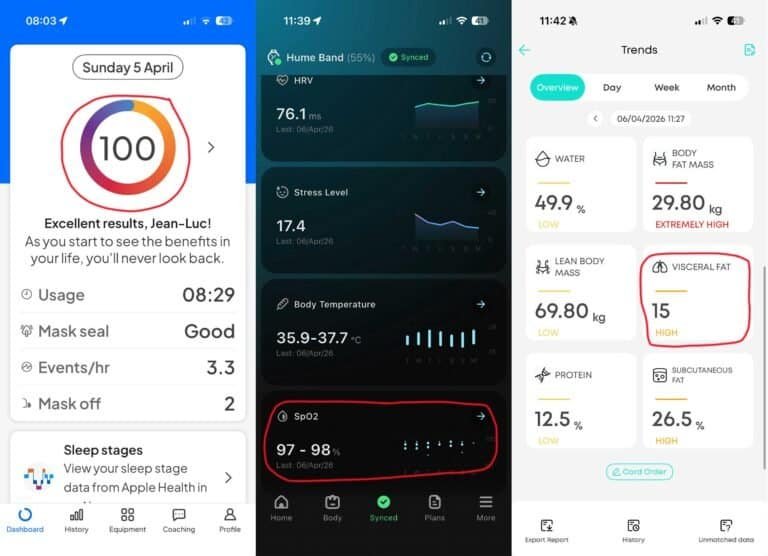
Tuesday 7th April — myAir:
- Usage: 6 hours 25 minutes
- Score: 89/100
- Mask seal: Good
- Events per hour: 1.8 (lowest of the entire experiment)
- Mask off: 7
The score dropped from 96 to 89 for a specific reason: I took the mask off seven times. I went to bed at 11pm but could not settle. The mind was still processing the photography session. Every time I drifted toward sleep, something shifted and the mask came off — and then I was just awake enough to put it back on. Seven rounds of this across the night.
The remarkable figure is the events-per-hour: 1.8. The lowest reading of the series. Which means that on every occasion the mask was on and I was actually asleep, the machine was working with near-perfect effectiveness. The restlessness is a sleep scheduling problem. The apnea treatment is working.
| Night | Date | Usage | Score | Events/hr |
|---|---|---|---|---|
| Night 2 | 2 Apr | 6h 42m | 96/100 | 9.5 |
| Night 3 | 3 Apr | 4h 29m | 68/100 | 2.6 |
| Night 4 | 4 Apr | 6h 52m | 98/100 | 9.3 |
| Night 5 | 5 Apr | 8h 29m | 100/100 | 3.3 |
| Night 6 | 6 Apr | 6h 43m | 96/100 | 2.5 |
| Night 7 | 7 Apr | 6h 25m | 89/100 | 1.8 |
Six consecutive compliant nights. The streak holds.
The Gym: Short, Adapted, and Expanded to Weights
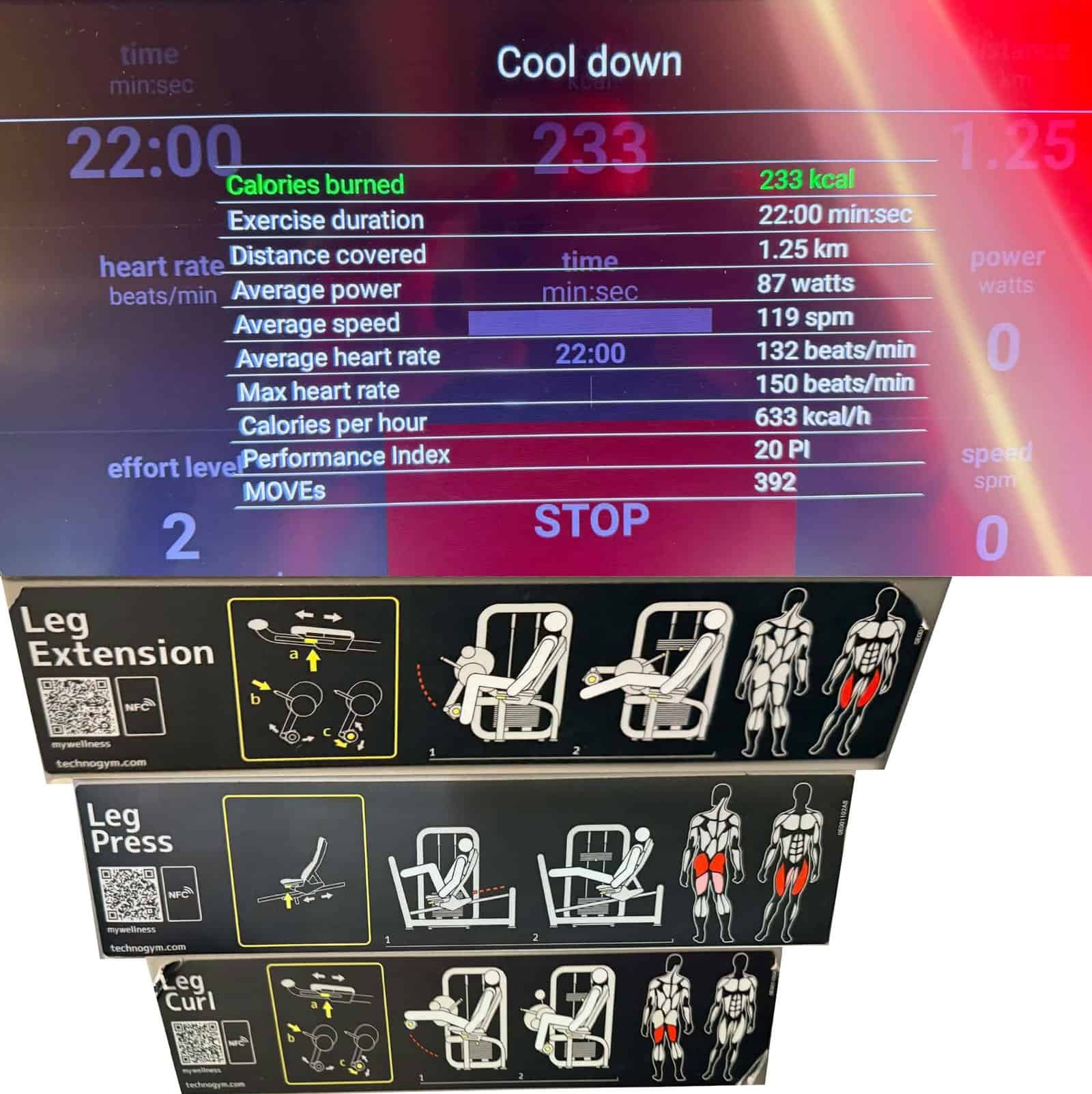
I woke at 6:10am and was at the gym shortly after. The knee was already making its position clear before I left the house, so the session adapted accordingly.
TechnoGym cross trainer — 22 minutes:
- Calories burned: 233 kcal
- Distance: 1.25 km
- Average power: 87 watts
- Average speed: 119 spm
- Average heart rate: 132 bpm
- Max heart rate: 150 bpm
- Effort level: 2
Twenty-two minutes at effort level 2 instead of sixty-two minutes at effort level 3. Lower intensity, lower max heart rate — 150 today versus 185 on Day 6. This is not failure. This is appropriate management of a joint that is under strain and needs to be around for the remaining 22 days.
What followed the cross trainer matters more for the long term: leg weights. Leg press, leg curl, and leg extension — the three machines that directly strengthen the quadriceps, hamstrings, and the stabilising musculature around the knee joint. This is not cosmetic. The evidence for resistance training as a primary intervention for knee pain and early osteoarthritic change is robust. Muscle around the joint acts as a shock absorber. As the muscles strengthen, the load on the cartilage decreases. As the weight on the scales decreases, the load decreases further. Both processes are running simultaneously.
The knee complained. I did something constructive about it rather than going home.
The Intermittent Fasting: What the Data Now Proves
The 16/8 protocol has been the nutritional backbone of this experiment. Eating between roughly midday and 8pm, fasting from 8pm to noon the following day. In eight days I have broken the window twice — the wedding reception on Day 3, and last night’s post-photography meal.
Both breaks happened because I was working late. This is a predictable pattern, not a random one. Photography sessions run into the evening, and there is a particular exhaustion after two hours of portraiture that makes a late meal feel not just acceptable but necessary.
The solution is planning, not willpower. Eating adequately before an evening photography session so that when it ends the hunger is manageable. I will implement this immediately.
What the scales this morning make undeniable: the fasting window is not optional. 100.2 kg versus 99.4 kg yesterday. 30.5% body fat versus 28.8%. One evening. The numbers are the argument.
A Correction to Yesterday’s Week 1 Review
Yesterday’s review stated that only two days exceeded 10,000 steps. The full weekly Fitbit data shows three:
| Date | Full Day Steps |
|---|---|
| Wed 1 Apr | 1,295 |
| Thu 2 Apr | 13,135 ✅ |
| Fri 3 Apr | 16,785 ✅ |
| Sat 4 Apr | 5,912 |
| Sun 5 Apr | 1,690 |
| Mon 6 Apr | 13,111 ✅ |
| Tue 7 Apr | 4,475 |
Day 1 was the very first morning before any routine existed. Day 5 was a deliberate recovery day following a 4am bedtime. Three proper high-step days in seven is a more accurate reflection of Week 1 than the two I reported.
Day 8 Summary
| Metric | Value | Direction |
|---|---|---|
| Weight (Eufy) | 100.2 kg | ⬆️ Late meal |
| Body Fat % (Eufy) | 30.5% | ⬆️ Back up |
| Blood pressure | 117/74 — 75 bpm | ⚠️ Up from last week |
| Resting HR | 75 bpm | ✅ Improving trend |
| CPAP usage | 6h 25m | ✅ Streak: 6 nights |
| CPAP score | 89/100 | ⬇️ Restless |
| Events/hr | 1.8 | ✅ Best of series |
| Gym | 22 min + leg weights | ✅ Knee-adapted |
| Intermittent fasting | ⚠️ Window broken | Honest admission |
| Bed time | 11pm | ✅ |
| Alcohol | 0 | ✅ |
Eight days. Back over 100kg. The data told me exactly why, which is the whole point of doing this publicly.
The fasting window closes at 8pm tomorrow. No exceptions.
— Day 8 of 30