WEEK 1 REVIEW — “What Seven Days of Data Actually Revealed”
April 1st–7th, 2026 — From 102kg to 99.4kg. From 88% to 97–98% blood oxygen. From chaos to something resembling a routine. This hume pod review will detail my findings.
Seven days ago I stood on a set of smart scales at 102 kilograms and watched a device tell me my visceral fat was “Extremely High.” A different device — more expensive, more complex, the one I had paid £300 for — looked at the same body and called it “Standard.” The contradiction was the premise. The blog was the accountability. The 30 days had begun.
Here is what the first week actually produced.
The Weight: What Moved and What Didn’t
The headline number is straightforward. In seven days, the Eufy scales moved from 102.0 kg to 99.4 kg — a loss of 2.6 kg. The Hume Pod, which has consistently read 1–2 kg higher than the Eufy throughout the series, shows a parallel downward trend confirming the direction.
In this hume pod review, I’ll share insights on how the device performed during this period.
Some of that loss is water weight, released through increased hydration, reduced sodium intake, and the early metabolic response to intermittent fasting 16/8. Some is genuine fat loss, driven by a caloric deficit maintained across most of the week. Some reflects the shift from a body chronically dehydrated and poorly oxygenated to one that is, slowly, starting to function more normally.
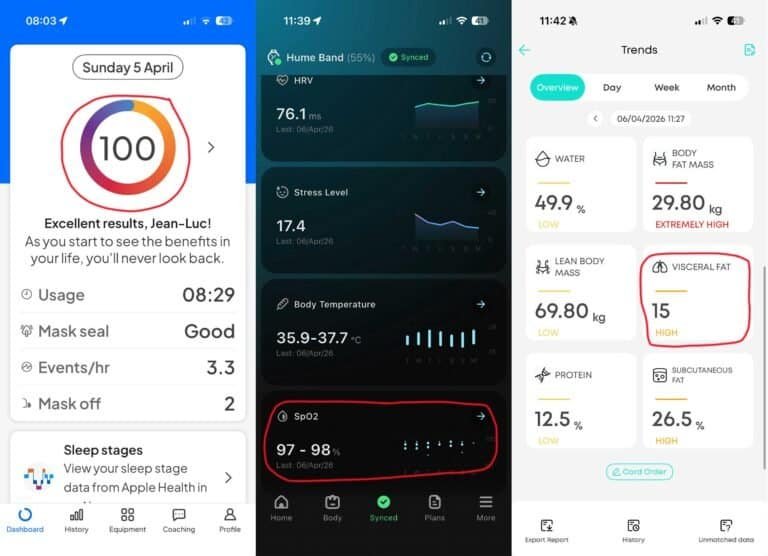
The visceral fat story is more important than the total weight number. Eufy’s visceral fat score sat at 16 — Extremely High — for the first five days without moving a single point. On Day 6 it dropped to 15 — High. On Day 7 it held there. One point in seven days. That is how visceral fat moves: slowly, stubbornly, in response to sustained lifestyle change rather than a single good day. The first point is always the hardest. It has gone.
The body fat percentage arc across the week:
| Day | Eufy Body Fat % | Eufy Visceral Fat |
|---|---|---|
| Day 1 | 30.7% | 16 — Extremely High |
| Day 3 | 30.7% | 16 |
| Day 5 | 30.4% | 16 |
| Day 6 | 30.0% | 15 — High |
| Day 7 | 28.8% | 15 — High |
A 1.9 percentage point reduction in body fat in seven days. Not dramatic. Real.
The CPAP: The Story of the Week
If this series had one unexpected narrative arc in Week 1, it was the CPAP machine sitting on my bedside table. I have owned it since June 2025. In nine months I never managed five consecutive compliant nights. The combination of public accountability, a positional sleep vest, and — eventually — enough stubbornness to put the mask back on every time I took it off produced the following arc:
| Night | Usage | Score | SpO2 |
|---|---|---|---|
| Night 1 (not counted) | 1h 04m | 41/100 | 88% |
| Night 2 | 6h 42m | 96/100 | 95–98% |
| Night 3 | 4h 29m | 68/100 | 95–99% |
| Night 4 | 6h 52m | 98/100 | 95–98% |
| Night 5 | 8h 29m | 100/100 | 97–98% |
| Night 6 | 6h 43m | 96/100 | 95%+ |
Five consecutive compliant nights. A 5-night badge earned on 6 April 2026. The machine’s average events per hour across those five nights: between 2.5 and 9.5, all within or close to the clinically normal range. The blood oxygen, which opened the series at 88% on Night 1, has not dropped below 95% during CPAP-covered sleep since Night 2.
The Hume Band’s weekly cardiovascular report confirms what the nightly data shows: zero low SpO2 warnings across the entire week. Baseline SpO2 consistently at 97%. The clinical summary, in plain terms: the machine is working. The only variable was compliance. Compliance is now happening.
The Hume Band’s Week 1 Report: Grades, Revelations, and a Sleep Debt
After seven days of continuous data, the Hume Band has produced its first full weekly Health Report. Here is what it found.
Overall Health Score: 618 — Above Average. Confidence Rating: 84%.
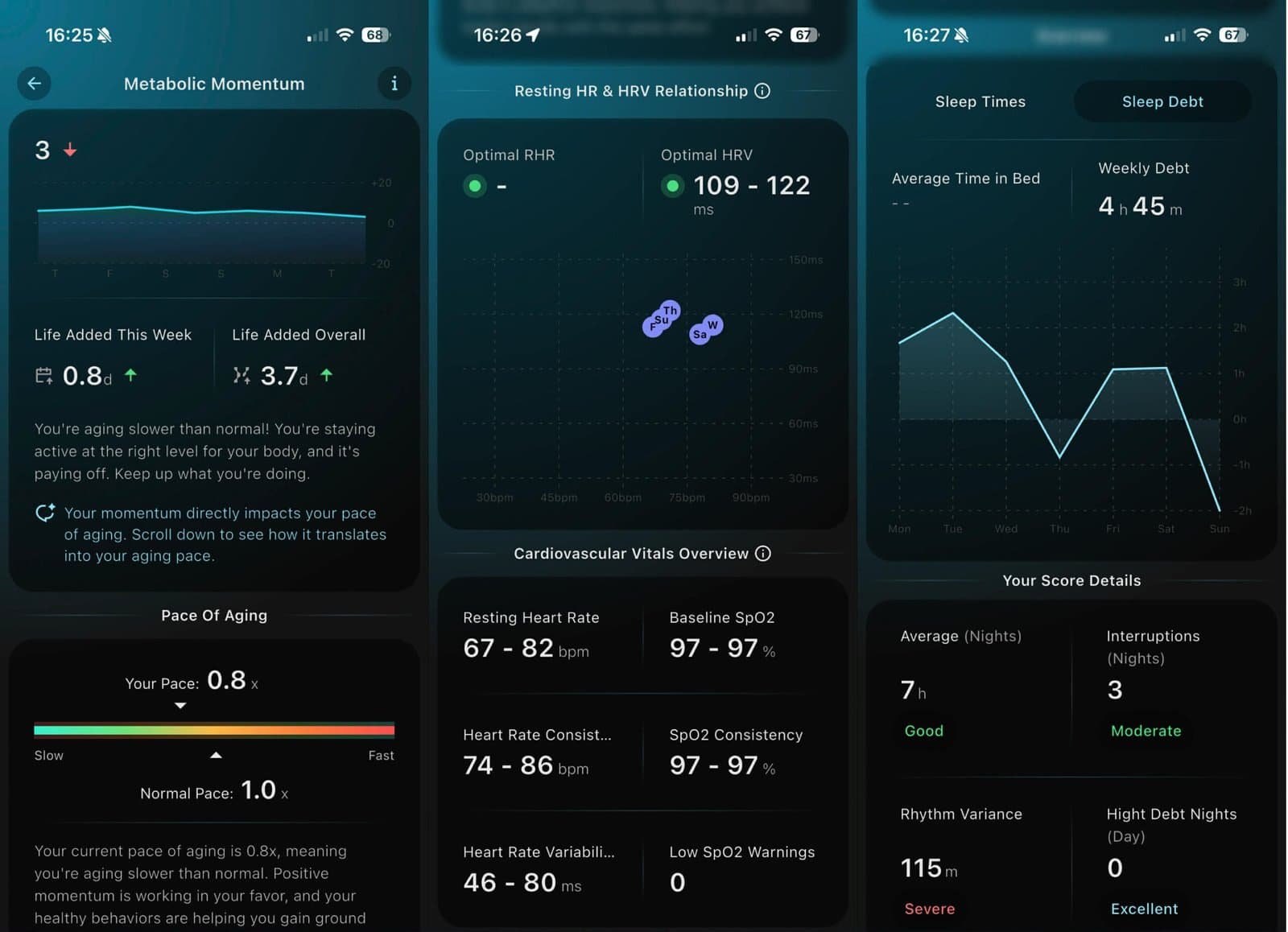
Cardiovascular Health: A Cardiovascular score of 87/100. Resting heart rate range of 67–82 bpm. HRV range of 46–80 ms across the week, with a peak of 76.1 ms on Day 6 — the highest single reading of the series. Zero low SpO2 warnings. The cardiovascular picture is the strongest category in the report, and it reflects what improving sleep oxygenation actually does to a body over time.
One notable finding: the Hume Band identifies my optimal energy peak as 6pm to 10pm. I am, physiologically, an evening person. Every 6am gym session this week has been swimming against that biological current. This does not mean I should stop. It means I should be honest that early mornings cost me more than they would cost someone whose natural rhythm peaks at dawn.
Activity: B ⬆️ — 73/100 Total active calories for the week: 2,469 — Good. Average daily active calories: 687. Average BMR: 2,048 kcal. Highest step day: 17,264 — Very Active. Average daily steps: 6,843 — Low.
That gap tells the story of Week 1. Two genuinely high-activity days — the wedding walk and a gym session — dragged the weekly average upward. The rest days were genuinely restful. Week 2 needs more consistency and fewer extremes.
High Activity Days: 2 — rated Too Low. The target for Week 2 is four.
Sleep: C+ ⬆️ — 69/100 The sleep grade is trending upward and the quality is improving. But the data beneath the grade is bracingly honest.
Weekly sleep debt: 4 hours 45 minutes. The average nightly duration of 7 hours is rated Good — but the rhythm variance of 115 minutes is rated Severe. Across seven nights I went to bed at times ranging from 10:48pm to 4:00am. My body has no idea what time it is supposed to be asleep. The quality, when I do sleep, is now excellent — 100% on multiple nights according to the Hume Pod. The schedule remains chaotic.
Interruption nights: 3 — Moderate. High debt nights: 0 — Excellent.
The C+ is accurate. The upward arrow is encouraging. The 115-minute rhythm variance is the number Week 2 needs to address above all else.
Body Composition: F ⬇️ — 45/100 Body fat mass 12kg above expected. This is the honest reckoning. The Hume Band — which has access to seven days of continuous biomarker data — grades the body composition F, while the Hume Pod’s point-in-time scans have rated the trunk “Standard” throughout. These are products from the same company, using different methodologies, producing incompatible conclusions. The technical team response, when it arrives, will need to address this internal contradiction directly.
Metabolic Momentum: 3 ⬇️ Down from 6 at midweek, reflecting accumulated cardiovascular strain from a week of genuine exercise that has not yet been fully absorbed. The positive framing: negative strain registers at zero — meaning this is productive training load, not harmful overtraining. Pace of aging: 0.8x. Life added this week: 0.8 days. Life added overall: 3.7 days.
Metabolic Capacity: 57/100 — Fair Baseline capacity of 66, currently running at 49 due to 31 points of unrecovered cardiovascular strain. The machine’s own analogy is unusually apt: “Think of it like a phone running background processes — the hardware capability remains the same, but available performance drops while those processes run.”
The Devices: What We Learned in Week 1
Seven days of parallel data from four devices has produced some clear findings:
On weight: Eufy and Hume Pod agree on direction but not magnitude. The Hume Pod consistently reads 1–2 kg higher. Both are trending downward. For this series, Eufy is the primary weight reference; Hume Pod provides trend confirmation.
On sleep duration: Fitbit measures time asleep, excluding awake periods. Hume Band measures total session length. They will always differ. Both are useful, measuring different things. The CPAP usage time is the most reliable cross-reference for total time in bed.
On steps: Hume Band and Fitbit disagree by 500–1,200 steps per day consistently. Neither is definitively correct. Both are directionally useful.
On body composition: Eufy and Hume Pod produce fundamentally different assessments of the same body. Eufy benchmarks against clinical thresholds. Hume Pod benchmarks against “users like you” — confirmed by Hume Support to mean same age, sex and height, with no mention of weight. Until Hume’s technical team provides the clinical database underpinning their thresholds, the Eufy’s clinical-threshold approach is the more medically meaningful reference.
The Hume correspondence remains open. Three emails sent. Three replies received. Technical team escalated. Still awaiting the substantive answer to: which clinical database? Is weight in the cohort? Why does the Hume Pod say Standard while the Hume Band says F?
The Lifestyle Changes: What Actually Happened
What worked:
- Intermittent fasting 16/8 — maintained throughout the week
- Early gym sessions on Days 2 and 6 — both produced 541–726 kcal burns
- CPAP compliance — five consecutive nights, personal record
- Positional sleep vest — clearly contributing to both compliance and oxygen quality
- Reduced alcohol — zero most days, minimal on two occasions
- Increased water intake — measurably improving body water percentage
What needs work:
- Bedtime consistency — 115-minute rhythm variance is severe and is the single biggest remaining obstacle to sleep quality
- Average steps — 6,843 per day is Low; the target is above 10,000 consistently
- High activity days — two in seven is too few; four is the Week 2 goal
Week 1 in Numbers
| Metric | Day 1 | Day 7 | Change |
|---|---|---|---|
| Weight (Eufy) | 102.0 kg | 99.4 kg | ⬇️ -2.6 kg |
| Body Fat % | 30.7% | 28.8% | ⬇️ -1.9% |
| Visceral Fat | 16 | 15 | ⬇️ -1 point |
| Water % | 49.4% | 50.7% | ⬆️ +1.3% |
| SpO2 (overnight) | 88% | 95–98% | ⬆️ +7–10% |
| CPAP streak | 0 nights | 5 nights | ✅ |
| HRV | 65.1 ms | 74.5 ms | ⬆️ +9.4 ms |
| Stress level | 27.5 | 21.3 | ⬇️ -6.2 |
| Blood pressure | 117/78 | 104/72 | ⬆️ Improving |
Week 1 is done. The devices contradict each other, Hume’s technical team is still composing their reply, and the sleep schedule is rated Severe. Everything else is moving in the right direction.
Week 2 starts tomorrow. The targets are simple: four high-activity days, bedtime before midnight every night, sixth consecutive CPAP night.
The belly is still Standard, apparently. The journey continues.