DAY 4 — “The Wedding Did What Weddings Do.”
April 4th, 2026 — Weight: 101.5kg. Sleep: 4h 29m CPAP. Steps yesterday: 16,750. Hip: Unhappy.
I will be honest with you. Yesterday was not in the plan.
The plan was: attend a wedding as a guest, eat sensibly, drive home, be in bed by 11pm, CPAP on, vest on, wake up fresh. The plan was sensible, measured, and entirely reasonable.
What actually happened was: I attended a wedding, walked approximately 16,750 steps between the morning walk and a full day on my feet, arrived home late, spent several hours editing photographs, drank two gins to compensate for an entirely tea-total wedding reception, and got into bed at 4 o’clock in the morning.
I woke up at 8:45am with a pain in my left hip significant enough to make me reconsider all of my recent decisions simultaneously.
This is Day 4. We take the good with the bad and we write it down.
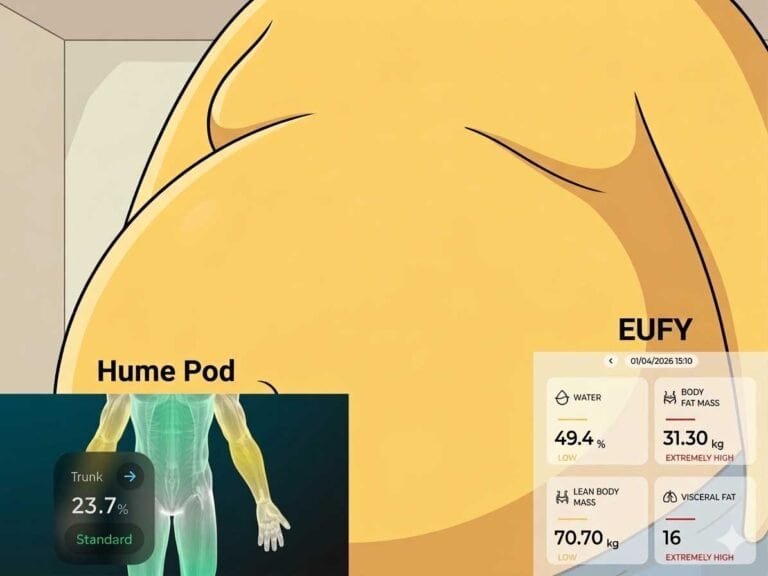
In this blog post, I will explore the differences between various scales, specifically focusing on the hume pod vs eufy scales.
The Hip: What Is Actually Going On?
The left hip pain deserves its own paragraph because it is potentially the most important signal in today’s data — and I genuinely do not know what caused it yet.
The candidates are:
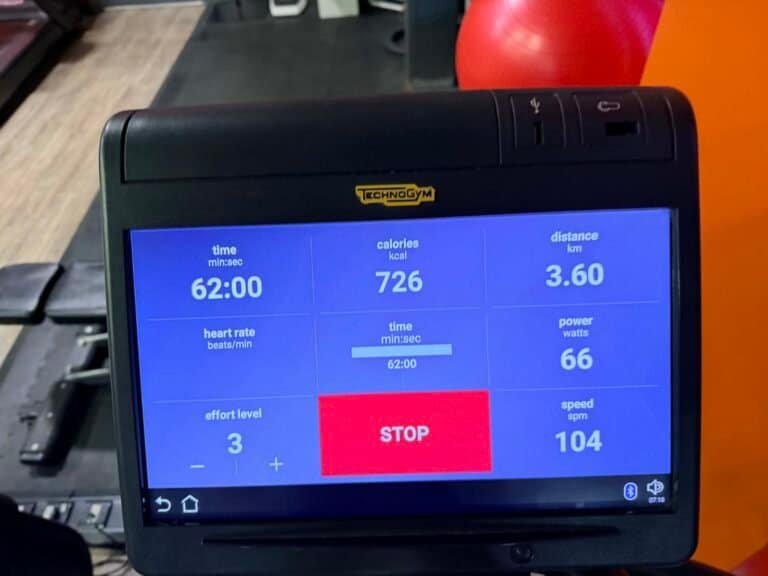
1. Cumulative load from exercise. On Day 2 I did 62 minutes on the cross trainer. On Day 3 I walked 7.64km, making it 16,750 steps across the full day. That is two consecutive days of significant lower body activity after a period of relative inactivity. A hip flexor or bursa protesting is entirely plausible.
2. The positional sleep vest. The vest keeps me on my side. Side sleeping, done well, is excellent for the airway. Done without adequate hip support — which a hotel bed or an unfamiliar sleeping position on a regular mattress might not provide — can compress the hip joint and create exactly this kind of morning pain. Something to monitor carefully.
3. Something new entirely. I already know my knees are under structural pressure from years of carrying excess weight. The hips are connected to the same system. An MRI from 2012 showed early changes in the right knee. The left hip may simply be joining that conversation.
For now: I will note it, watch it, and not use it as a reason to stop moving. The worst thing I could do for a weight-bearing joint problem is stop losing weight.
The Sleep: Abbreviated But Not Disastrous
Last night was always going to produce compromised sleep data. Into bed at 4am, up at 8:45am — that is a maximum possible window of four and a half hours, regardless of what any device reports.
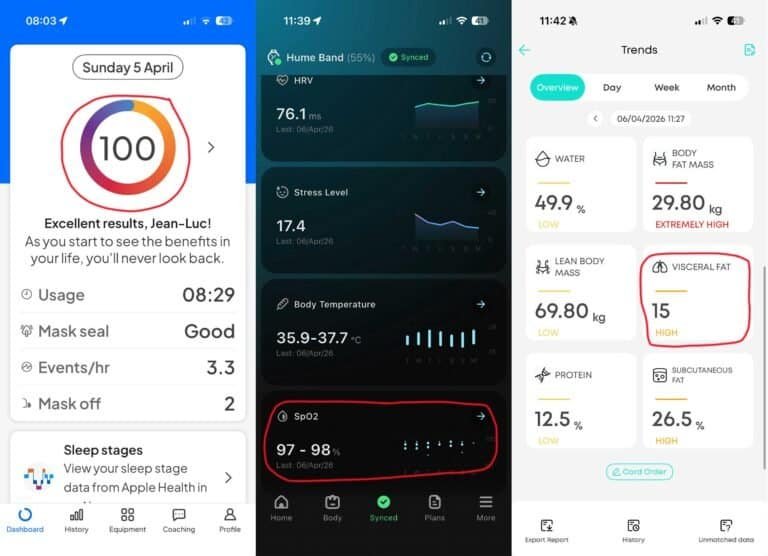
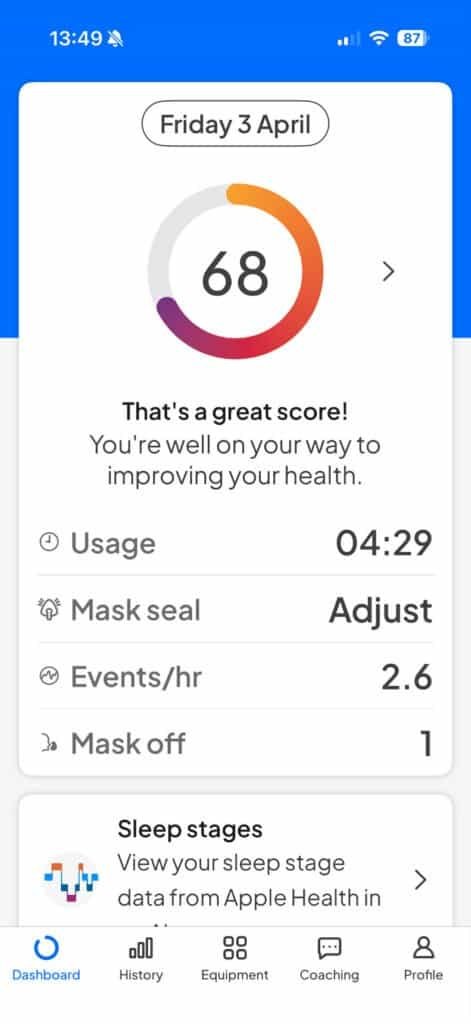
CPAP — Friday 3rd April (last night’s data):
- Usage: 4 hours 29 minutes
- Score: 68/100
- Mask seal: Adjust (the seal wasn’t perfect — possibly because I was wearing it at 4am after two gins and considerably less care than usual)
- Events per hour: 2.6 (still in the mild range — the machine was working)
- Mask off: 1
The score dropped from 96 to 68. That is a meaningful decline, and the “Adjust” mask seal warning explains part of it — a loose seal reduces the machine’s effectiveness. But 2.6 events per hour is still clinically mild, and crucially, the SpO2 data tells a much more encouraging story than the score alone suggests.
Fitbit sleep breakdown:
- Total session: 04:15–08:45
- Time asleep: 4h 3m
- Sleep score: 79/100 — Fair
- Awake: 27 min / REM: 46 min / Light: 2h 31m / Deep: 45 min
Hume Band sleep session: 6h 43m
Wait — the Hume Band says 6h 43m for a night where I went to bed at 4am and woke at 8:45am? That is impossible as an overnight figure. What the Hume Band is almost certainly capturing here is a combination of last night’s short sleep plus some residual data from the wedding day’s rest periods — or it is simply miscalculating the session boundaries. This is worth flagging as a Hume Band data quality issue: its sleep session measurement appears unreliable when sleep timing is significantly outside normal patterns. The Fitbit’s 4h 3m and the CPAP’s 4h 29m are the credible figures here.
The Good News: SpO2 Holds
Despite everything — the late night, the gins, the shortened sleep, the imperfect mask seal — the Hume Band recorded my overnight SpO2 at 95–99%.
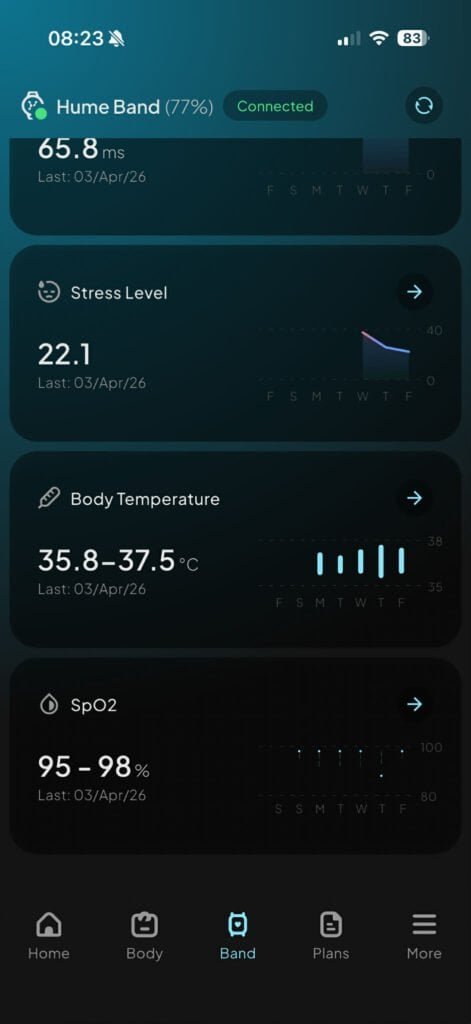
That is the best overnight oxygen reading of the four nights so far. Better than Night 3’s 95–98%. Better than anything before the vest and CPAP combination. Even on a chaotic night, the combination of side-sleeping and CPAP treatment kept my blood oxygen in the healthy range. This is the data point that matters most, and it held.
| Night | CPAP Usage | SpO2 |
|---|---|---|
| Night 1 | 1h 04m | 88% |
| Night 2 | 6h 42m | 95–98% |
| Night 3 | 4h 29m | 95–99% |
The trend is clear. Even imperfect CPAP use, combined with the positional vest, is producing oxygen levels that my body has probably not seen during sleep in years.
The Weight: Up, Expected, Contextualised
- Eufy smart scales: 101.5 kg ⬆️ up 0.3 kg from yesterday
- Eufy body fat: 30.5% — Extremely High
- Eufy visceral fat: 16 — Extremely High, unchanged
- Eufy lean body mass: 70.60 kg — Low
- Eufy water: 49.5% — Low
- Eufy protein: 12.5% — Low
The 0.3 kg gain is entirely expected and completely unalarming. Wedding food — which existed in quantities and varieties I did not fully audit — combined with two gins, a 4am bedtime, and four hours of sleep, will produce a scale reading that reflects inflammation, retained water, and digestive timing rather than genuine fat gain. I have not put on 0.3 kg of fat in 24 hours. That is not how the human body works.
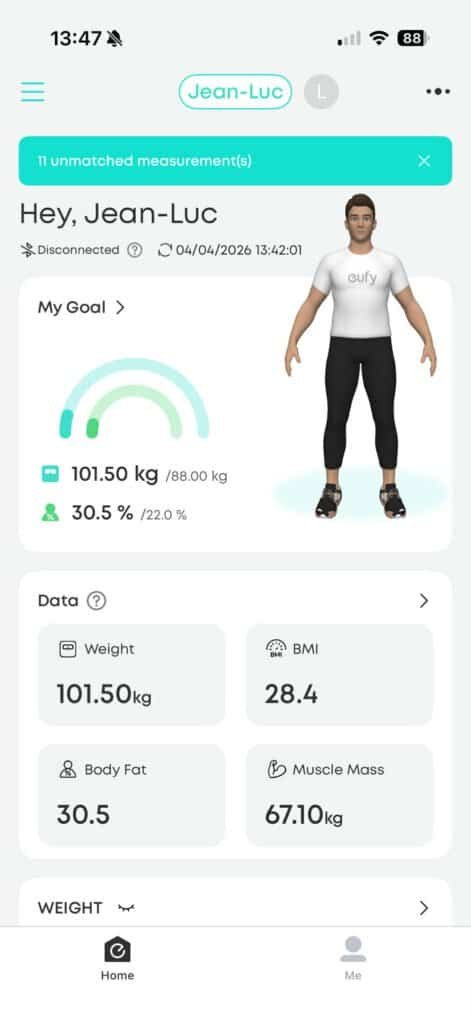
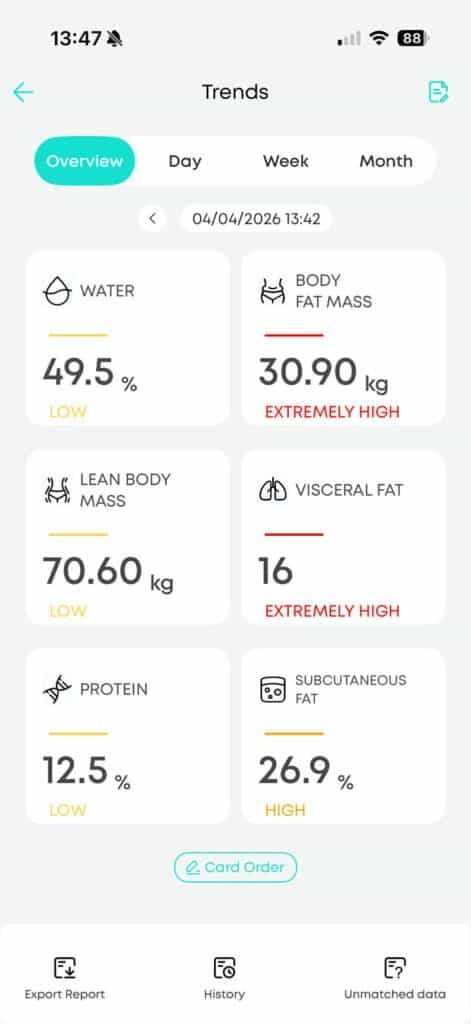
What I will watch is whether tomorrow’s reading returns to or below 101.2 kg. If it does, the trend is intact.
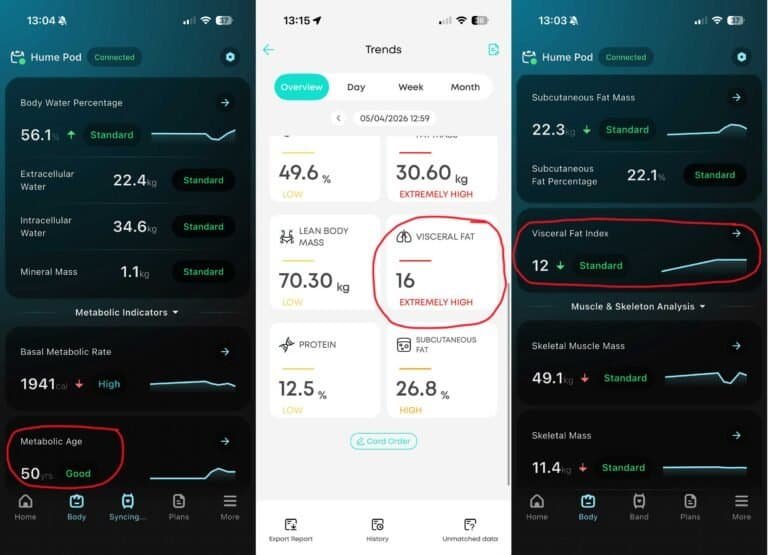
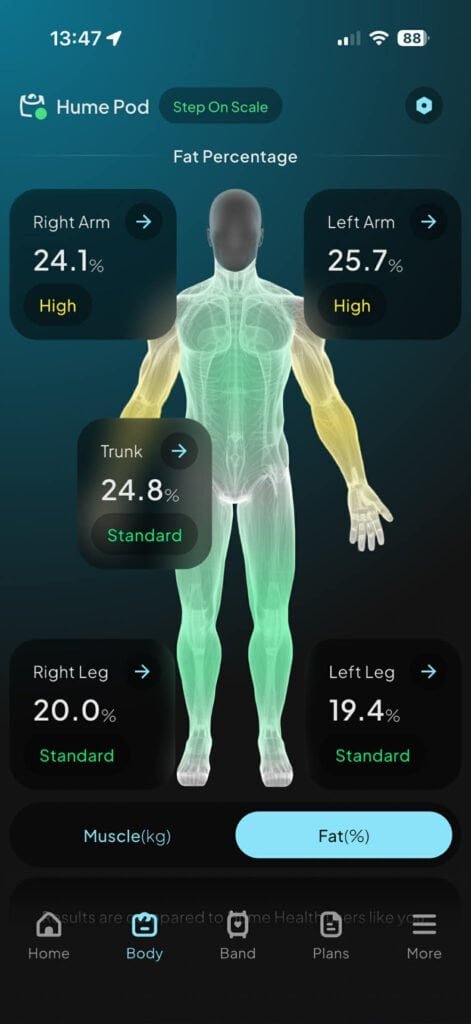
Hume Pod body composition today:
- Right Arm: 24.1% — High
- Left Arm: 25.7% — High (back down from yesterday’s “Very High” of 26.5%)
- Trunk: 24.8% — Standard (the belly, still perfectly comfortable with itself)
- Right Leg: 20.0% — Standard
- Left Leg: 19.4% — Standard
The left arm’s “Very High” reading from yesterday has already retreated to “High” — confirming my suspicion that it was post-exercise fluid rather than any real compositional change. The Hume Pod’s day-to-day volatility in arm readings continues to raise questions about its precision as a daily measurement tool versus a weekly trend tracker.
The Steps: Accidentally Impressive
Despite everything, yesterday produced 16,750 steps — between the 7.64km morning walk and a full day on my feet at the wedding. Today, understandably, the Hume Band shows 5,315 steps as of early afternoon today. The body is resting. The hip is asking for it.
Hume Band data today:
- Steps: 5,315
- Heart Rate: 84 bpm (down from 94–95 bpm earlier in the week — the body is calmer today)
- HRV: 63.5 ms (slight dip from 65.8 ms — reflects the disrupted night)
- Stress: 27.1 (up from 22.1 yesterday — also reflects disrupted sleep)
- Body Temperature: 35.6–37.1°C
- SpO2: 95–99% ✅
The HRV dip and stress level increase are textbook responses to short, disrupted sleep. They will recover with a proper night tonight.
The Hume Pod vs Eufy Comparison: Day 4 Edition
Four days in, the divergence between these two devices remains the central editorial question of this series. Let me state it plainly as it stands today:
| Metric | Eufy Says | Hume Pod Says |
|---|---|---|
| Trunk / belly fat | Visceral Fat 16 — Extremely High | Trunk 24.8% — Standard |
| Body fat overall | 30.5% — Extremely High | Varies by segment |
| Benchmark basis | Clinical thresholds | “Hume Health users like you” |
Hume’s technical team is preparing a detailed response to my questions about their benchmark methodology. Until that response arrives, I am treating the Eufy’s clinical-threshold approach as the more medically meaningful data — while continuing to use the Hume Pod’s segmental readings to track directional change over time.
The benchmark question is not resolved. The technical team response is awaited. Readers will be the first to know.
Honesty Corner: What Yesterday Actually Was
Two gins. Wedding food in untracked quantities. Bed at 4am. Hip pain this morning.
In a 30-day experiment, Day 4 being a partial derailment is not a crisis. It is information. The question is not whether I had a difficult night — I did, knowingly, at a wedding — but whether the underlying habits hold. The CPAP went on at 4am. The vest was worn. The SpO2 held at 95–99%. The walk happened before the wedding.
Four days out of thirty. The direction of travel is still correct.
Day 4 Summary
| Metric | Value | Direction |
|---|---|---|
| Weight (Eufy) | 101.5 kg | ⬆️ +0.3 kg (expected) |
| Steps yesterday (total) | 16,750 | ✅ Accidental achievement |
| Steps today so far | 5,315 | 🔄 Rest day |
| Sleep (CPAP usage) | 4h 29m | ⬇️ Late night |
| CPAP score | 68/100 | ⬇️ Down from 96 |
| SpO2 overnight | 95–99% | ✅ Best yet |
| HRV | 63.5 ms | ⬇️ Slight dip |
| Stress (Hume Band) | 27.1 | ⬆️ Disrupted night |
| Alcohol | 2 gins | ⚠️ |
| Bed time | 4:00 am | ⚠️ |
| Hip pain | Present | 🔴 Monitoring |
The wedding did what weddings do. The CPAP went on anyway. The oxygen held.
Tonight: early bed, proper seal on the mask, vest on, hip elevated if needed.
— Day 4 of 30