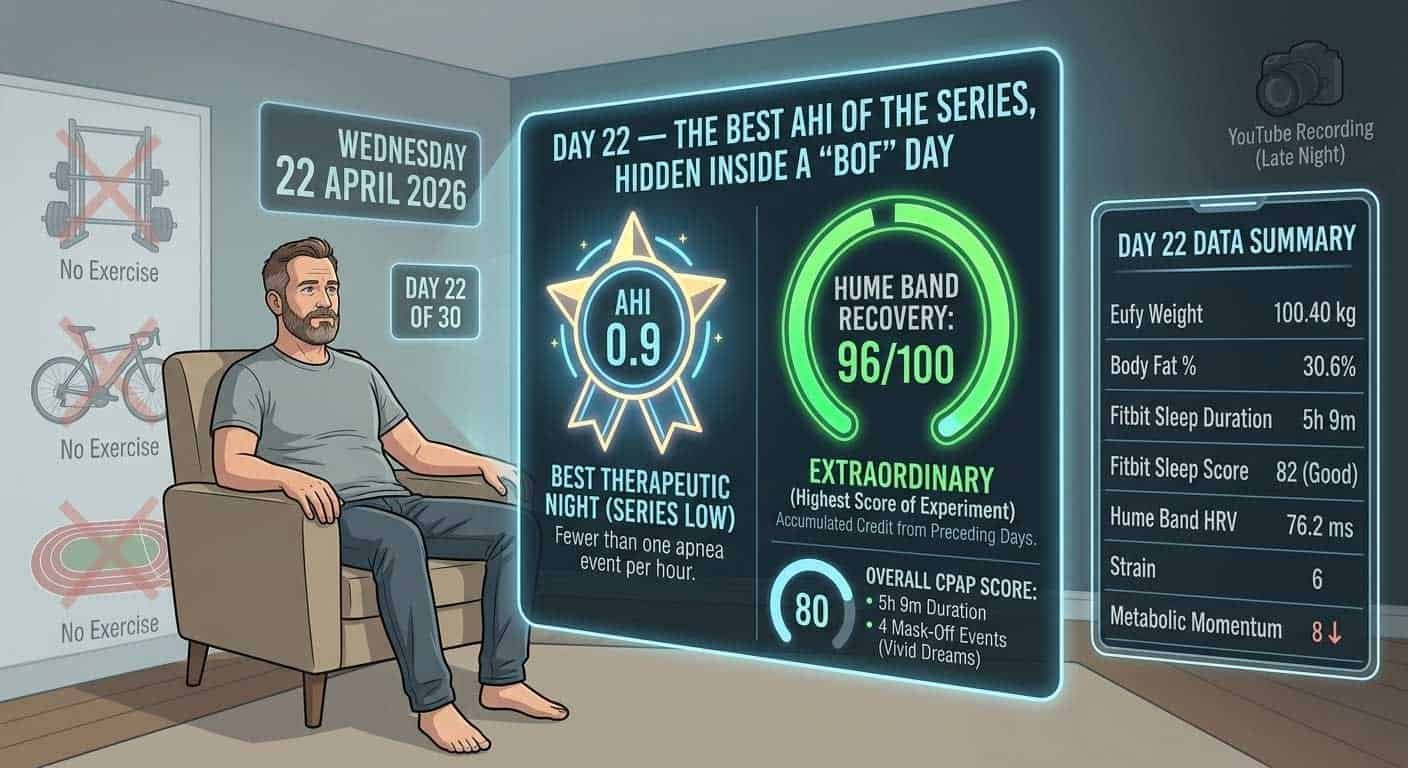
DAY 22 — The Best AHI of the Series, Hidden Inside a “Bof” Day
Sometimes the most interesting number in the data is the one you almost miss because everything else about the day feels unremarkable. Today’s cpap ahi score is 0.9 events per hour. Zero point nine. That is the lowest AHI reading of the entire twenty-two-day experiment — fewer than one apnea event per hour across a full night of therapy — and it arrived on a night where I went to bed at nearly 2am after recording a YouTube video, dreamed relentlessly, and took the mask off and put it back on so many times that the app logged four mask-off events.
The French have a word for how today feels: bof. Not bad. Not good. Just… bof. No gym. No cycling. Weight essentially unchanged. Body fat ticking slightly upward. And yet, underneath the flatness, the CPAP machine delivered its best therapeutic performance to date, and the Hume Band’s recovery score hit 96 out of 100 — the highest of the experiment by a considerable margin.
Some days the story hides.
Day 22 Data Summary
| Metric | Value | Source |
|---|---|---|
| Weight | 100.40 kg (HIGH) | Eufy |
| BMI | 28.1 (HIGH) | Eufy |
| Body fat % | 30.6% (EXTREMELY HIGH) | Eufy |
| Body fat mass | 30.70 kg (EXTREMELY HIGH) | Eufy |
| Water % | 49.4% (LOW) | Eufy |
| BMR | 1,735 kcal (LOW) | Eufy |
| CPAP score | 80/100 | CPAP App |
| CPAP usage | 05:09 | CPAP App |
| AHI | 0.9 events/hr | CPAP App |
| Mask seal | Good | CPAP App |
| Mask-off events | 4 | CPAP App |
| Hume Band sleep | 5h 34m | Hume Band |
| Fitbit sleep | 5h 9m / Score 82 (Good) | Fitbit |
| Sleep timeline | 01:56–07:28 | Fitbit |
| Heart rate | 66 bpm | Hume Band |
| HRV | 76.2 ms | Hume Band |
| Metabolic Momentum | 8 ↓ | Hume Band |
| Metabolic Capacity | 51 | Hume Band |
| Strain | 6 | Hume Band |
| Recovery | 96 | Hume Band |
| Steps (as at 12:07) | 589 | Hume Band |
| Exercise | None | — |
CPAP: The Perfect Streak Breaks — But the Therapy Has Never Been Better
The three-night streak of 100 out of 100 is over. Tonight’s score of 80 reflects two things: the shorter usage time of 5 hours 9 minutes, and the four mask-off events scattered across the night. After three consecutive nights above nine hours, the session length dropped by more than four hours. The late start — bed at nearly 2am after a YouTube recording session — compressed the available sleep window to just five and a half hours, and the mask came off repeatedly during what was, by all accounts, a restless and dream-heavy night.
And yet: 0.9 events per hour.
That figure deserves to be separated from the overall score and examined on its own terms. The previous lowest AHI of the series was 1.4, recorded on both Day 16 and Day 20. Before that, the best readings clustered around 1.7–1.8. An AHI below 1.0 means the CPAP resolved fewer than one breathing event per hour across the entire five-hour session. In clinical terms, this is essentially indistinguishable from a person without sleep apnea. The machine has never performed better.
The four mask-off events tell the story of the night’s subjective experience. I remember dreaming — vividly, repeatedly — and the semi-conscious cycle of realising the mask was off, fumbling for it, putting it back on, falling back asleep, and repeating the process at some later point. The CPAP app does not record timestamps for individual mask-off events, so I cannot say whether they were evenly distributed across the session or clustered in the early hours when the dreams were at their most vivid. What I can say is that between those interruptions, the therapy was working better than it ever has. The mask seal held at Good throughout. The events per hour stayed below one. The machine did its job in the gaps between my unconscious attempts to stop it.
The overall score of 80 is a function of the app’s scoring algorithm, which weights duration heavily. Five hours and nine minutes falls short of the seven-to-eight-hour window that produces scores above 90. That is a valid criticism of the night — shorter sleep is shorter sleep, and the late bedtime was entirely within my control. But the therapeutic quality of the sleep that did happen was the best of twenty-two nights. The two numbers — 80 for quantity, 0.9 for quality — tell opposite stories about the same night, and both are true.
Sleep: A Short Night, Differently Measured
The Hume Band records 5 hours 34 minutes. The Fitbit records 5 hours 9 minutes with a sleep score of 82, rated “Good.” The CPAP records 5 hours 9 minutes of mask-on therapy time. The Fitbit and CPAP agree precisely for once — both measuring 5 hours 9 minutes — which suggests that the Fitbit’s sleep detection closely matched the actual mask-on period on this particular night.
The sleep window ran from 01:56 to 07:28 — a five-and-a-half-hour opportunity compressed into less than five hours of actual sleep by the 23 minutes of awake time the Fitbit detected. The sleep architecture shows 1 hour 20 minutes of REM, 2 hours 44 minutes of light sleep, and 1 hour 5 minutes of deep sleep. The deep sleep figure, at just over an hour, is proportionally reasonable for the short session length — the body prioritised recovery sleep in the limited time available.
The Hume Band’s 5 hours 34 minutes includes slightly more of the wind-down and wake periods, as it consistently does. After two nights of 10 hours 32 minutes and 9 hours 59 minutes, tonight’s figure represents a drop of nearly five hours. The body banked considerable sleep credit over the previous three nights, and that credit is visible in another number entirely.
Recovery: 96 Out of 100
The Hume Band’s recovery score of 96 is the highest of the entire experiment. Not by a small margin — by a large one. The previous best was 80 on Day 18. Before that, the recovery score had typically ranged between 60 and 80 depending on sleep quality, exercise load, and recent disruption.
The number makes physiological sense even on a short sleep night. Recovery is not purely a function of how long you slept last night — it reflects the body’s accumulated state across multiple days. Three consecutive nights of nine-plus hours of CPAP therapy, two days of exercise, resumed intermittent fasting, and zero alcohol have collectively filled the recovery tank to a level the Hume Band has not previously recorded. The short night tonight drew down the sleep credit without apparently depleting the recovery reserves. The body arrived at this morning well-rested enough from the preceding days to absorb one bad night without significant impact.
Strain at 6 confirms the picture from the other direction. Yesterday’s cycling and the preceding days’ gym sessions have been fully absorbed. The body is ready for a hard session — it simply did not get one today. No exercise, minimal steps, a genuine rest day in every sense. Whether this was the right call or a missed opportunity depends on how you read the data: the recovery of 96 says the body could have worked hard today; the sleep of 5 hours says the mind needed the day off. Both readings are valid.
Weight: Holding Pattern
Eufy: 100.40 kg. Up 0.2 kg from yesterday’s 100.20 kg, which is within the normal noise range of daily fluctuation. Body fat percentage has ticked up slightly to 30.6% from yesterday’s 30.4%, and body fat mass reads 30.70 kg against yesterday’s 30.40 kg. Water percentage has dipped to 49.4% from 49.6%.
None of these movements are significant in isolation. They represent a single day’s measurement against the background of the conference recovery, and the direction of travel since Day 20’s peak of 100.60 kg remains slightly but consistently downward on the Eufy: 100.60, 100.20, 100.40. The Hume Pod was not weighed today.
The body fat percentage sitting at 30.6% is the highest since Day 1’s 30.7%, which is frustrating even if it represents noise rather than trend. The Eufy’s body composition figures have proven to be sensitive to hydration state, and today’s lower water percentage of 49.4% may be driving the higher fat reading as much as any actual compositional change. The structural picture — lean body mass, visceral fat, protein — will become clearer with several more days of consistent measurement.
HRV: The Overnight Drop
Yesterday’s HRV of 86.3 ms — the bounce-back from the conference that came within 2.2 ms of the series high — has dropped to 76.2 ms today. A fall of more than 10 points, driven by the shorter sleep window and the late bedtime.
The 76.2 ms figure is respectable by any standard and sits comfortably in the upper range of the experiment’s HRV data. But after yesterday’s dramatic overnight recovery, today’s reading confirms what the data has shown repeatedly across twenty-two days: HRV follows sleep duration and quality with near-mechanical precision. Nine hours of CPAP therapy produces readings in the 80s. Five hours produces readings in the 70s. The variable is straightforward. The challenge is making the nine-hour nights the norm rather than the exception.
Metabolic Capacity: The Biggest Drop of the Series
Metabolic Capacity has fallen to 51 — down from 69 on Day 20. That is an 18-point drop in two days, and the lowest reading since the experiment began tracking this metric. The “baseline not found” note persists, meaning the device is still calibrating, but the direction is notable.
The drop likely reflects the accumulated strain of the previous days’ exercise load — leg weights, elliptical, cycling — combined with the shorter recovery night. Strain has correspondingly crashed to just 6, the lowest of the series, indicating that the body has absorbed the recent training load almost completely. The very high recovery score of 96 paired with the very low strain of 6 suggests the body is in a state of readiness — fully recovered, fully rested, capacity depleted from recent work but available to rebuild.
Metabolic Momentum continues its gradual decline at 8, down from 10 yesterday and 12 the day before. This downward trend across the past three days reflects the tapering of exercise intensity from the gym session on Day 20 to the cycling on Day 21 to the complete rest of Day 22. The number will respond to tomorrow’s exercise — if it happens.
The “Bof” Day Thesis
Not every day in a thirty-day experiment can be a story. Some days are just days. Today had no gym session, no cycling, no walk, no dramatic data point that demands five paragraphs of interpretation. The weight held. The sleep was short. The blood pressure was not measured. The step count at midday would embarrass a moderately active cat.
But the data does not agree that today was unremarkable. A recovery score of 96 — the highest of the experiment. An AHI of 0.9 — the best therapeutic result the CPAP has ever delivered. A resting heart rate of 66 bpm — consistent with the long-term downward trend. These numbers are the downstream effects of the preceding days’ discipline: the early bedtimes, the nine-hour CPAP nights, the no-alcohol commitment, the exercise. They are the body’s receipts for good behaviour, arriving on a day when the behaviour itself was mediocre.
The plan for tomorrow: exercise, and bed before 11pm. The recovery score is screaming for a hard session. The body is ready. The only question is whether the mind shows up.
Data captured Wednesday 22 April 2026. Eufy reading 22/04/2026 at 12:02. Hume Band data as at 12:07, last recorded 22/Apr/26. CPAP covers the night of 21–22 April 2026. Fitbit sleep data as at 12:18. No exercise recorded. No blood pressure reading taken.
— Day 22 of 30